How Can Tactile Sensors Enhance Robotic Manipulation?
TL;DR
Tactile sensors are critical for advancing robotic manipulation in contact-rich environments, addressing challenges like varying contact conditions. The research highlights two projects: a compact multimodal tactile sensor for in-hand object manipulation and a smart suction cup utilizing pressure sensors for enhanced haptic exploration and grip monitoring. These innovations aim to improve dexterity and collaboration between robots and humans.
Transcript
it's a great honor for me to be invited to this talk series so yeah actually I took several courses in this Auditorium and it feels pretty different by standing on the other side of the auditarium okay so today I'm going to talk about adaptable robotic manipulation using tactile sensors I want to start with this question why are robots not around u... Read More
Key Insights
- 🤑 Tactile sensors are essential for achieving adaptable robotic manipulation in contact-rich environments.
- 🤖 Generalizing tactile sensors to suit different robot hardware, tasks, and contact physics is a significant challenge.
- 💋 Compact multimodal tactile sensors can differentiate between linear and rotational slip, enhancing overall dexterity.
- 💘 Smart suction cups with pressure sensors offer improved haptic exploration and grip monitoring capabilities.
- 🪛 Combining tactile sensors with data-driven approaches can enhance accuracy in predicting contact states and preventing failures.
- 🥳 The future focus is on developing tactile skins for various robot body parts, enabling whole-body manipulation and social touch.
- 🤩 Processing large arrays of tactile sensors efficiently remains a key technical challenge.
Install to Summarize YouTube Videos and Get Transcripts
Explore YouTube Video Summarizer or Get YouTube Transcript Extractor
Questions & Answers
Q: Why don't we see many robots in labor-intensive sectors like healthcare and e-commerce?
One of the reasons is that robots struggle with handling contact-rich environments and uncertain and changing contact conditions, which are common in these industries.
Q: What is the main challenge in developing tactile sensors for robots?
The main challenge lies in creating tactile sensors that can be generalized across different robot hardware, tasks, and contact physics, as each robot application requires a unique type of tactile sensor in terms of form factor and functionality.
Q: How does the compact multimodal tactile sensor differentiate between linear and rotational slip?
The sensor measures capacitance changes between four directional electrodes when under normal pressure or shear force. By analyzing the frequency response of the capacitance, the sensor can estimate the direction of slip and differentiate between linear and rotational slip.
Q: How does the smart suction cup enable haptic exploration and grip monitoring?
The smart suction cup has pressure sensors placed remotely from the suction seal, allowing measurement of local contacts without interfering with the suction seal. This enables haptic exploration to locate the best contact points and grip monitoring to prevent suction cup failures.
Summary & Key Takeaways
-
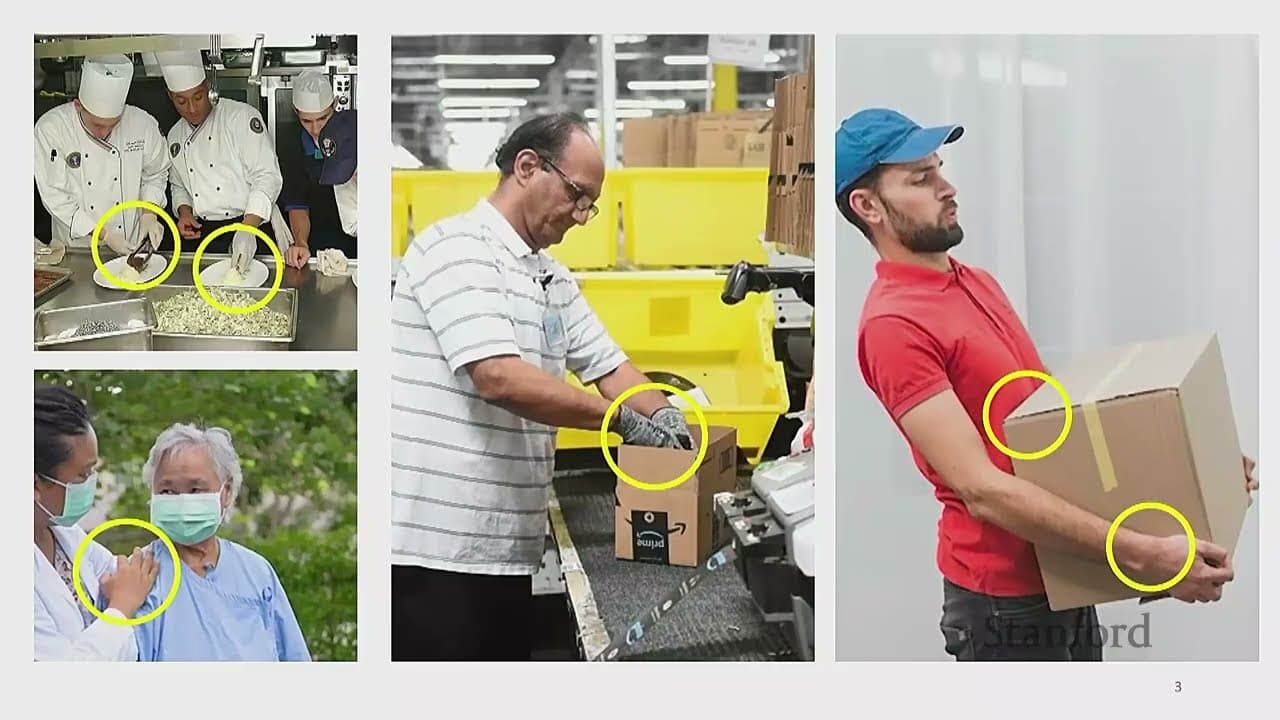
Robots are not commonly seen in our daily lives in industries like healthcare, kitchen, and e-commerce due to their difficulty in handling contact-rich environments and uncertain and changing contact conditions.
-
Tactile sensors are crucial for achieving contact adaptive control, but their development is challenging due to the need for customization based on different robot hardware and tasks.
-
The first research project focuses on in-hand manipulation using a compact multimodal tactile sensor to achieve extrinsic dexterity and differentiate linear and rotational slip.
-
The second research project presents a smart suction cup with pressure sensors to enable haptic exploration and grip monitoring for improved object manipulation.
Read in Other Languages (beta)
Share This Summary 📚
Summarize YouTube Videos and Get Video Transcripts with 1-Click
Try YouTube Summary with ChatGPT & Claude or YouTube Transcript Generator
Explore More Summaries from Stanford Online 📚

Summarize YouTube Videos and Get Video Transcripts with 1-Click
Try YouTube Summary with ChatGPT & Claude or YouTube Transcript Generator