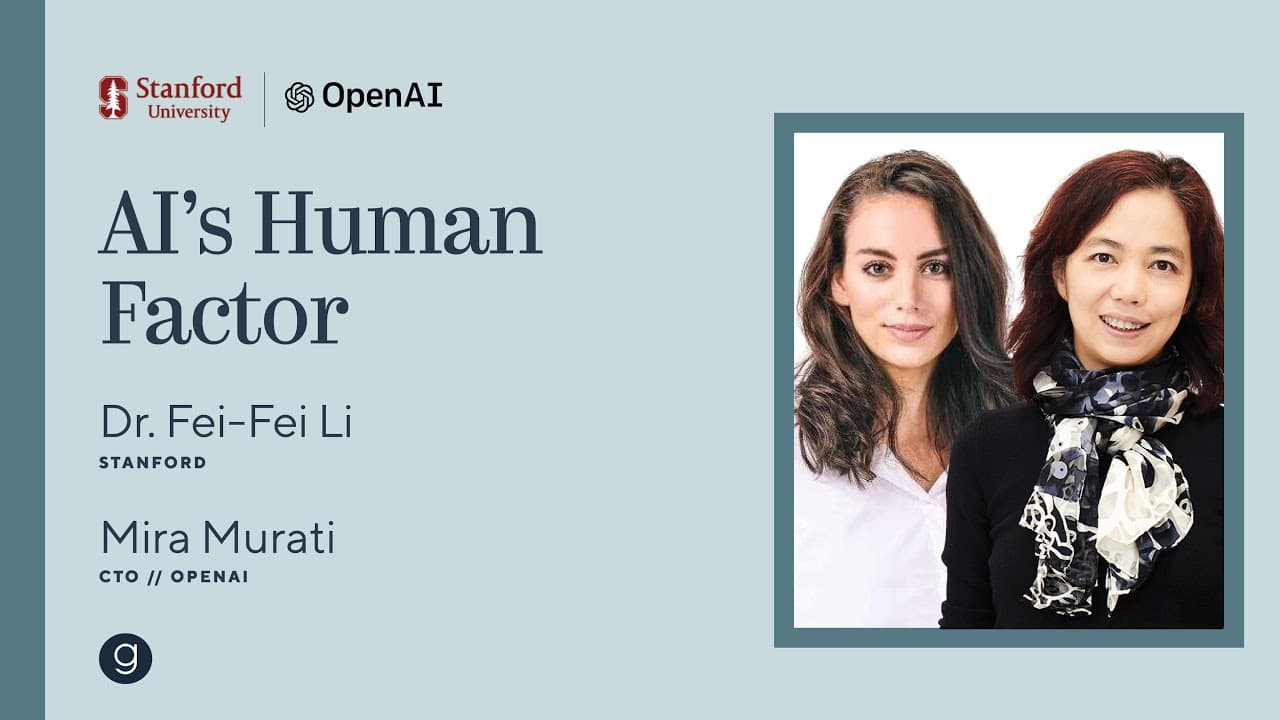
AI's Human Factor | Stanford's Dr. Fei-Fei Li and OpenAI CTO Mira Murati
TL;DR
AI safety and ethics must be prioritized throughout the development process. Fei-Fei Li and Mira Murati emphasize the importance of creating human-centered AI systems and deploying models with ongoing user feedback to mitigate risks. Establishing inclusive governance and regulatory frameworks is crucial for balancing innovation with ethical considerations, ensuring that the benefits of AI are realized while minimizing potential harms.
Transcript
while we'll be covering a bunch of things on safety which is a highly relevant thing especially in the uh uh this kind of new foundational models universe because both um uh feife and Mira are accomplished technologists uh massively beyond the scope of of safety both building amazing things and have been part of the historic contributions I thought... Read More
Key Insights
- 🫷 Robotics research is pushing the boundaries of what can be achieved, with Fei-Fei Li and Mira Colas introducing a benchmark of a thousand robotic tasks inspired by real human activities.
- 🤔 AI systems that combine large neural networks with extensive data and computing power have shown great potential in thinking like humans, with advancements like gpt3 and Dali enabling creative and high-quality outputs.
- 🦺 Safety and ethics are crucial considerations in AI development. OpenAI prioritizes safety by deploying systems with controlled access, gaining feedback, and iteratively improving models. Stanford High focuses on human-centeredness and infusing ethics into every stage of AI research.
- 💍 The governance and regulation of AI require a balance between innovation and guardrails. The industry and government should engage in dialogue to establish effective and inclusive governance systems that promote innovation while addressing potential risks.
Install to Summarize YouTube Videos and Get Transcripts
Explore YouTube Video Summarizer or Get YouTube Transcript Extractor
Questions & Answers
Q: What is the main focus of Fei-Fei Li and Mira Colas' research paper on robotics?
Fei-Fei Li and Mira Colas' research paper focuses on redefining a North star for robotics by outlining a benchmark of a thousand robotic tasks inspired by real human activities.
Q: How does OpenAI prioritize safety and address potential risks associated with AI systems like gpt3 and Dali?
OpenAI prioritizes safety by initially deploying AI systems like gpt3 through controlled access and gradually expanding access as they learn to mitigate risks. They gather user feedback and use reinforcement learning with human feedback to train more reliable and effective models.
Q: How does Stanford High ensure ethics and human-centeredness in AI research and development?
Stanford High infuses human-centeredness into every stage of AI research, emphasizing considerations like fairness, privacy, and ethical implications. They have an Ethics and Society Review Board that reviews grant applications, ensuring researchers think about the social and ethical impacts of their work.
Q: How does the National Research Cloud initiative address the concentration of resources in AI innovation?
The National Research Cloud initiative aims to prevent the concentration of resources in a few companies by providing resources, including compute and data, to universities and other entities. It encourages a healthy ecosystem for AI innovation and ensures a broader impact and diversity in ideas.
Summary
In this video, Fei-Fei Li and Mira Murati discuss various topics related to safety in AI and the exciting developments in the field. They touch on the advancements in robotics, the potential of large neural networks, and the need for safety measures in AI development. They also talk about the approaches taken by OpenAI and Stanford High to ensure safety in AI and the importance of considering ethics and human-centeredness. Furthermore, they discuss the iterative process of deploying models like GPT-3 and DALL-E and the potential for amplifying human creativity with these technologies.
Questions & Answers
Q: What is currently most exciting in the field of AI research?
Fei-Fei Li expresses her excitement about the progress being made in robotic learning. She mentions a forthcoming paper that redefines a benchmark for robotic tasks, drawing inspiration from real human activities.
Q: Can you provide some examples of the robotic tasks from the benchmark?
Fei-Fei Li explains how the benchmark incorporates a thousand real tasks inspired by the American labor survey of time usage. Some examples include tasks like cleaning toilets and packing kids' lunches, which are derived from studying what people want robots to help with in their daily lives.
Q: What is most exciting for OpenAI in terms of AI development?
Mira Murati shares OpenAI's excitement in pushing the development of AI systems that have a robust concept of the world, similar to how humans perceive it. They aim to build general systems that can understand language and visual concepts, and they have seen progress with models like GPT-3, Codex, and DALL-E.
Q: How does OpenAI approach safety in AI development?
Mira Murati explains OpenAI's strategy of deploying AI systems in a controlled way, starting with limited access through an API and gradually expanding access as they gain insights into potential risks. They collaborate with industry experts and trusted users to identify and mitigate risks, ensuring that their models are safe and effective. They also emphasize the importance of model deployment in understanding real-world limitations and iteratively building mitigations.
Q: What role does Stanford High play in considering safety and ethics in AI?
Fei-Fei Li describes Stanford High's focus on infusing human-centeredness and ethics into every stage of AI research and development. They aim to educate students who understand the social and ethical implications of AI. Additionally, they have formed an Ethics and Society Review Board, similar to an IRB for human subjects research, to guide researchers in addressing ethical and social issues in their work.
Q: How does Stanford High address the tension between the pace of innovation and ethical considerations?
Fei-Fei Li acknowledges the need for balance between innovation and regulation. She believes that good guardrails can actually foster innovation, citing an example of privacy concerns in healthcare-driven research that led to the development of privacy-protected machine learning algorithms. She emphasizes the importance of dialogue and collaboration between various stakeholders to achieve a balance that encourages both innovation and ethical practices.
Q: How does OpenAI ensure that potential risks and societal effects are taken into account?
Mira Murati acknowledges that full understanding of risks and effects can only come with deployment at scale, and they use feedback from users to iteratively improve safety measures. OpenAI prioritizes understanding user expectations and potential failure modes through collaboration with industry experts and other researchers. They aim to make models more robust, reliable, and helpful by incorporating user feedback and reinforcement learning with human feedback.
Q: Do AI advancements like GPT-3 and DALL-E amplify human creativity?
Mira Murati explains that both GPT-3 and DALL-E have demonstrated the ability to amplify human creativity. GPT-3, for example, has generated creative and touching poetry, and DALL-E has democratized the creation of high-quality images. She believes that these technologies can contribute to a more nuanced appreciation of human and AI co-creation, promoting diversity, prosperity, and innovation.
Takeaways
Fei-Fei Li and Mira Murati highlight the exciting developments in the field of AI, such as advancements in robotics and the combination of large neural networks with vast amounts of data and compute power. They emphasize the importance of safety and ethics in AI development, with OpenAI deploying models iteratively and gathering user feedback to improve safety measures. Stanford High focuses on infusing human-centeredness and ethics into every stage of AI research and collaborates with policy makers and stakeholders to address the social impact of AI. They believe that good guardrails can encourage innovation and that a balance between regulation and innovation is crucial. Additionally, they discuss the potential of AI technologies like GPT-3 and DALL-E to amplify human creativity and foster diversity and prosperity.
Summary & Key Takeaways
-
Fei-Fei Li and Mira Colas discuss the potential of robotics, particularly in redefining human activities through their research paper that outlines a benchmark of a thousand robotic tasks inspired by real human activities.
-
They highlight the significance of developing AI systems that can think like humans by combining large neural networks with extensive data and computing power.
-
The discussion covers the importance of safety and ethics in AI development, with OpenAI's approach of deploying systems with controlled access and continuously iterating on their models based on user feedback.
Read in Other Languages (beta)
Share This Summary 📚
Summarize YouTube Videos and Get Video Transcripts with 1-Click
Try YouTube Summary with ChatGPT & Claude or YouTube Transcript Generator
Explore More Summaries from Greylock 📚





Summarize YouTube Videos and Get Video Transcripts with 1-Click
Try YouTube Summary with ChatGPT & Claude or YouTube Transcript Generator