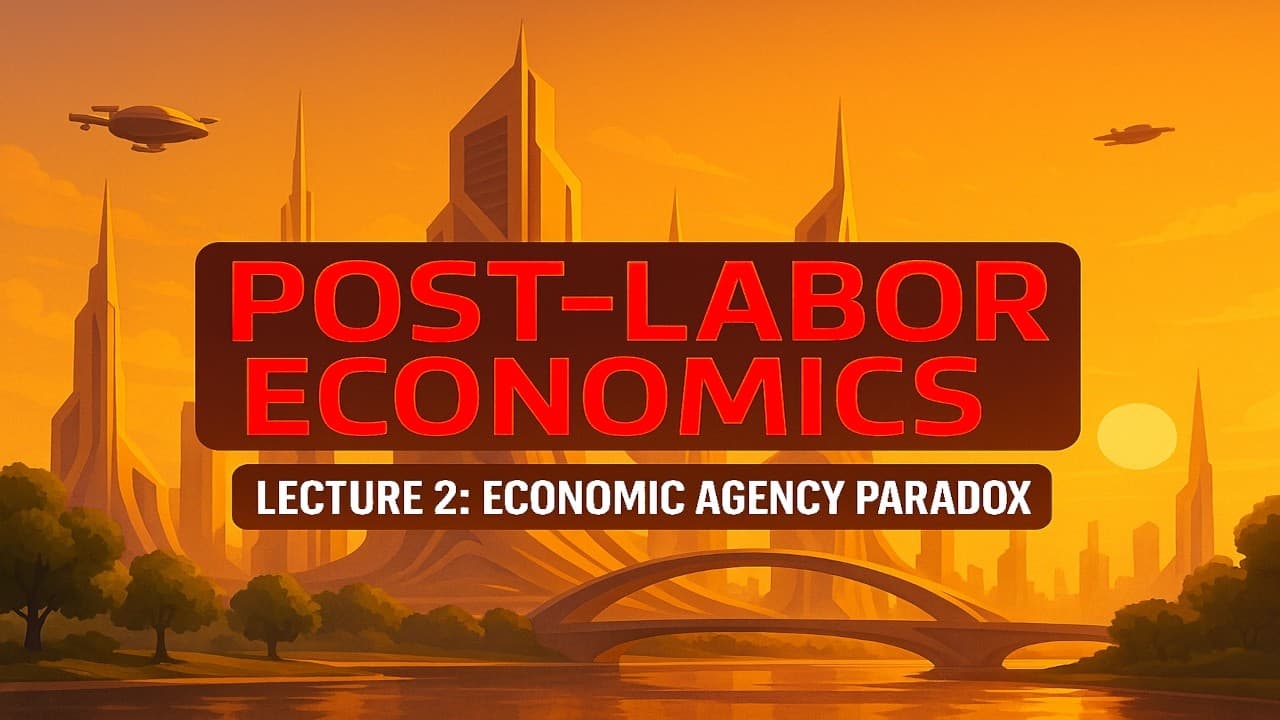
How does economic agency survive in a post-labor economy?
TL;DR
Economic agency is the ability to shape one’s financial future through rights and social mechanisms, which automation threatens by reducing traditional paths to participation. The paradox arises because automation can raise productivity while eroding consumer purchasing power, risking a collapse in demand if workers are unemployed. Societal response requires protecting labor, property, and voting rights while sustaining aggregate demand.
Transcript
Welcome to lecture number two of post-labor economics. This is my series to get everyone spun up and on the same page as to the current state of post labor economics as of 2025. This episode will be about economic agency or about what do humans actually need to participate in the economy. So before we dive in, let's do a recap of lecture one which ... Read More
Key Insights
- Economic agency is the capacity to shape financial destiny through established rights and social mechanisms, a foundational concept in modern civil societies.
- The three pillars of economic agency are labor rights, property rights, and voting rights, collectively enabling work, wealth creation, and collective policy influence.
- Automation promises productivity gains but threatens aggregate demand if unemployment rises, creating a paradox where the economy can stall without sufficient consumer purchasing power.
- Labor rights historically supported bargaining power and stable employment, though they are increasingly debated in terms of efficiency and flexibility within liberal democracies.
- Property rights underpin wealth accumulation, asset ownership, and generational transfer, making them essential for innovation, entrepreneurship, and long-term economic progress.
- Voting rights provide democratic participation to influence policies and regulations that shape economic opportunities and regulatory environments.
- The social contract today relies on a balance among rights and market mechanisms; disruption to any pillar can destabilize both economy and society.
- Aggregate demand depends on widespread consumer spending; without jobs, even high productivity from automation may not translate into sustained growth.
Install to Summarize YouTube Videos and Get Transcripts
Explore YouTube Video Summarizer or Get YouTube Transcript Extractor
Questions & Answers
Q: How does economic agency define a citizen's role in the post-labor economy?
Economic agency is defined as an individual's capacity to shape their financial destiny through established rights and social mechanisms. In a post-labor economy, where automation can replace human labor, maintaining labor rights, property rights, and voting rights becomes essential to preserve participation in markets and governance. These rights enable individuals to secure income, own assets, and influence policy, which in turn sustains demand and social stability even as job structures shift. The paradox is that automation can increase output while eroding purchasing power if wage-based consumption declines, making robust rights more critical than ever.
Q: What is the economic agency paradox as described in the lecture?
The economic agency paradox states that automation promises liberation from mundane labor while threatening the economic foundations of consumer purchasing power. If wage earning opportunities vanish but consumption remains essential for production and growth, the economy risks a systemic collapse due to a collapse in aggregate demand. Automation can raise efficiency and growth on paper, but without enough people earning wages to spend, demand falters, investment slows, and the whole economy can stall. The paradox requires policies that preserve or rebuild demand alongside productivity.
Q: Why are labor rights discussed as a pillar in the post-labor framework?
Labor rights are discussed as a pillar because they historically provided the primary means for workers to secure fair compensation, organize, and negotiate within the market. In a scenario where automation reduces available jobs, labor rights help preserve bargaining power, collective action, and protections that sustain wages and working conditions. Even as the speaker acknowledges unions can influence efficiency, the emphasis is on maintaining a pathway for workers to participate economically, ensuring a minimum level of income, employment fairness, and social stability amid rapid automation.
Q: How do property rights contribute to economic resilience in automation scenarios?
Property rights contribute to economic resilience by enabling ownership of assets, wealth accumulation, and generational transfer of value. They allow individuals to start businesses, monetize inventions via patents, and benefit from market growth through asset ownership. In a world with pervasive automation, strong property rights support continued investment, risk-taking, and innovation because people can expect to retain the value they create. This foundation underpins long-term prosperity and provides a buffer against volatility caused by shifts in employment.
Q: What role does voting rights play in shaping an economy affected by AI and automation?
Voting rights enable citizens to influence economic policies, regulations, and structural opportunities that determine how automation affects employment and welfare. Through elections and representation, the public can steer policy toward social safety nets, retraining programs, and incentives for innovation that align with shared economic goals. Democratic participation helps adapt the economy to new technologies by legitimizing reforms, balancing market efficiency with protections for consumers and workers, and maintaining trust in the system during transitions.
Q: What is meant by aggregate demand in the context of automation and unemployment?
Aggregate demand refers to the total purchasing power and spending in an economy, which drives production and growth. When automation reduces the number of wage earners, consumer purchasing power can decline, shrinking aggregate demand. If demand falls, businesses cut back, investment slows, and the economy risks stagnation. The discussion emphasizes maintaining sufficient demand through wages, transfers, or policy measures to keep the economic engine running even as technology changes the job landscape.
Q: How can societies avoid a reckless foretelling of civil unrest due to automation?
Societies can avoid unrest by maintaining economic agency through a combination of labor rights, property rights, and voting rights, ensuring people retain access to income, assets, and political influence. Active policies that sustain purchasing power, provide retraining, and encourage innovation help prevent demand collapse. Transparent governance, social safety nets, and inclusive economic reforms reduce volatility and give citizens confidence that automation will coexist with broadly shared prosperity rather than concentrating wealth and power.
Q: What future challenges does the speaker anticipate for property and IP rights in automation-heavy economies?
The speaker anticipates questions about how IP and copyright law will adapt when automation dominates production and idea generation. As ownership structures evolve, there may be debates about who benefits from innovations, how to protect creators, and how to balance incentives with access. The discussion signals the need to explore how property rights can sustain innovation while ensuring broad participation and fair distribution of value created by automated systems.
Summary & Key Takeaways
-
Economic agency is defined as the capacity to shape financial destiny through established rights and social mechanisms, a framework stressed by automation’s disruption.
-
Three pillars support the social contract in modern democracies: labor rights, property rights, and voting rights, each enabling participation in the economy and political process.
-
The economic agency paradox highlights a tension between liberation from routine work through automation and the risk of reduced consumer demand if wage earners vanish.
Read in Other Languages (beta)
Share This Summary 📚
Summarize YouTube Videos and Get Video Transcripts with 1-Click
Try YouTube Summary with ChatGPT & Claude or YouTube Transcript Generator
Explore More Summaries from David Shapiro 📚


Summarize YouTube Videos and Get Video Transcripts with 1-Click
Try YouTube Summary with ChatGPT & Claude or YouTube Transcript Generator