How Can Practicing Islam Influence Others?
TL;DR
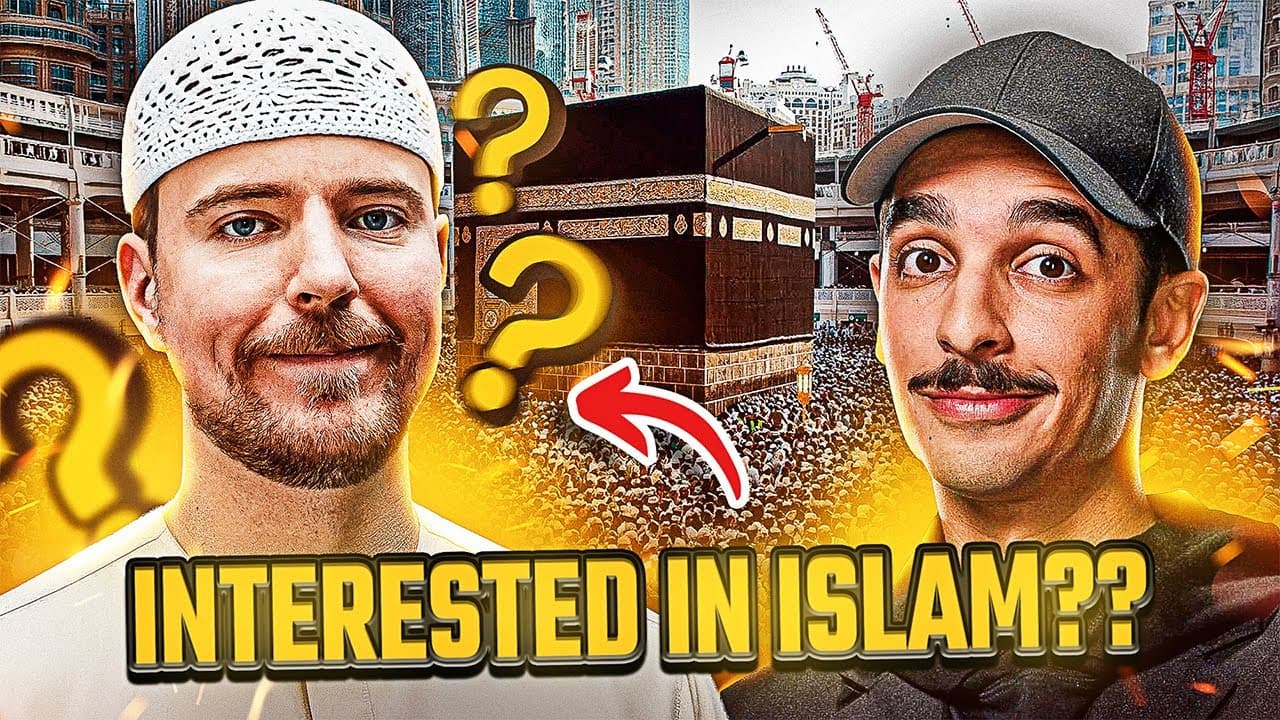
Practicing religious principles consistently can influence others more powerfully than merely discussing them. MrBeast said his Muslim friend’s devotion, including avoiding alcohol and praying five times daily, made him feel that there was “something there.” The commentator presents this reaction as evidence that Muslims can communicate Islam through disciplined conduct, charity, fairness, and alignment between their words and actions.
Transcript
Mr. Beast is arguably the biggest Englishspeaking YouTuber on the planet. Ali. Asalamu alaikum, guys, and welcome to another episode of Smile to Jenna. Here is a clip from his recent discussion on flagrant where he discussed religion. Is it true that your old YouTube banner used to be like a Bible verse? It did. I used to go to a Christian school b... Read More
Key Insights
- MrBeast is portrayed as religiously uncertain rather than committed to a particular faith. He recalls attending a Christian school and displaying a Bible verse, says he believes some kind of God exists, and asks how anyone can determine which religion is correct.
- Religious diversity is presented as a reason to investigate competing claims carefully. The commentator compares the process with evaluating shampoos, entertainment, cameras, schools, and doctors by examining relevant information, evidence, ingredients, ratings, or qualifications before making an informed decision.
- Consistent religious practice is the quality that most visibly impresses MrBeast. He praises his Muslim friend for avoiding alcohol, praying five times daily, and following the principles he advocates, which leads MrBeast to say that the devotion makes him feel there is “something there.”
- Personal conduct is described as a form of da'wah available to people who cannot articulate complex religious arguments. The commentator advises Muslims to practice and visibly demonstrate Islam because non-Muslims may form their understanding of the religion by observing Muslims and evaluating whether their actions match their words.
- Islamic charity is presented as evidence that the religion directs material benefits toward people in need. The commentator points to meat distributed to poor people during the second Eid celebration and obligatory charity given once a year as examples of religious duties that oppose purely self-centered materialism.
- Direct access to God is presented as an appealing feature of Islam. According to the commentator, forgiveness does not depend on giving wealth to a religious figure, and a believer does not need to approach God exclusively through an imam or sheikh.
- Muslim ethical conduct is credited with attracting communities in Indonesia, East Africa, and the Balkans. The commentator says traders and merchants demonstrated strong moral rules, while Muslim courts impressed non-Muslims because their judgments reflected the principles Muslims publicly claimed to uphold.
- Alignment between speech and action is presented as a central Quranic demand. The commentator cites a verse asking believers why they say what they do not do, then connects that warning with the need for people of action rather than commentators who reshape Islam around subjective secular ideals.
Install to Summarize YouTube Videos and Get Transcripts
Explore YouTube Video Summarizer or Get YouTube Transcript Extractor
Questions & Answers
Q: How did a Muslim friend affect MrBeast's view of religion?
MrBeast says his Muslim friend’s devotion made him feel that there was “something there.” He highlights observable practices, including avoiding alcohol, praying five times daily, and genuinely following what he advocates. The commentator interprets this reaction as evidence that consistent conduct can make Islam appear credible and meaningful to someone who is uncertain about which religion is right.
Q: What does MrBeast say about his own religious beliefs?
MrBeast recalls attending a Christian school and previously using a Bible verse on his YouTube banner. He says it is difficult to determine what is right or wrong because there are many religions. Although he believes there is some kind of God, he remains uncertain about how a person can know which religious account is correct.
Q: How should someone compare different religions?
The commentator recommends reading, researching, and making an informed decision instead of treating the number of religions as an insurmountable problem. He compares religious investigation with choosing shampoo, entertainment, a camera, a school, or a doctor. His broader point is that people routinely examine evidence and qualifications for practical decisions, so they should approach religion with comparable seriousness.
Q: How can Muslims share Islam without mastering complex arguments?
Muslims who do not feel articulate can share Islam by practicing it consistently, according to the commentator. He emphasizes disciplined worship, moral behavior, charity, fairness, and agreement between speech and action. The argument is that observers may judge Islam through the Muslims they know, so personal conduct can communicate religious principles even without formal debates or polished presentations.
Q: Why does the commentator emphasize actions over preaching?
The commentator believes a message loses credibility when a person presents it attractively but relies on excuses or fails to embody it. MrBeast’s praise focuses specifically on a friend who does not merely preach but follows his religion. The commentator therefore treats visible practice as the substance that makes religious claims persuasive, while words without corresponding conduct can undermine them.
Q: What Islamic practices does the commentator identify as socially beneficial?
The commentator identifies obligatory annual charity, meat distributed to poor people during the second Eid celebration, moral rules in commerce, and fair court systems as socially beneficial practices. He uses these examples to argue that Islam directs believers beyond personal material gain and establishes duties toward poor people, trading partners, and those seeking impartial judgment.
Q: What historical examples support the commentator's argument about conduct?
The commentator cites Indonesia and East Africa, where he says Muslim traders or merchants attracted people through their commercial ethics and moral standards. He also refers to the Balkans, claiming that non-Muslims used Muslim courts because the system’s fairness impressed them. These examples are offered to support his claim that practiced principles can persuade communities without relying only on verbal preaching.
Q: What warning does the commentator give about presenting Islam online?
The commentator warns against manipulating Islam to fit secular, subjective ideals or reducing it to a social media version shaped for platforms such as TikTok. He says Islam should first be understood as a complete way of life before people publish commentary. His concern is that poorly informed presentation can produce mistakes and replace religious practice with fashionable speech.
Summary & Key Takeaways
-
MrBeast describes uncertainty about religion after previously displaying a Bible verse and attending a Christian school. He says he believes some kind of God exists but questions how anyone can know which religion is right. The commentator argues that numerous choices should encourage careful research instead of becoming an excuse for avoiding the question.
-
MrBeast praises his Muslim friend for living according to his stated beliefs. He specifically notices that his friend avoids alcohol, prays five times daily, and does not merely preach. The commentator treats this consistency as a practical form of da'wah, especially for Muslims who understand its importance but do not feel capable of presenting complex arguments.
-
The commentator argues that Islam should be demonstrated through action, charity, moral trade, fair judgment, and consistency between speech and behavior. He cites examples involving Muslim traders, merchants, courts, obligatory charity, and meat given to poor people. He closes by warning against reshaping Islam around secular ideologies or social media trends.
Read in Other Languages (beta)
Share This Summary 📚
Summarize YouTube Videos and Get Video Transcripts with 1-Click
Try YouTube Summary with ChatGPT & Claude or YouTube Transcript Generator
Explore More Summaries from Smile 2 Jannah 📚



Summarize YouTube Videos and Get Video Transcripts with 1-Click
Try YouTube Summary with ChatGPT & Claude or YouTube Transcript Generator