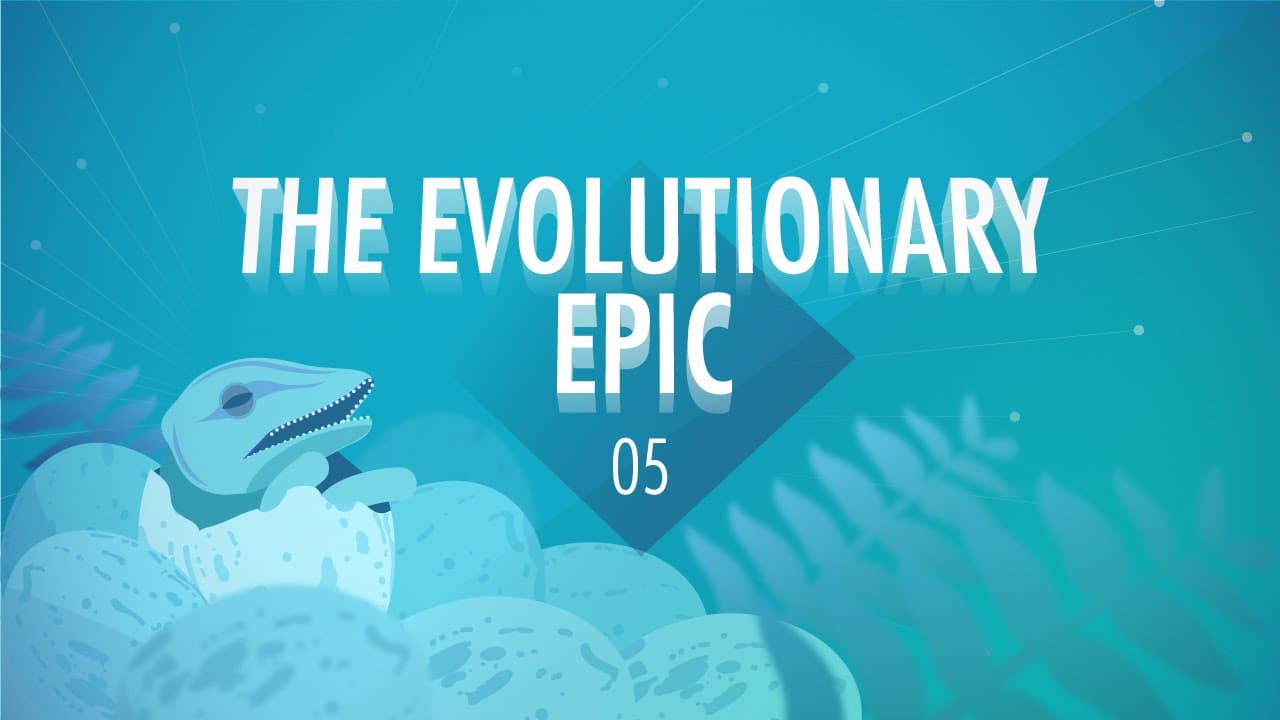
The Evolutionary Epic: Crash Course Big History #5
TL;DR
Exploration of evolution from prokaryotes to modern species.
Transcript
Hi, I'm John Green. Welcome to Crash Course Big History. Today we're gonna be traversing the evolutionary epic - the great story of magnificent beasts, terrifying predators, quite a lot of extinctions, and countless varieties of evolutionary forms. It's the ultimate epic - millions upon millions of species playing out a drama that has so far lasted... Read More
Key Insights
- Evolution by natural selection, as proposed by Charles Darwin, is the central theme of the evolutionary epic, explaining the adaptation and survival of species.
- Darwin's observations on the Galapagos Islands led to the understanding of how species adapt to their environments through natural selection.
- The concept of 'survival of the fittest' was actually coined by Herbert Spencer and is often misunderstood; Darwin preferred 'natural selection.'
- Evolution is a well-tested scientific theory, supported by fossil records, DNA sequencing, and radiometric dating, illustrating shared traits and lines of descent.
- Mass extinction events have periodically reset ecological niches, allowing for rapid evolutionary changes and the emergence of new species.
- Symbiosis played a crucial role in early life forms, leading to complex multicellular organisms and the eventual colonization of land by plants and animals.
- The history of life on Earth is marked by adaptive radiations following extinctions, with mammals evolving significantly after the extinction of dinosaurs.
- The evolutionary timeline includes significant periods such as the Cambrian explosion, the rise of vertebrates, and the dominance of reptiles and dinosaurs.
Install to Summarize YouTube Videos and Get Transcripts
Explore YouTube Video Summarizer or Get YouTube Transcript Extractor
Questions & Answers
Q: What is the central theme of the evolutionary epic discussed in the video?
The central theme of the evolutionary epic discussed in the video is evolution by natural selection. This concept, first proposed by Charles Darwin, explains how species adapt and survive by passing on advantageous traits to their offspring. Over millions of years, this process has led to the incredible diversity of life we see today, with species evolving to fit specific ecological niches.
Q: How did Charles Darwin develop his theory of natural selection?
Charles Darwin developed his theory of natural selection after his voyage on the HMS Beagle, where he observed a variety of species, particularly finches on the Galapagos Islands. He noted how their beaks were adapted to different environments and food sources. Combining these observations with the idea of competition for resources, Darwin concluded that species evolve by natural selection, where advantageous traits are passed down through generations.
Q: What role do mass extinction events play in evolution?
Mass extinction events play a crucial role in evolution by periodically resetting ecological niches. These events wipe out a significant portion of species, creating opportunities for surviving species to rapidly evolve and fill the empty niches. This process, known as adaptive radiation, leads to the emergence of new species and increased biodiversity, as seen after the extinction of dinosaurs, which allowed mammals to diversify.
Q: Why is the phrase 'survival of the fittest' often misunderstood?
The phrase 'survival of the fittest,' coined by Herbert Spencer, is often misunderstood because it suggests that only the strongest survive. However, in the context of evolution, 'fitness' refers to an organism's ability to survive and reproduce in its environment. Darwin's concept of 'natural selection' better captures this idea, emphasizing that advantageous traits are passed on, not necessarily those of the physically strongest.
Q: How is evolution supported by scientific evidence?
Evolution is supported by a wealth of scientific evidence, including fossil records, DNA sequencing, and radiometric dating. Fossils show shared traits with extinct species and help map lines of descent. DNA sequencing reveals genetic similarities between species, indicating common ancestry. Radiometric dating assigns ages to fossils, further illustrating evolutionary timelines. This robust evidence base makes evolution one of the most widely accepted scientific theories.
Q: What is the significance of symbiosis in early evolutionary history?
Symbiosis was significant in early evolutionary history as it led to the development of complex multicellular organisms. Single-celled eukaryotes began to cooperate, forming symbiotic relationships where each cell performed tasks beneficial to the other. This cooperation eventually became so intertwined that the cells could not live without each other, paving the way for the evolution of more complex life forms and the eventual colonization of land.
Q: How did the extinction of dinosaurs impact mammalian evolution?
The extinction of dinosaurs, caused by a massive asteroid impact, drastically altered the Earth's ecosystems, clearing ecological niches previously dominated by dinosaurs. This allowed mammals, which had been small and nocturnal, to rapidly diversify and occupy these niches. This adaptive radiation led to the evolution of a wide variety of mammalian species, including primates, and eventually, humans, significantly impacting the course of evolution.
Q: What are some key periods in the evolutionary timeline mentioned in the video?
Key periods in the evolutionary timeline mentioned in the video include the Cambrian explosion, which saw a rapid increase in multicellular life forms; the rise of vertebrates during the Devonian period; the dominance of reptiles and the emergence of dinosaurs; and the adaptive radiation of mammals following the extinction of dinosaurs. These periods are marked by significant evolutionary developments and mass extinctions that shaped biodiversity.
Summary & Key Takeaways
-
The video explores the epic journey of evolution over 3.8 billion years, highlighting key concepts like natural selection and the role of mass extinctions in shaping biodiversity.
-
Darwin's theory of evolution, based on his observations of finches and other species, revolutionized our understanding of how species adapt and survive through natural selection.
-
The evolutionary history of life on Earth is punctuated by mass extinction events, which periodically reset ecological niches and drive rapid evolutionary changes.
Read in Other Languages (beta)
Share This Summary 📚
Summarize YouTube Videos and Get Video Transcripts with 1-Click
Try YouTube Summary with ChatGPT & Claude or YouTube Transcript Generator
Explore More Summaries from CrashCourse 📚



Summarize YouTube Videos and Get Video Transcripts with 1-Click
Try YouTube Summary with ChatGPT & Claude or YouTube Transcript Generator