What Are Transcription and Translation in Protein Synthesis?
TL;DR
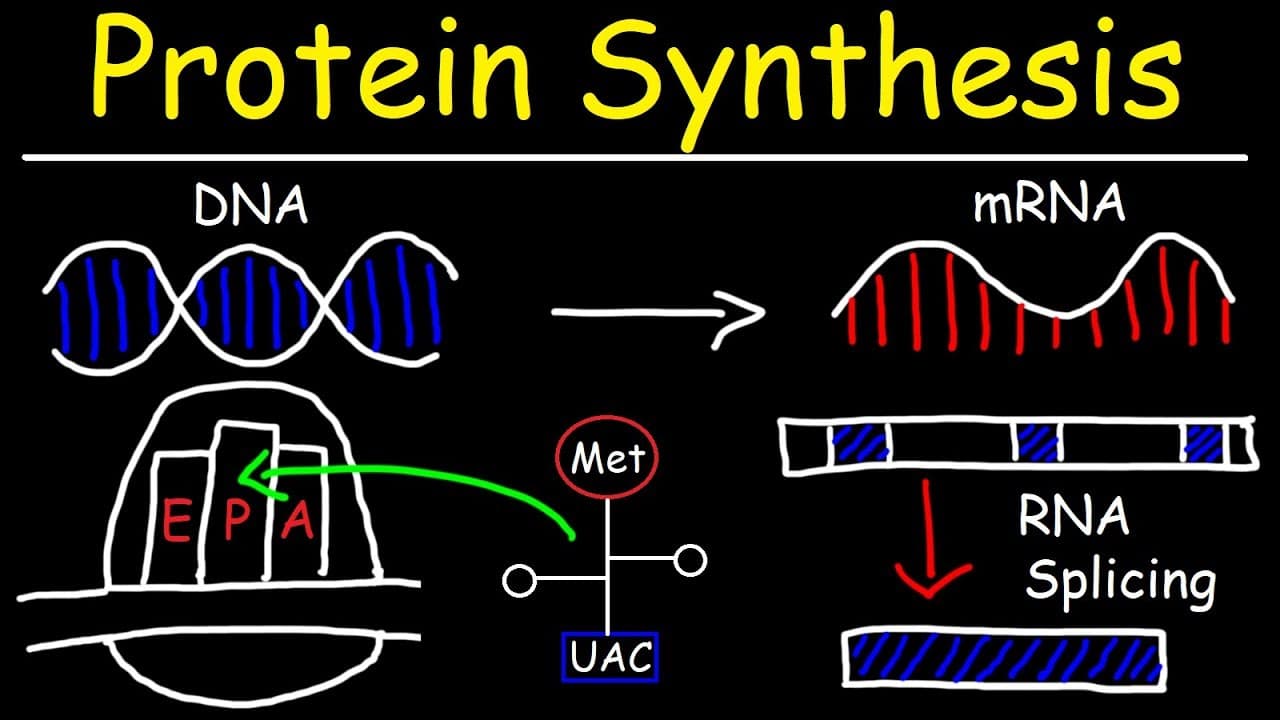
Transcription is the process that converts DNA into mRNA, occurring in three steps: initiation, elongation, and termination. Translation then uses that mRNA to build proteins in the ribosome by pairing codons with corresponding tRNA molecules, also following three steps: initiation, elongation, and termination, culminating when a stop codon is encountered.
Transcript
in this video we're going to talk about transcription and translation and here is just a basic overview of these two processes transcription is the process by which dna gets converted into mrna also known as messenger rna and translation is the process of converting the information stored in messenger rna and using it to build a protein now if you ... Read More
Key Insights
- 🧬 Transcription is the process of converting DNA into mRNA, while translation is the process of using mRNA to build a protein. The ribosome is the site where proteins are manufactured in the cell.
- 📝 Transcription occurs in three steps: initiation, elongation, and termination. Initiation involves RNA polymerase binding to the promoter region. The template strand is used to synthesize mRNA, while the non-template strand is not used.
- 🔗 During elongation, RNA polymerase adds nucleotides to the growing mRNA strand from the 5' end to the 3' end. In the termination step, RNA polymerase and the mRNA strand separate from the DNA template strand.
- ⚙️ Pre-mRNA contains introns and exons, with introns being longer sequences that do not code for anything and must be removed through RNA splicing. The completed mRNA strand contains only the exons, which are used to synthesize proteins.
- 🧬 The correspondence sequence on an mRNA strand is determined by pairing G with C, A with U (uracil instead of thymine), and T with A. The mRNA sequence for the provided DNA strand is UCAUAUGC.
- 🕸️ Translation involves taking the information stored in mRNA and using it to construct a protein. The mRNA strand leaves the nucleus and enters the cytosol, where it interacts with a free ribosome or one attached to the rough ER.
- 🔠 Each set of three nucleotides on the mRNA strand (codon) corresponds to a specific amino acid. Codons match up with anticodons on tRNA molecules, which bring the corresponding amino acids to the ribosome for protein synthesis.
- ✂️ Translation occurs in three steps: initiation, elongation, and termination. During elongation, the growing chain of amino acids exits the ribosome through the E site. Translation ends when a stop codon is read and a release factor enters the A site, causing ribosomal subunits to disassemble.
Install to Summarize YouTube Videos and Get Transcripts
Explore YouTube Video Summarizer or Get YouTube Transcript Extractor
Questions & Answers
Q: What are the three steps involved in transcription?
Transcription involves initiation, elongation, and termination. Initiation involves the binding of RNA polymerase to the promoter region of DNA, while elongation adds nucleotides to the growing mRNA strand. Termination occurs when the RNA polymerase, mRNA strand, and DNA template separate.
Q: How does the mRNA strand differ from the DNA template strand?
The mRNA strand is synthesized from the template strand, also known as the antisense strand. The template strand is read in the 3' to 5' direction, while the mRNA strand is synthesized in the 5' to 3' direction.
Q: What is the purpose of RNA splicing?
RNA splicing removes introns, longer sequences of nucleotides that do not code for anything, from the pre-mRNA strand. Exons, shorter sequences of nucleotides, remain and are used for protein synthesis.
Q: How is the mRNA sequence translated into proteins?
Translation occurs when the mRNA strand interacts with a ribosome and tRNA molecules. Each set of three nucleotides on the mRNA, called a codon, corresponds to a specific amino acid. The tRNA molecules, with complementary anticodons, bring in the corresponding amino acids, forming a protein chain.
Q: What are the three steps involved in translation?
Translation involves initiation, elongation, and termination. During initiation, the start codon is recognized, and the first tRNA molecule enters the ribosome. Elongation involves the addition of amino acids to the growing polypeptide chain. Termination occurs when a stop codon is reached, leading to the release of the protein from the ribosome.
Q: What happens to the protein after translation?
After translation, the protein goes to the Golgi body for further processing and modification. At the Golgi body, the protein undergoes folding to form its specific shape, enabling it to perform its designated function.
Summary & Key Takeaways
-
Transcription: Three steps - initiation, elongation, and termination.
-
Translation: Interaction between mRNA, ribosomes, and tRNA to construct proteins.
-
Termination: Stop codons trigger the release of proteins from the ribosome.
Read in Other Languages (beta)
Share This Summary 📚
Summarize YouTube Videos and Get Video Transcripts with 1-Click
Try YouTube Summary with ChatGPT & Claude or YouTube Transcript Generator
Explore More Summaries from The Organic Chemistry Tutor 📚



Summarize YouTube Videos and Get Video Transcripts with 1-Click
Try YouTube Summary with ChatGPT & Claude or YouTube Transcript Generator