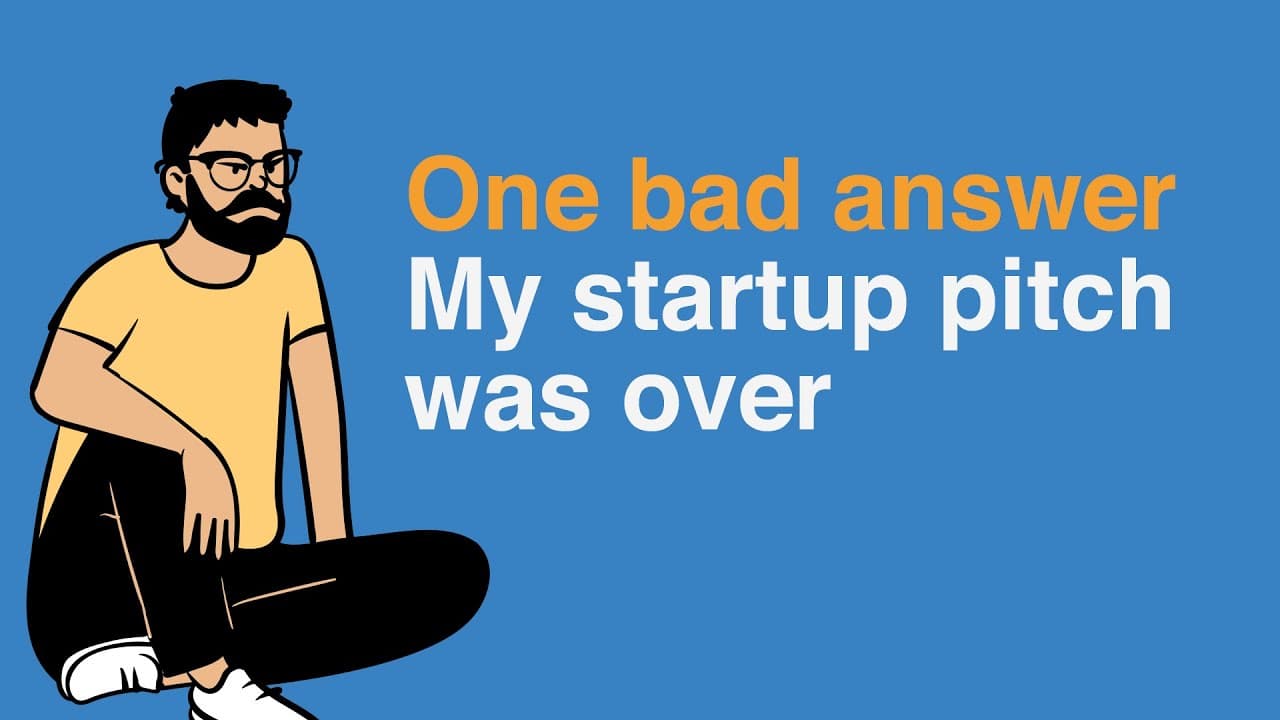
I said the wrong thing and suddenly our Series A pitch meeting was over
TL;DR
Choose a clear business model when an investor presents a meaningful strategic fork, because answering “both” can reveal that you have not understood the underlying tradeoff. If a pitch question is unclear, ask what the investor means and why they are asking, then connect your answer to how the company creates value, acquires users, and earns revenue.
Transcript
- Well, picture this, we were raising our Series A for my startup Posterous. My co-founders and I were at Benchmark Capital on Sand Hill Road, meeting with Peter Fenton, legendary investor in Twitter and Yelp. We think it's going fine until Peter asks this question. So, are you a platform or a network? The three of us looked at each other and we sa... Read More
Key Insights
- A decisive investor question can expose an unresolved strategic choice. When Peter Fenton asked whether Posterous was a platform or a network, the founders answered “both,” which failed to show that they understood the distinct business models and the need to select one.
- A network creates value by becoming as large as possible. Twitter represented this model because it was free, users themselves were the product, and ownership of the network created an opportunity to charge rent through advertising.
- A platform creates value through a direct exchange between the company and paying customers. Squarespace and Weebly represented this approach, with software builders working directly for customers and revenue providing funds that could be used to acquire additional users.
- A platform is viable when long-term customer value exceeds customer acquisition cost. When long-term value rises far above acquisition cost, the economics become especially attractive because spending to acquire customers can generate substantially greater value over time.
- An unclear pitch question should prompt clarification rather than confident improvisation. Founders can ask what the investor means and why the question matters, particularly because investors often draw their questions from repeated startup experience and previous investments that lost money.
- Posterous had a possible path to becoming a network before Instagram emerged as the stronger alternative for mobile social posting. Tan observed that Posterous stopped growing when Instagram launched, showing that posting by email no longer offered the best available experience.
- Posterous missed a plausible opportunity to become a paid platform after its network prospects weakened. With about 2 million active bloggers, a 5% conversion rate at $5 per month would have generated more than $500,000 monthly, exceeding its burn of under $200,000.
- The answer to a strategic either-or question is probably not “both.” Tan’s central lesson is that founders should recognize the tradeoff embedded in an investor’s question, admit when they do not understand it, and make a deliberate choice that produces a coherent business.
Install to Summarize YouTube Videos and Get Transcripts
Explore YouTube Video Summarizer or Get YouTube Transcript Extractor
Questions & Answers
Q: How should founders answer unclear investor questions?
Founders should pause and ask the investor what the question means and why it is being asked. It is acceptable not to know an answer, especially when a company is still early. Investors draw on experience across many startups, sometimes including investments where they already lost money, so clarification can reveal the practical risk or strategic distinction behind the question.
Q: Why was answering “both” a mistake in the Posterous pitch?
Answering “both” was a mistake because the platform-versus-network question required Posterous to make a strategic choice. The response indicated that the founders did not understand the distinction or its consequences. A network needed broad participation and viral value, while a platform needed paying customers and direct service. Posterous ultimately followed a path that achieved neither model effectively.
Q: What is the difference between a platform and a network?
A network is free and becomes more valuable as its user base grows, with users themselves serving as the product and advertising providing a way to charge rent after the network is established. A platform transfers value directly from the company to paying customers, giving the company revenue that can support software development and customer acquisition.
Q: How does a paid software platform become viable?
A paid software platform becomes viable when the long-term value generated by a customer exceeds the cost of acquiring that customer. Charging users gives the company money to acquire more users while continuing to build for its customers. If long-term value is far above customer acquisition cost, the company has what Tan describes as a money machine.
Q: Why did Posterous stop growing after Instagram launched?
Posterous stopped growing when Instagram launched because Instagram offered a better alternative to posting by email. At launch, Posterous appeared as one of Instagram’s checked posting destinations alongside Twitter, Facebook, and Foursquare, but Instagram ultimately won the mobile social media battle. That moment showed that Posterous was losing its opportunity to become the dominant network.
Q: Could Posterous have become a profitable paid platform?
Tan believes Posterous had a credible opportunity to become a paid platform. The company had 20 million unique visitors and about 2 million active bloggers while burning under $200,000 per month. If 5% of active bloggers had paid $5 per month, monthly revenue would have exceeded $500,000, giving the company a clear paid business model.
Q: What strategy did Posterous choose instead of becoming a platform?
Posterous tried to become a private sharing network for families before changing ideas and choosing to pivot. According to Tan, that service could neither grow virally nor persuade people to pay. The strategy therefore lacked the growth mechanism of a successful network and the customer revenue of a successful platform, leaving the company between two workable models.
Q: What happened to Posterous after the failed Series A pitch?
Benchmark Capital did not fund Posterous after the pitch. Posterous later sold to Twitter for about $20 million in what Tan describes as basically a talent acquisition, and Twitter eventually shut down the platform. Tan contrasts that outcome with Weebly, which continued charging customers, and Squarespace, which became one of the most profitable platforms on the web.
Summary
In this video, the speaker shares their experience of a pivotal pitch meeting for their startup Posterous. They were asked the question, "Are you a platform or a network?" and their response of "both" ultimately hindered their chances of securing funding. The speaker reflects on the importance of understanding the question being asked and the implications of choosing the right path for a startup. They discuss the differences between a network and a platform, using examples like Twitter and Weebly. The speaker also shares their regrets about not choosing to become a platform when they had the opportunity and how Posterous could have potentially been a different company if they had. The video ends with advice for founders to pay attention to the questions asked by investors and not pretend to have all the answers.
Questions & Answers
Q: Why was the question, "Are you a platform or a network?" so important for the speaker's startup, Posterous?
The question was important because it forced the speaker and their co-founders to choose a direction for their startup. They realized that saying both was not a viable option, and their inability to provide a clear answer may have led to the investor losing interest in their pitch.
Q: What are the differences between a network and a platform?
A network, like Twitter, relies on having a large user base as its primary source of value. The users themselves are the product, and the network can monetize by charging for ads. In contrast, a platform, such as Squarespace or Weebly, offers a product or service that customers pay for directly. The platform then has the ability to acquire new users because it generates revenue.
Q: Why does the speaker believe it is important to understand the questions asked in a pitch meeting?
The speaker suggests that investors ask questions based on their lived experiences, often having lost money on certain ventures. Understanding the questions allows founders to gain clarity and ensure they are addressing the investor's concerns. It is acceptable for founders to admit when they don't know the answer to certain questions.
Q: What happened to the speaker's startup, Posterous, after the pitch meeting?
Posterous did not secure funding from the investor, but it eventually sold to Twitter for around $20 million as a talent acquisition. However, Twitter later shut down the platform. Meanwhile, Weebly continued to charge its users and became a successful platform that is still in operation today.
Q: How did the launch of Instagram impact Posterous?
When Instagram launched, Posterous was one of the destinations featured on the post page. However, Instagram's popularity as a better alternative for posting by email led to Posterous's growth stalling. This realization made it clear that Posterous needed to become a platform instead of trying to be a network.
Q: What regrets does the speaker have about their startup, Posterous?
The speaker regrets not choosing to become a platform when they had the opportunity. Instead, they attempted to pivot and create a private sharing network, which did not generate significant growth or revenue. Looking back, they recognize that Posterous could have been a different company if it had become a platform.
Q: What advice does the speaker have for founders during a pitch meeting?
The speaker advises founders to pay attention to the questions asked by investors and not pretend to have all the answers. It is acceptable to admit when something is unclear or uncertain. They also emphasize that the answer to the platform vs. network question is unlikely to be both.
Q: How did the speaker's experience with Posterous shape their understanding of pitching and startups?
The speaker learned valuable lessons from the pitch meeting, including the importance of understanding the questions being asked and the significance of choosing the right direction for a startup. They acknowledge that sometimes the worst thing a founder can do is say both when asked to choose between being a platform or a network.
Q: What was the outcome for other companies mentioned in the video, such as Twitter and Squarespace?
Twitter, which was mentioned as a network, became successful by leveraging its large user base and charging for ads. Squarespace, on the other hand, has become one of the most profitable platforms on the web. The video clarifies that the mention of these companies is not sponsored.
Q: What is the speaker's general hope for founders and entrepreneurs?
The speaker hopes that founders and future founders can learn from their experience and avoid making the same mistakes. They emphasize the importance of understanding the implications of the platform vs. network question and provide good luck wishes to those embarking on the journey of building their own businesses and startups.
Takeaways
The video highlights the significance of understanding the questions asked by investors during a pitch meeting and not pretending to have all the answers. Choosing the right direction for a startup, whether as a platform or a network, is crucial for success. The speaker shares their regrets of not recognizing the opportunity to become a platform and encourages founders to pay attention to the questions posed by investors. By learning from these lessons, founders can avoid unnecessary challenges and make informed decisions for the growth and future of their startups.
Summary & Key Takeaways
-
Posterous sought Series A funding from Benchmark Capital in 2010. When Peter Fenton asked whether the startup was a platform or a network, its three co-founders answered “both.” Garry Tan later concluded that this response showed they neither understood the question nor had made the strategic choice the business required at that moment.
-
A network seeks broad participation because its value comes from having as many users as possible, and it can later charge rent through advertising. A platform directly serves paying customers. Its economics can support user acquisition when long-term customer value exceeds customer acquisition cost, creating a viable and potentially highly profitable business.
-
Posterous later pursued private family sharing, which could neither grow virally nor attract paying customers. Tan believes it could instead have become a paid platform. With 20 million unique visitors and roughly 2 million active bloggers, converting 5% at $5 monthly would have produced more than $500,000 in monthly revenue.
Read in Other Languages (beta)
Share This Summary 📚
Summarize YouTube Videos and Get Video Transcripts with 1-Click
Try YouTube Summary with ChatGPT & Claude or YouTube Transcript Generator
Explore More Summaries from Garry Tan 📚


Summarize YouTube Videos and Get Video Transcripts with 1-Click
Try YouTube Summary with ChatGPT & Claude or YouTube Transcript Generator