How to Sell Without Talking About Price First
TL;DR
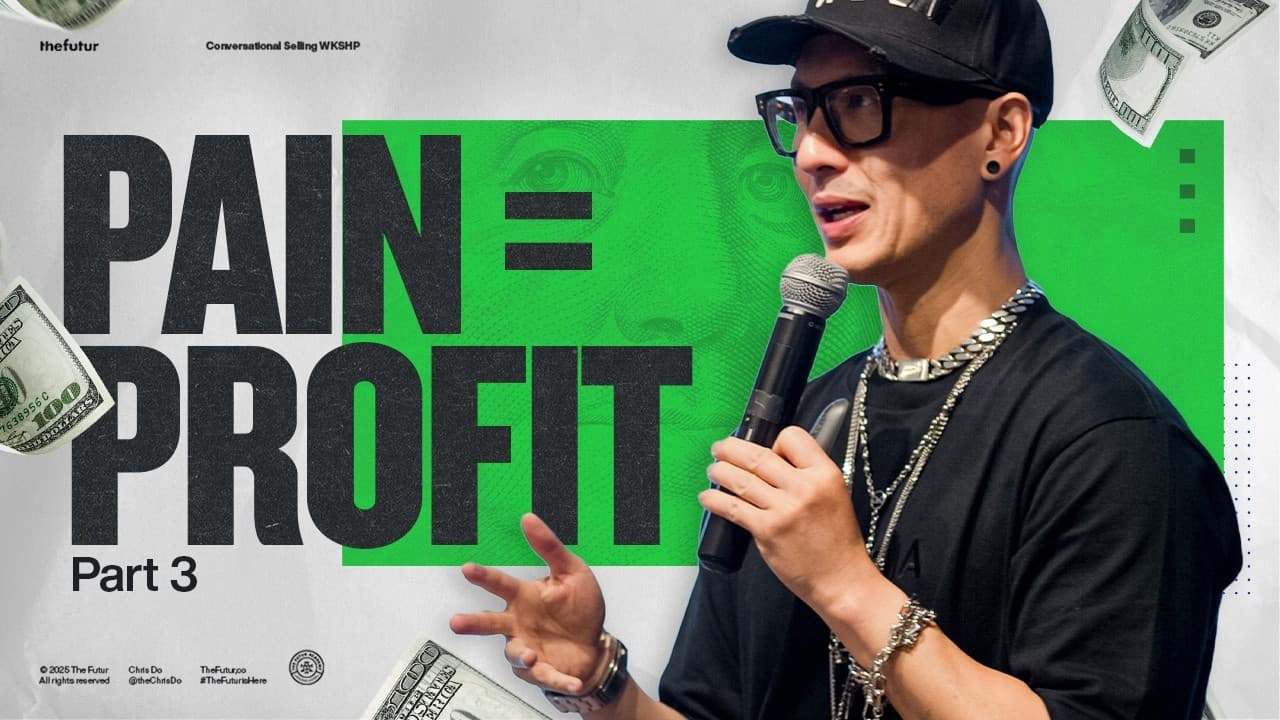
Before discussing price, guide clients through their now, past, and future to surface real pain and a measurable goal. Quantify the desired outcome, then anchor your fee as a small percentage of that value. When a client sees an extra $84,000 a year, a $7,500 to $8,400 plan feels like an easy yes.
Transcript
Where are you in your business right now? The more measurable result is, the easier it is for us to make it feel less abstract and then we can assign a value to it. So if my goal was I want my designers to be better, is that an abstract goal or is that a quantifiable goal? It's super abstract. What happens then is if you tell your designer, I just ... Read More
Key Insights
- The sales framework moves a client through three states: now, past, and future. You establish where they are today, revisit the past to find what changed and caused pain, then guide them toward a desired future result.
- Pain drives urgency. The more pain a client feels about a problem, the more urgently they seek a solution, so revisiting the past to help them feel that pain must happen before moving to the future.
- Telling a client there may be no problem often backfires in your favor. When you say they could do nothing and be fine, most respond that the problem is still urgent, proving the need themselves instead of feeling pushed.
- Measurable results beat abstract goals. Asking a designer to 'just be better' is abstract and makes them fearful, so instead ask the client how you will both know when the goal is reached and how it can be measured.
- The 'five whys' technique means repeatedly asking why, usually three to five times, to move past surface answers and reach the client's real underlying motivation, which is often simply making more money.
- The word 'if' creates a low-commitment, safe space to explore imagination. Framing a change as 'if this happened, would you?' lets a client take small mental steps, and momentum carries them toward agreement.
- Keeping existing clients is more valuable than chasing new leads, because it is much harder to get a new client than to keep one, so recurring revenue can replace the pressure to constantly generate leads.
- Price is framed as a percentage of the value delivered. After quantifying an $84,000 annual gain, offering a plan at roughly 10 percent, about $8,400 or a discounted $7,500, makes the fee feel reasonable to the client.
Install to Summarize YouTube Videos and Get Transcripts
Explore YouTube Video Summarizer or Get YouTube Transcript Extractor
Questions & Answers
Q: Why should you not talk about price too early in a sales conversation?
Talking about price too early kills the sale because you skip the real work of understanding the client. According to the description, you lose deals not because of your pricing but because you skip the conversation that builds trust, uncovers urgency, and positions your price as the obvious next step. First you must establish the client's situation, surface their pain, and quantify their desired outcome so the price feels justified rather than pushed.
Q: What is the now, past, and future sales framework?
The framework recognizes that everyone has a present, past, and future. When a client arrives they are in their now state, which gives context about who they serve and what problems they solve. Before moving to the future, you revisit the past to find the change story, the moment something interrupted them and caused a problem. This leads to today, then to their desired future state, the goal or result they want to achieve.
Q: Why does the speaker focus on making the client feel pain?
The speaker focuses on pain because the more pain a client feels, the more urgently they seek a solution. Before moving to the future, you must revisit the past and help them feel the pain. If there is no pain, you find a different problem or honestly say you may not be able to help. Interestingly, when you suggest doing nothing might be fine, clients often insist the problem is still urgent, confirming the need themselves.
Q: How do you turn an abstract client goal into a measurable one?
You ask the client how you will both know when the goal is reached and how it can be measured. An abstract goal like wanting designers to 'be better' makes people fearful and leaves you frustrated because it is never clearly achieved. Instead, look for measurable indicators such as customer satisfaction going up, turnover rate going down, or more website visitors. The more measurable a result is, the easier it becomes to assign a value to it.
Q: What is the five whys technique in selling?
The five whys, called the five W's in the workshop, is a technique where you keep asking the client why in response to their answers. You might ask three, four, or five times, since five is more than enough. Each why pushes past the surface answer to reach the deeper, real motivation. In the live example, repeatedly probing revealed the client ultimately just wanted to make more money and double his revenue.
Q: Why is keeping existing clients better than generating new leads?
Keeping existing clients is better because it is much harder to get a new client than to keep one. If clients consistently came back, recurring revenue could generate the money the business owner wants without the constant pressure of generating new leads. In the example, the advice was to focus on committed, successful clients like manufacturing clients who pay more, rather than chasing creators who give up posting and disappear from the system.
Q: How does the 'if' framing help close a sale?
The word 'if' creates a safe, low-commitment space to play with imagination. By asking questions like 'if this happened and that happened, would you then?', you let the client remove their fear, such as losing revenue, and imagine the change without pressure. This produces a visible shift in language and body. Momentum builds as the client takes a small step, realizes it is not scary, then takes another, until they have agreed almost before they know it.
Q: How should you set your price relative to the value you deliver?
You set the price as a small percentage of the quantified value delivered. In the live example, doubling the client's 10k to 20k created 7k in monthly profit, which over twelve months equals about $84,000 more per year. The fee was anchored at 10 percent of that gain, roughly $8,400, then offered at a slightly lower $7,500. Quantifying the outcome first makes the price feel like an obvious, reasonable investment.
Summary & Key Takeaways
-
The framework maps a client on a timeline from years ago to today. You first ask where they are in their business now for context, then find the moment in the past when something changed and created a problem, called the change story.
-
Feeling pain is essential before offering solutions. The presenter helps clients understand and feel their pain, because urgency comes from pain. If there is no pain, you either find a different problem or honestly tell the client you may not be able to help.
-
In a live practice with a video editing agency owner stuck on leads for six months, the goal became doubling revenue. By quantifying an $84,000 yearly gain and focusing on committed clients, the fee was anchored at 10 percent, then offered at $7,500.
Read in Other Languages (beta)
Share This Summary 📚
Summarize YouTube Videos and Get Video Transcripts with 1-Click
Try YouTube Summary with ChatGPT & Claude or YouTube Transcript Generator
Explore More Summaries from The Futur 📚



Summarize YouTube Videos and Get Video Transcripts with 1-Click
Try YouTube Summary with ChatGPT & Claude or YouTube Transcript Generator