How to Solve Ideal Gas Law Problems
TL;DR
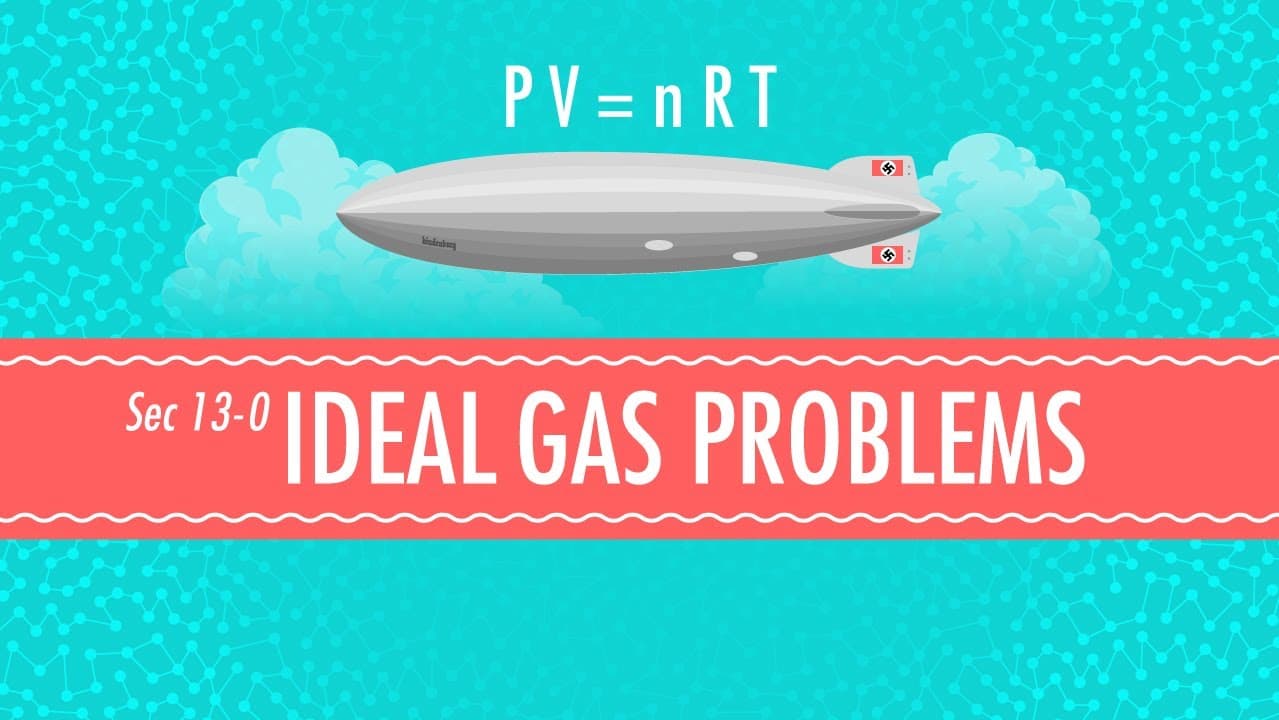
The ideal gas law, PV=nRT, provides a useful estimate for gas behavior under normal conditions, though it assumes particles have no size or attraction. By combining Boyle's, Charles', and Avogadro's laws, the ideal gas law simplifies calculations. However, it becomes less accurate at high pressures or low temperatures, where real gases deviate from ideal behavior.
Transcript
What does your perfect world look like? An end to genocide, corn dogs for dinner everyday, David Tennant at my house for board games and Carl Sagan would be there too, he'd be immortal...and not dead. We could cure cancer with puppies and vomit wouldn't exist. Unfortunately, sometimes we need to vomit to survive, David Tennant doesn't know I exist,... Read More
Key Insights
- The ideal gas law combines Boyle's, Charles', and Avogadro's laws into one formula: PV=nRT.
- Ideal gas law assumes particles have no size and do not attract each other, which is often unrealistic.
- Mendeleev combined the gas laws and introduced the universal gas constant, R, to simplify calculations.
- Real gases deviate from ideal behavior at high pressures and low temperatures due to particle size and attraction.
- Standard Temperature and Pressure (STP) is 0°C and 100 kPa, used as a baseline for gas behavior comparisons.
- The Hindenburg disaster illustrates the risks of hydrogen gas, which is flammable but provides more lift than helium.
- Johannes van der Waals developed corrections for real gas behavior to address limitations of the ideal gas law.
- A fire piston demonstrates that increased pressure leads to increased temperature, igniting a small piece of cotton.
Install to Summarize YouTube Videos and Get Transcripts
Explore YouTube Video Summarizer or Get YouTube Transcript Extractor
Questions & Answers
Q: How does the ideal gas law simplify gas calculations?
The ideal gas law, PV=nRT, simplifies gas calculations by combining Boyle's, Charles', and Avogadro's laws into a single equation. This law uses the universal gas constant, R, to relate pressure, volume, temperature, and the amount of gas, making it more convenient than using three separate laws. It provides a close estimate of gas behavior under normal conditions.
Q: Why does the ideal gas law have limitations?
The ideal gas law assumes that gas particles have no size and do not attract each other, which is often unrealistic. These assumptions lead to inaccuracies at high pressures or low temperatures, where particles are closer together and their size and attraction become significant. Real gases deviate from ideal behavior under these extreme conditions, necessitating corrections.
Q: What role did Mendeleev play in gas law development?
Dmitri Mendeleev played a crucial role in gas law development by combining Boyle's, Charles', and Avogadro's laws into the ideal gas law, PV=nRT. He introduced the universal gas constant, R, which incorporates constants from the individual laws, simplifying calculations and making the law more practical for estimating gas behavior under normal conditions.
Q: How does the ideal gas law apply to the Hindenburg disaster?
The Hindenburg disaster illustrates the practical implications of gas laws. The airship used hydrogen gas for lift, as its molar mass is roughly half that of helium, providing more lift. However, hydrogen's flammability led to the disaster. The ideal gas law helps understand the volume and pressure of gases like hydrogen, but real-world factors such as flammability must also be considered.
Q: What is the significance of the universal gas constant?
The universal gas constant, R, is significant because it allows the ideal gas law, PV=nRT, to relate pressure, volume, temperature, and the amount of gas in a single equation. R incorporates constants from Boyle's, Charles', and Avogadro's laws, making the ideal gas law more practical for calculations. Its value is 8.3145 L kPa/K mol, serving as a conversion factor for units.
Q: How do real gases deviate from ideal behavior?
Real gases deviate from ideal behavior at high pressures and low temperatures due to particle size and attraction. Under these conditions, particles are closer together, making their size and attraction significant. The ideal gas law's assumptions become less accurate, requiring corrections such as those developed by Johannes van der Waals to account for real gas behavior.
Q: What is the role of STP in gas law calculations?
Standard Temperature and Pressure (STP) serves as a baseline for comparing gas behaviors. It is defined as 0°C and 100 kPa, providing a consistent reference point for scientists worldwide. Gas law calculations are often performed using STP to ensure uniformity and accuracy in comparing results. It's important to convert temperatures to Kelvin for these calculations.
Q: How does a fire piston demonstrate gas law principles?
A fire piston demonstrates gas law principles by showing how increased pressure leads to increased temperature. The device compresses air rapidly, causing its temperature to rise. When a small piece of cotton is placed inside, the heat generated by compression ignites it, illustrating the relationship between pressure and temperature, as described by the ideal gas law.
Summary & Key Takeaways
-
The ideal gas law, PV=nRT, is a simplified equation combining Boyle's, Charles', and Avogadro's laws, useful for estimating gas behavior under normal conditions. However, it assumes no particle size or attraction, which can lead to inaccuracies at high pressures or low temperatures. Mendeleev's introduction of the universal gas constant, R, made the law more practical.
-
Real gases deviate from ideal behavior due to particle size and attraction, especially under extreme conditions. Johannes van der Waals addressed these limitations with corrections for real gas behavior. Despite these deviations, the ideal gas law remains a valuable tool for understanding gas properties and performing calculations.
-
The Hindenburg disaster highlights the dangers of hydrogen gas, used for its lift despite being flammable. The video also demonstrates a fire piston, showing how increased pressure can ignite materials by rapidly increasing temperature. These examples underscore the practical implications of gas laws in real-world scenarios.
Read in Other Languages (beta)
Share This Summary 📚
Summarize YouTube Videos and Get Video Transcripts with 1-Click
Try YouTube Summary with ChatGPT & Claude or YouTube Transcript Generator
Explore More Summaries from CrashCourse 📚





Summarize YouTube Videos and Get Video Transcripts with 1-Click
Try YouTube Summary with ChatGPT & Claude or YouTube Transcript Generator