How Do Affine Functions Model Relationships?
TL;DR
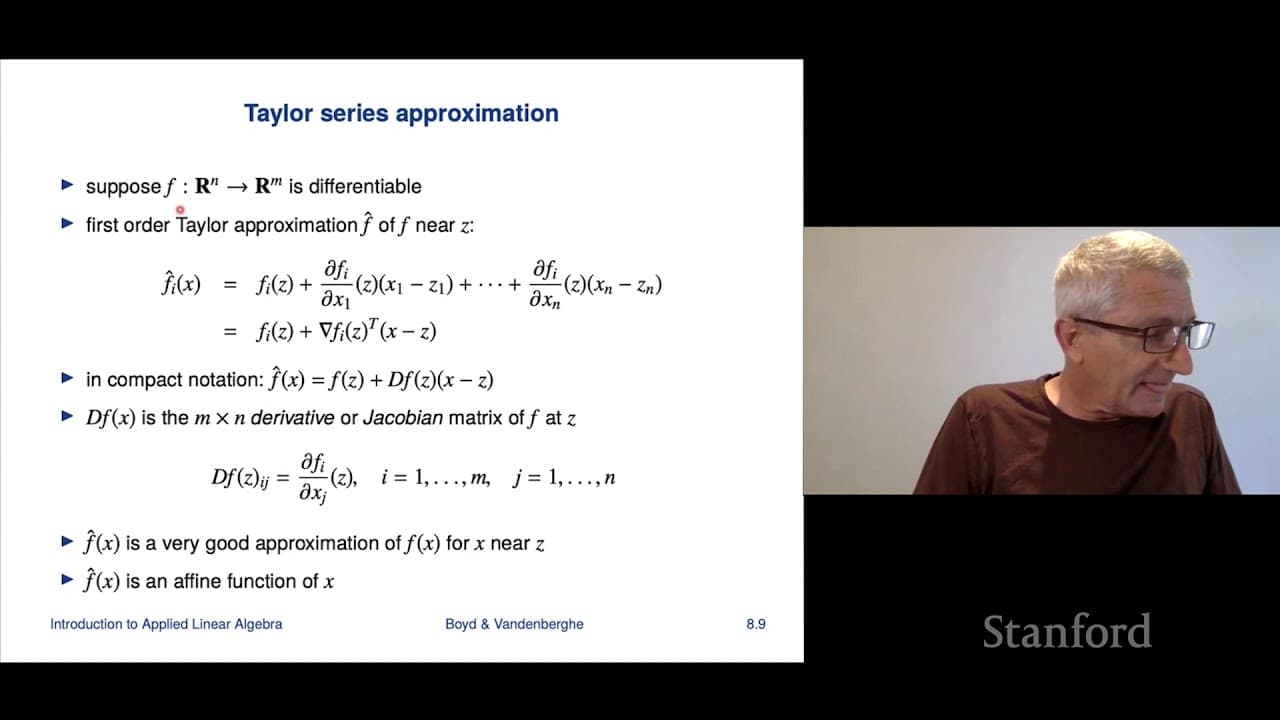
Affine functions effectively approximate relationships between vectors in various fields, including economics and aerodynamics. They help model demand changes relative to price adjustments using an elasticity matrix and provide insights through regression models by predicting outcomes based on features while minimizing errors.
Transcript
so in many applications uh relations between an n vector and an m vector are either are approximated sometimes the approximation is very good as linear or affine right so um sometimes the approximation is really good and holds over like you know holds out at the you know fifth and sixth decimal place or something an example of that would be electro... Read More
Key Insights
- 🏑 Linear or affine approximations are commonly used in various fields, including economics, electromagnetics, acoustics, and aircraft dynamics.
- 👋 The elasticity matrix in economics provides interpretable insights into how changes in prices affect demands for different goods or services.
- 🪈 Affine functions can be derived from differential calculus using a first-order Taylor expansion, offering a straightforward approximation technique.
Install to Summarize YouTube Videos and Get Transcripts
Explore YouTube Video Summarizer or Get YouTube Transcript Extractor
Questions & Answers
Q: What is the main purpose of using affine functions in various applications?
Affine functions are used to approximate relationships between vectors, allowing for predictions, analysis, and optimization of various systems.
Q: How is the elasticity matrix used in economics to model changes in prices and demands?
The elasticity matrix relates changes in prices to changes in demands, providing insights into how a change in price affects the demand for a specific item or good.
Q: Can affine functions accurately predict outcomes for large changes?
Affine functions are most accurate for small changes, and their accuracy diminishes for larger changes. They serve as useful approximations within reasonable ranges of the variables involved.
Q: What is the purpose of regression modeling and how does it utilize affine functions?
Regression modeling aims to predict outcomes based on features or attributes. It utilizes affine functions to approximate the relationship between the features and the outcome, minimizing the difference between the predicted and observed values.
Summary & Key Takeaways
-
In many applications, relations between vectors are approximated as linear or affine functions, with varying degrees of accuracy.
-
Elasticity is a key concept in economics, where changes in prices and demands are modeled using an elasticity matrix.
-
Affine functions can also be derived from differential calculus, using a first-order Taylor expansion to approximate a function.
-
Regression models use affine functions to predict outcomes based on features, with the goal of minimizing prediction errors.
Read in Other Languages (beta)
Share This Summary 📚
Summarize YouTube Videos and Get Video Transcripts with 1-Click
Try YouTube Summary with ChatGPT & Claude or YouTube Transcript Generator
Explore More Summaries from Stanford Online 📚


Summarize YouTube Videos and Get Video Transcripts with 1-Click
Try YouTube Summary with ChatGPT & Claude or YouTube Transcript Generator