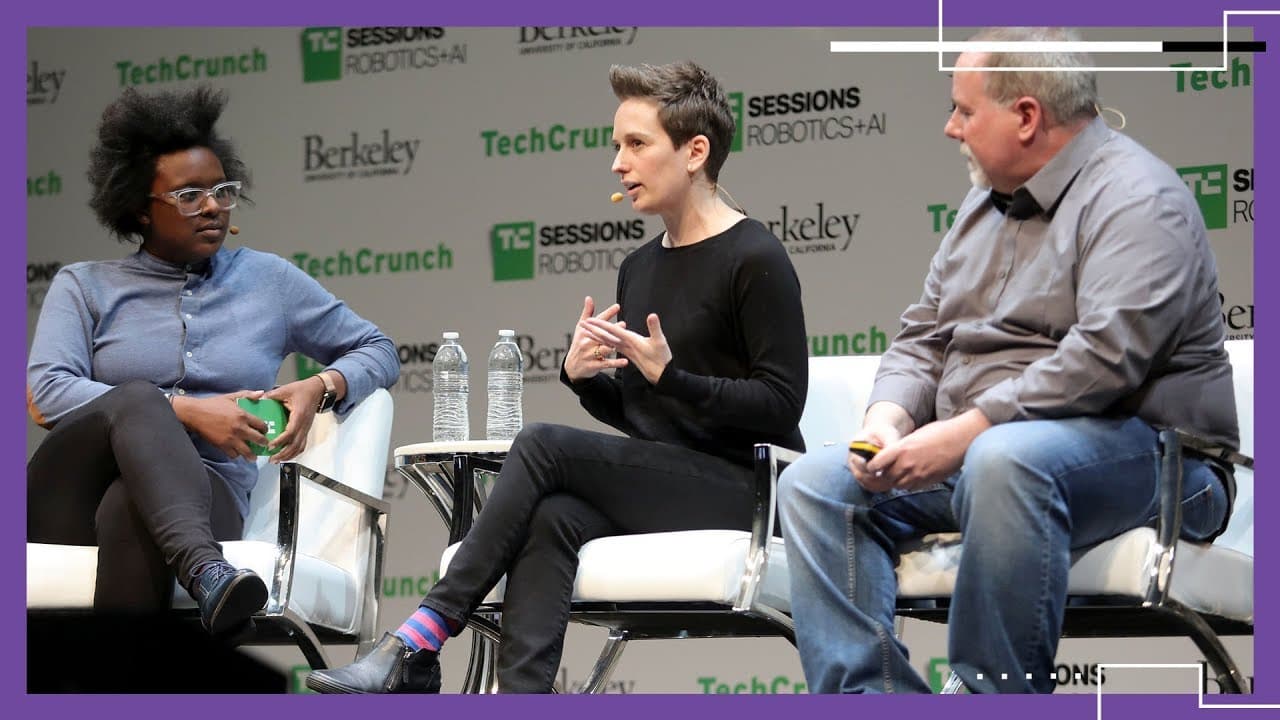
Facilitating Human-Robot Interaction | TC Sessions: Robotics + AI 2020
TL;DR
Human-robot interaction is advancing through systems that make machines safer, more predictable, and responsive to people, but robots resembling the emotionally aware companion in “Lost in Space” remain far beyond current capabilities. Factory robots can lift objects weighing hundreds of pounds while humans handle dexterity and judgment; home robots assist people with mobility impairments. Read on to see how sensing, computer vision, and thoughtful task division enable collaboration.
Transcript
good afternoon everyone all right let's talk let's talk robots interacting with humans so I've actually been rewatching lost in space on Netflix Clara I know you actually haven't seen this show so this reference might fall a little flat and so essentially it's this robot that befriends a child at least in season one I haven't seen season two yet bu... Read More
Key Insights
- 🤖 The idea of anthropomorphic robots can create unrealistic expectations and may not be practical in terms of functionality.
- 🧑🏭 Robots in factories are designed to work alongside humans and make use of deterministic 3D modeling and visualizations to ensure safety.
- 🤖 The future of manufacturing lies in humans and robots collaborating, with humans performing tasks that they excel at and robots handling repetitive or physically demanding tasks.
- 🤖 Voice commands, buttons, and smartphone apps are used to control robots in home settings, with the goal of integrating the robot into the natural flow of human behavior.
- 🤖 Sensors and processing power have become more affordable and advanced, enabling robots to have a better understanding of their environment and perform tasks more efficiently.
Install to Summarize YouTube Videos and Get Transcripts
Explore YouTube Video Summarizer or Get YouTube Transcript Extractor
Questions & Answers
Q: How close are we to creating robots that emotionally connect with humans?
Robots with the combined emotional understanding, physical ability, and consciousness portrayed in “Lost in Space” are still a long way from reality. Discrete elements are possible, and gesture-based interaction and startups focused on emotional behavior show more progress than fully functional human-like robots.
Q: What safety precautions protect people working near large industrial robots?
Large industrial robots are traditionally kept in cages to prevent people from approaching dangerous machinery. New safety systems use sensing and computer vision, custom sensors and computers, dual-redundant hardware, and algorithms with well-defined failure modes that can be detected and addressed.
Q: Why are large industrial robots dangerous to people?
Their superhuman capabilities require powerful mechanical systems: a robot may lift a 200-pound object, move it at 2 meters per second, and place it with submillimeter precision. Those same capabilities can injure nearby workers unless the robot is separated from them or governed by appropriate safety systems.
Q: How can humans and robots divide work in manufacturing?
Robots can perform physically demanding and precise positioning work, while people handle tasks requiring dexterity, judgment, and flexibility. For example, a robot can lift an electric motor weighing hundreds of pounds and position it while a worker attaches fasteners and connects a wiring harness.
Q: Why is human-robot collaboration more flexible than putting robots in cages?
Caged production forces manufacturing engineers to choose between a fully automated step and a fully manual one. Full automation requires auxiliary equipment to move parts into and out of cages, while manual work can create ergonomic and performance challenges; collaboration lets each participant handle the work it does best.
Q: How does Veo facilitate human-robot interaction in factories?
Veo develops technology that makes machines responsive to people in flexible and efficient manufacturing. Its first product gives industrial robot arms “eyes and brains” so they can interact safely and effectively with production workers.
Q: What tasks can home-assistance robots perform?
Home robots can help carry people, transport objects, or deliver items for someone with impaired mobility. According to the page summary, they are designed to fit into the natural flow of human behavior and remain subordinate to the person using them.
Q: How are robots controlled and understood in factories and homes?
Factory workers are trained around predictable robot behavior and can use visualizations of a robot’s internal state to understand its actions. At home, people can direct robots through voice commands, buttons, or smartphone apps, supporting interaction within their normal routines.
Summary & Key Takeaways
-
Humans and robots in the manufacturing industry are working together to achieve flexible and efficient production. Industrial robots are given eyes and brains to interact safely and effectively with human workers.
-
The safety precautions taken in factories involve using sensors and computer vision systems to meet regulatory requirements and protect people from dangerous machinery.
-
In the home, robots are being developed to assist people with mobility issues or carry and deliver objects. These robots are designed to work within the natural flow of human behavior and have a subordinate role to humans.
Read in Other Languages (beta)
Share This Summary 📚
Summarize YouTube Videos and Get Video Transcripts with 1-Click
Try YouTube Summary with ChatGPT & Claude or YouTube Transcript Generator
Explore More Summaries from TechCrunch 📚






Summarize YouTube Videos and Get Video Transcripts with 1-Click
Try YouTube Summary with ChatGPT & Claude or YouTube Transcript Generator