What Are Random Variables and Expectation?
TL;DR
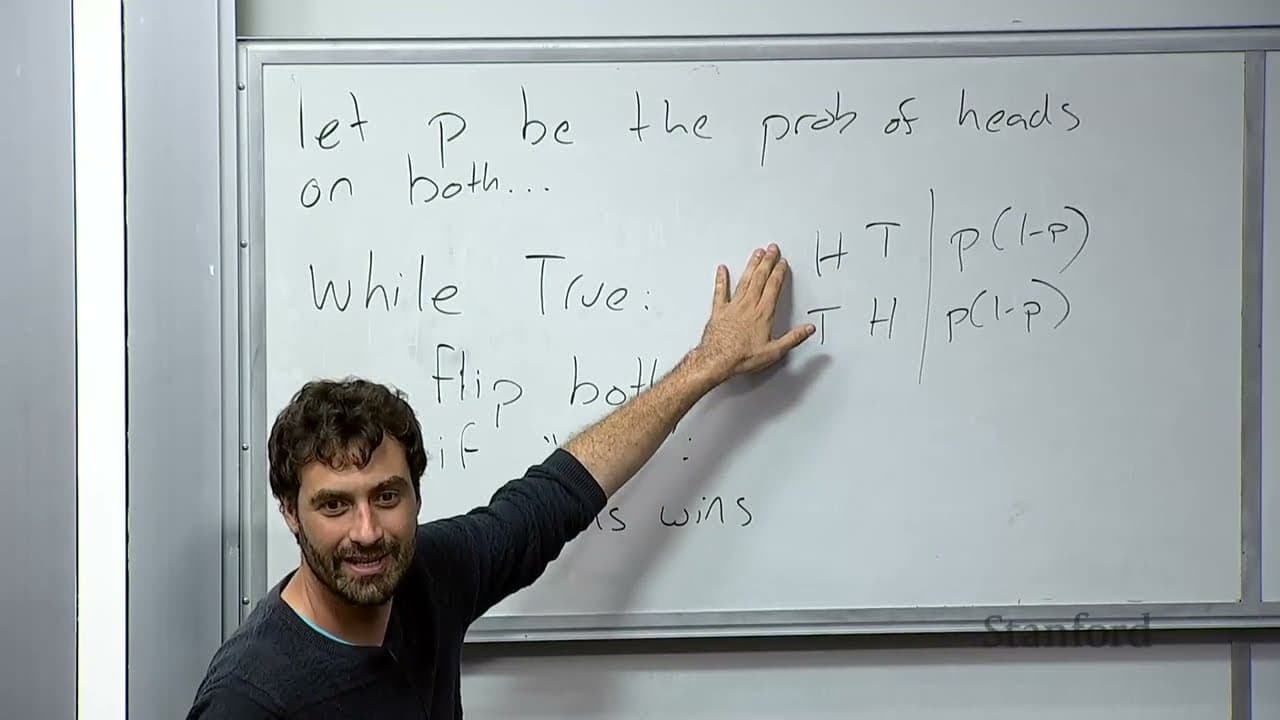
Random variables are defined as variables that can take on different values with associated probabilities, reflecting uncertainty. This lecture also covers the probability mass function and how to calculate the expected value, a key statistic representing the average outcome of a random variable.
Transcript
we're live hey good afternoon everybody welcome back to cs109 how are you guys doing today oh fantastic I love to hear that I hope you guys are having a splendid Friday and you're looking forward to a great weekend everything okay uh we're waiting for the screen to pop up oh it's probably much easier for the screen to pop up if the HDMI is plugged ... Read More
Key Insights
- 💱 Conditional Independence is an important concept in probability that can change the relationship between two events when conditioning on another event.
- ❓ Random variables are variables that can take on values with associated probabilities.
- 💆 The probability mass function summarizes the relationship between the values a random variable can take on and their probabilities.
- ❓ Expectation is a statistic that represents the average value or center of a random variable.
- ❓ Expectation has several useful properties, including linearity and preservation under certain transformations.
Install to Summarize YouTube Videos and Get Transcripts
Explore YouTube Video Summarizer or Get YouTube Transcript Extractor
Questions & Answers
Q: What is the difference between a random variable and an event?
A random variable is a variable that can take on values with associated probabilities, while an event is a specific outcome or combination of outcomes of a random variable. Random variables can be transformed into events by asking Boolean questions about their values.
Q: Can a random variable take on non-integer values?
In this lecture, the focus is on discrete random variables that take on integer values. However, random variables can also be continuous and take on non-integer values, but that is beyond the scope of this lecture.
Q: What is the purpose of a probability mass function?
The probability mass function summarizes the relationship between the values a random variable can take on and their respective probabilities. It allows for the calculation of probabilities and other statistics related to the random variable.
Q: How can we calculate the expectation of a random variable?
To calculate the expectation, multiply each possible value of the random variable by its corresponding probability, and sum up these products. The expectation represents the "center" or average value of the random variable.
Summary & Key Takeaways
-
The lecture begins with announcements about problem set deadlines and upcoming review sessions.
-
The concept of conditional Independence is introduced, explaining how it can change the relationship between two events when conditioning on another event.
-
The idea of random variables is introduced, defining them as variables that can take on values with associated probabilities.
-
The lecture discusses the probability mass function, which represents the relationship between the values a random variable can take on and their respective probabilities.
-
The calculation of expectation in random variables is explained, with examples using dice rolls and class sizes.
Read in Other Languages (beta)
Share This Summary 📚
Summarize YouTube Videos and Get Video Transcripts with 1-Click
Try YouTube Summary with ChatGPT & Claude or YouTube Transcript Generator
Explore More Summaries from Stanford Online 📚



Summarize YouTube Videos and Get Video Transcripts with 1-Click
Try YouTube Summary with ChatGPT & Claude or YouTube Transcript Generator