What Are Support Vector Machines and How Do They Work?
TL;DR
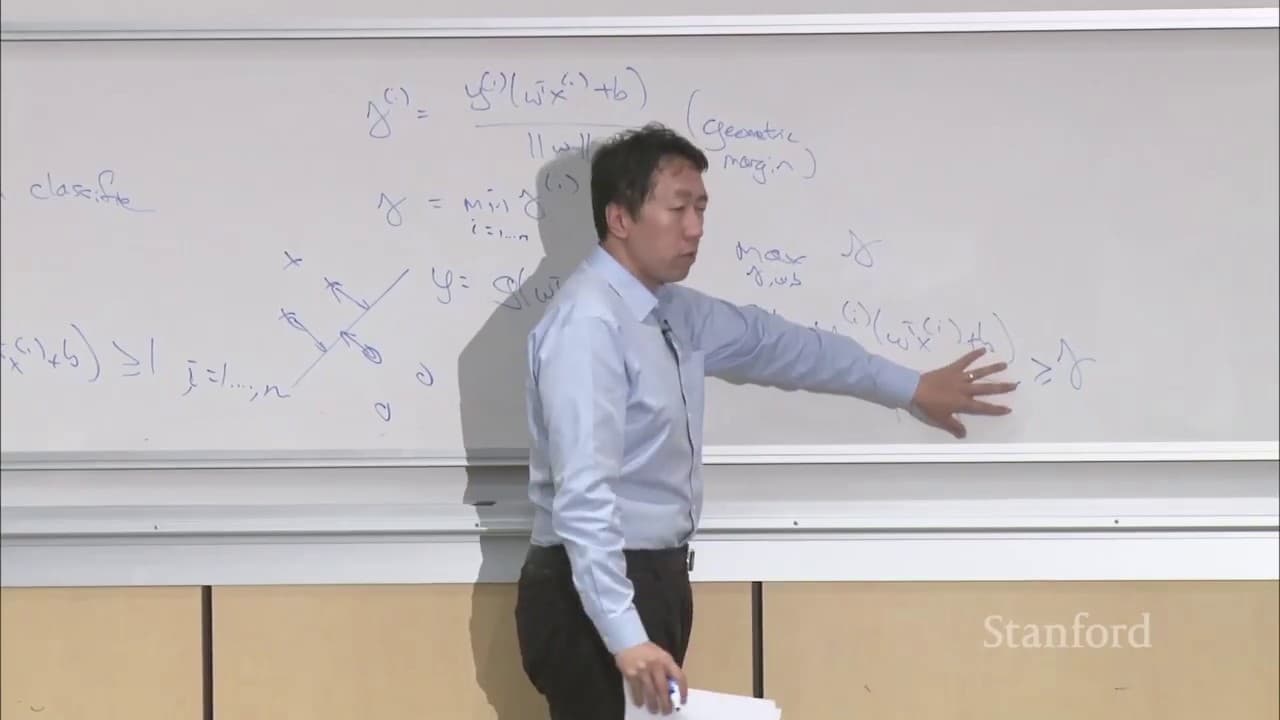
Support Vector Machines (SVMs) are classification algorithms that work by finding the best decision boundary to separate data while maximizing the geometric margin. The kernel trick enables SVMs to effectively operate in high-dimensional feature spaces, allowing them to tackle non-linear data separability. This method makes SVMs versatile and powerful for various classification tasks.
Transcript
All right. Good morning. Um, let's get started. So, ah, today you'll see the Support Vector Machine Algorithm. Um, and this is one of my favorite algorithms because it's very turnkey, right? If you have a classification problem, um, you just, kind of, run it and it more or less works. So in particular, I'll talk a bit more about the optimization pr... Read More
Key Insights
- ❓ SVMs are a powerful algorithm for classification problems, providing a turnkey solution for separating different categories of data.
- 👻 The kernel trick is a mathematical technique that allows SVMs to work efficiently in high-dimensional feature spaces.
Install to Summarize YouTube Videos and Get Transcripts
Explore YouTube Video Summarizer or Get YouTube Transcript Extractor
Questions & Answers
Q: How does the support vector machine algorithm work?
The support vector machine algorithm aims to find the decision boundary with the largest geometric margin and separate data into different categories. It works by iteratively optimizing an objective function to find the best parameters for the decision boundary.
Q: What is the role of the kernel trick in SVMs?
The kernel trick is a mathematical technique used in SVMs to efficiently work in high-dimensional feature spaces. It transforms feature vectors into a high-dimensional space and uses an inner product to measure the similarity between the transformed vectors.
Q: What is the L1 norm soft margin SVM and why is it useful?
The L1 norm soft margin SVM is an extension of the SVM algorithm that allows for some misclassification of data. It adds a penalty term to the optimization objective, which improves robustness to outliers and makes the decision boundary generalize better to unseen data.
Q: How are kernels used in SVMs?
Kernels in SVMs are used as a measure of similarity between feature vectors. They allow SVMs to work efficiently in high-dimensional spaces by computing inner products between feature vectors without explicitly mapping them to a high-dimensional space.
Summary & Key Takeaways
-
Support Vector Machines (SVMs) are a turnkey algorithm for classification problems that work well in high-dimensional feature spaces.
-
SVMs aim to find the decision boundary with the largest geometric margin to separate different categories of data.
-
The kernel trick allows SVMs to work efficiently in high-dimensional feature spaces and handles non-linear separable data.
-
The L1 norm soft margin SVM is an extension of SVMs that allows some misclassification and uses a penalty term to account for outliers.
Read in Other Languages (beta)
Share This Summary 📚
Summarize YouTube Videos and Get Video Transcripts with 1-Click
Try YouTube Summary with ChatGPT & Claude or YouTube Transcript Generator
Explore More Summaries from Stanford Online 📚

Summarize YouTube Videos and Get Video Transcripts with 1-Click
Try YouTube Summary with ChatGPT & Claude or YouTube Transcript Generator