What Are Policy Gradient Methods in Reinforcement Learning?

TL;DR
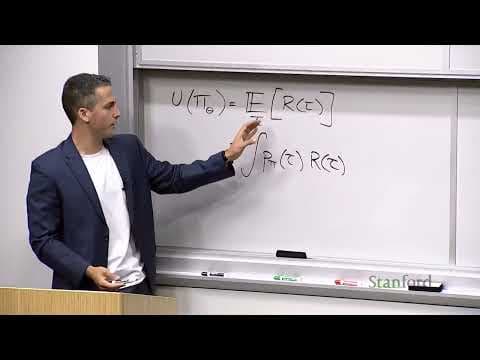
Policy gradient methods optimize the parameters of a policy by calculating the gradient of expected rewards with respect to these parameters. They are effective for learning in high-dimensional and continuous action spaces, particularly useful in various applications such as robotics, by allowing for the development of stochastic policies.
Transcript
All right. We're gonna go ahead and get started. Um, homework two, it should be well underway. If you have any questions feel, feel free to reach out to us. Um, [NOISE] project proposals, if you have questions about that, feel free to come to our office hours or to reach out, um, via Piazza. Somebody have any other questions I can answer right now?... Read More
Key Insights
- 🫡 Policy gradient methods optimize policy parameters by taking the gradient of expected rewards with respect to the parameters.
- 👾 These methods are suitable for learning in high-dimensional and continuous action spaces, making them ideal for robotics applications.
Install to Summarize YouTube Videos and Get Transcripts
Explore YouTube Video Summarizer or Get YouTube Transcript Extractor
Questions & Answers
Q: What are policy gradient methods?
Policy gradient methods are a class of reinforcement learning algorithms that optimize policy parameters by taking the gradient of expected rewards with respect to the parameters.
Q: How do policy gradient methods handle high-dimensional state and action spaces?
Policy gradient methods are well-suited for high-dimensional and continuous action spaces, allowing for efficient learning and optimization in these domains.
Q: What are the advantages and disadvantages of policy gradient methods?
Policy gradient methods offer flexibility in learning stochastic policies, efficient optimization in high-dimensional spaces, and the ability to encode domain knowledge. However, policy gradient methods typically converge to a local optimum and may require large amounts of data to estimate the gradient accurately.
Q: How can policy gradient methods be useful in robotics applications?
Policy gradient methods have been successfully used in robotics applications such as optimizing robot gaits and training exoskeleton assistance patterns. These methods allow for the learning of complex policies in robotic systems with high-dimensional state and action spaces.
Summary & Key Takeaways
-
Policy gradient methods are widely used in reinforcement learning for optimizing policy parameters to maximize expected rewards.
-
These methods allow for learning in high-dimensional and continuous action spaces, making them suitable for a wide range of applications.
-
Policy gradient methods leverage the temporal structure of decision-making problems to estimate the gradient of the policy parameters efficiently.
Read in Other Languages (beta)
Share This Summary 📚
Summarize YouTube Videos and Get Video Transcripts with 1-Click
Try YouTube Summary with ChatGPT & Claude or YouTube Transcript Generator
Explore More Summaries from Stanford Online 📚

Summarize YouTube Videos and Get Video Transcripts with 1-Click
Try YouTube Summary with ChatGPT & Claude or YouTube Transcript Generator