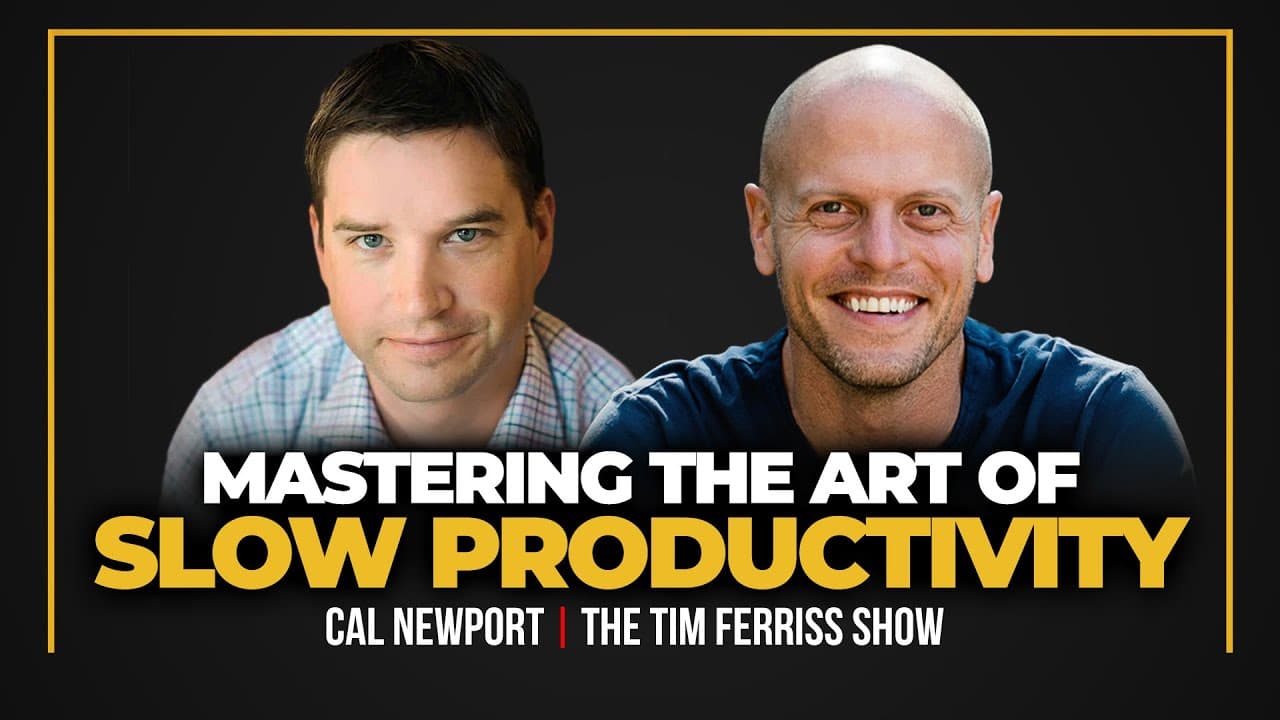
What Is Slow Productivity and How Can It Benefit You?
TL;DR
Slow productivity focuses on producing high-quality work over simply increasing output, helping to avoid burnout and fostering a more meaningful engagement with tasks. Key principles include obsessing over quality, doing fewer things, and working at a natural pace—allowing individuals to find fulfillment and create a sustainable work-life balance.
Transcript
and if that's all you're doing you're just building up this negative attitude towards work which I think by the way is a one of the dominant reactions to burnout right now in let's say Elite culture it's just an allout rejection of work itself like well any drive to do things is it's a it's a capitalist construction and the real thing to do is just... Read More
Key Insights
- 🥺 Slow productivity encourages individuals to prioritize excellence over productivity, ultimately leading to more fulfilling work and sustainable success.
- 🧑⚕️ Traditional knowledge workers, such as artists, philosophers, and scientists, serve as examples of slow productivity, as they have historically approached their work with patience and a commitment to quality.
- 🔆 Slow productivity requires discernment in selecting the right projects to pursue and a deep understanding of what constitutes high-quality work.
Install to Summarize YouTube Videos and Get Transcripts
Explore YouTube Video Summarizer or Get YouTube Transcript Extractor
Questions & Answers
Q: How does slow productivity differ from traditional productivity approaches?
Slow productivity prioritizes quality over quantity, encouraging individuals to focus on excellence in their work rather than chasing after a high volume of tasks. It emphasizes sustained effort and deliberate practice.
Q: Can slow productivity be incorporated into corporate or remote work settings?
Absolutely. Slow productivity is a mindset and approach that can be adapted to any work environment. It involves being intentional with your time and dedicating focused attention to producing high-quality work.
Q: What are some of the challenges and trade-offs of choosing slow productivity?
Slow productivity may require individuals to prioritize deep work and say no to certain tasks or opportunities. It requires patience and a long-term perspective, as results may take longer to materialize. Additionally, it may be necessary to resist the cultural pressure to constantly be busy or hustle.
Q: How does slow productivity contribute to work-life balance?
By focusing on quality work and avoiding burnout, slow productivity allows individuals to find a better balance between work and personal life. It creates the opportunity to engage more deeply in meaningful activities while still maintaining professional success.
Summary & Key Takeaways
-
Slow productivity emphasizes the importance of obsessing over quality rather than solely focusing on doing less or being busy.
-
Traditional knowledge workers, such as Isaac Newton and Lyn-Manuel Miranda, exemplify the principles of slow productivity by dedicating time and effort to their craft over a longer period.
-
Embracing slow productivity requires discernment to choose the right ideas or projects to pursue and develop a deep understanding of what makes them successful.
Read in Other Languages (beta)
Share This Summary 📚
Summarize YouTube Videos and Get Video Transcripts with 1-Click
Try YouTube Summary with ChatGPT & Claude or YouTube Transcript Generator
Explore More Summaries from Tim Ferriss 📚





Summarize YouTube Videos and Get Video Transcripts with 1-Click
Try YouTube Summary with ChatGPT & Claude or YouTube Transcript Generator