How to Train for Competitive HYROX Performance
TL;DR
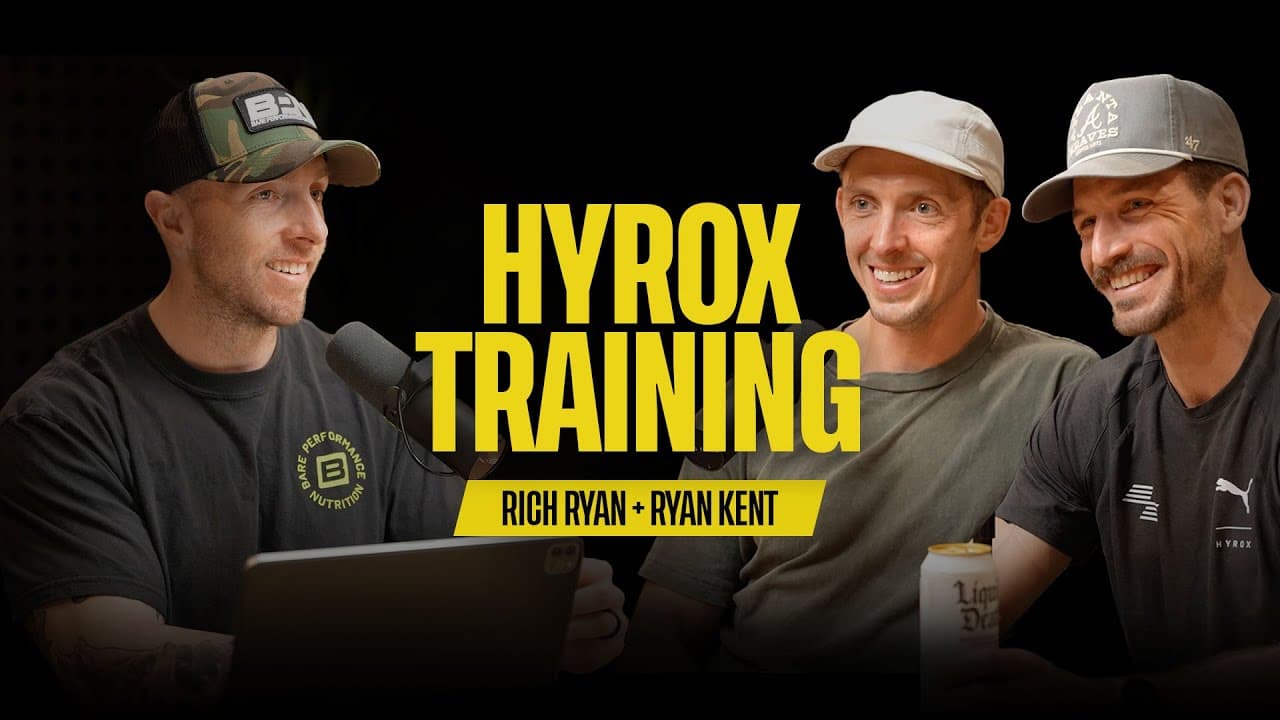
Competitive HYROX performance depends heavily on faster running, fatigue resistance, and the ability to sustain power across repeated stations. Athletes can expand aerobic capacity through skiing, rowing, cycling, and running while limiting excessive lower-body impact, but they must also practice high-intensity efforts, fuel consistently, and prepare for course variables such as flooring and sled friction.
Transcript
today on the podcast we have Rich Ryan and Ryan Kent and we're talking what it takes to be a competitive hybrid athlete what's up boys dude thanks for having us man to be absolutely it's great to be here appreciate really looking forward to chatting been a nice em run this morning yeah I feel like that's just the best way to just kick things off ge... Read More
Key Insights
- The Elite 15 is HYROX's top competitive track, with qualification based on combined race times and results at major events. Athletes who advance through the majors can reach the Elite 15 World Championships, while a major victory may provide automatic qualification for the following season.
- Professional status in HYROX depends on how the term is defined. Elite 15 athletes compete at the pinnacle of the sport, but not everyone in the field earns enough from competition to support a professional lifestyle or participates in HYROX as an exclusive occupation.
- HYROX courses are designed to be standardized across locations, but venue conditions still influence results. Differences in floor surfaces and carpet friction can change the difficulty of sled pushing and pulling, making direct comparisons between finishing times imperfect even when the prescribed competition format remains consistent.
- HYROX participation and competitive depth have increased substantially since the first United States event in Miami in 2019, which drew roughly 400 people. More recent weekends have accommodated thousands, including 13,000 participants in Birmingham, while broader access to training has attracted increasingly capable athletes.
- Running is about 50 percent of a HYROX race, so it offers the greatest opportunity to reduce overall finishing time. Individual stations such as skiing, sled pushing, and burpees occupy much smaller shares, meaning improvements in running pace can affect the result more substantially.
- Erg training is a low-impact way to expand aerobic capacity without repeatedly stressing the legs through running. Skiing and rowing use fixed movement patterns and can support oxygen delivery, conditioning, recovery, and sustainable power, even though their improvements do not transfer to running on a one-to-one basis.
- Stay power is the ability to sustain a high output as fatigue accumulates. Rich Ryan and Ryan Kent connect it with fatigue resistance, strong running, overall athletic strength, and maintaining power for the duration of a hybrid event rather than producing only a brief peak effort.
- Wall-ball proficiency can materially change a beginner's HYROX result. Ryan Kent recalls needing almost eight minutes to complete 100 wall balls during his first race, but focused training helped him progress from nearly 68 minutes overall to a personal best of 55:12.
Install to Summarize YouTube Videos and Get Transcripts
Explore YouTube Video Summarizer or Get YouTube Transcript Extractor
Questions & Answers
Q: What is the HYROX Elite 15 qualification system?
The Elite 15 is HYROX's top competitive qualification track. Athletes can qualify through their two best combined general-course times during the season, then use the major events as a route toward the Elite 15 World Championships. The system also rewards major victories. Ryan Kent explains that winning the Chicago major in November 2023 automatically placed him in the Elite 15 for the following season.
Q: Does competing in the Elite 15 make someone a professional athlete?
Competing in the Elite 15 places an athlete at the pinnacle of HYROX competition, but it does not automatically make that athlete a professional under every definition. Rich Ryan and Ryan Kent distinguish competitive level from financial sustainability. Some Elite 15 athletes may be called professionals because they race in the highest field, yet not everyone supports their life entirely through the sport.
Q: Why can HYROX finishing times vary between venues?
HYROX attempts to make its courses consistent across locations, but venue-specific conditions cannot be completely controlled. The floor surface and the friction between the carpet and sled can affect how difficult the sled push or pull becomes. Consequently, athletes may encounter meaningfully different resistance in Austin, Hong Kong, or another venue despite competing under the same general race structure.
Q: Which part of HYROX training offers the greatest potential time improvement?
Running offers the greatest opportunity because the eight one-kilometer segments collectively account for about 50 percent of the competition. By comparison, skiing, sled pushing, and burpees each represent only a small percentage of total race time. Station training remains necessary, but improving the pace an athlete can repeatedly sustain between stations can produce the largest overall reduction in finishing time.
Q: How do skiing and rowing support HYROX preparation?
Skiing and rowing can build aerobic capacity while reducing the lower-body impact associated with additional running. Their fixed movement patterns allow athletes to accumulate substantial conditioning work and recover more easily than they might from equally large running volumes. These machines also help develop power output, supporting the broader HYROX requirement to sustain power across both running segments and exercise stations.
Q: What does stay power mean for a hybrid athlete?
Stay power means sustaining a high output over the duration of an event despite accumulating fatigue. It is closely related to fatigue resistance rather than a single burst of maximum performance. For a HYROX athlete, it involves remaining a strong runner and capable all-around athlete while continuing to produce useful power through repeated runs and stations without a severe decline in output.
Q: How much did focused training improve Ryan Kent's HYROX time?
Ryan Kent says his first HYROX took nearly 68 minutes, with the 100 wall balls alone requiring almost eight minutes after he became severely fatigued. He believed focused preparation could make him highly competitive and committed fully to the sport. That work eventually produced a personal best of 55:12, an improvement of more than twelve minutes from his initial result.
Q: How fast might elite HYROX performances become?
The discussion suggests that future improvement will depend primarily on faster running and better recovery after demanding stations, particularly the sled push and pull. With the world record described as a low 53-minute result and recent athletes recording times in the 54-minute range, the guests consider a sub-50-minute performance possible someday, although they do not present a precise timetable or required pace.
Summary & Key Takeaways
-
Rich Ryan and Ryan Kent describe the Elite 15 as HYROX's top competitive qualification track. Athletes can enter through combined general-course results or qualify at major races, while winning a major can secure automatic entry for the following season. Reaching this field represents the sport's highest level, although it does not necessarily provide a full professional income.
-
HYROX has grown from an event of roughly 400 participants in Miami in 2019 to weekends serving thousands of competitors, including 13,000 in Birmingham. As participation and athletic quality rise, finishing times continue to improve. Course standardization remains difficult because flooring, carpet friction, and venue conditions can materially affect sled performance and overall results.
-
Running accounts for about half of a HYROX competition, making it the largest opportunity for meaningful time improvements. Skiing, rowing, and cycling can develop aerobic capacity and sustainable power without producing the same impact as additional running. Successful preparation combines this large aerobic base with station skills, high-intensity exposure, sound pacing, recovery, nutrition, and fatigue resistance.
Read in Other Languages (beta)
Share This Summary 📚
Summarize YouTube Videos and Get Video Transcripts with 1-Click
Try YouTube Summary with ChatGPT & Claude or YouTube Transcript Generator
Explore More Summaries from The Nick Bare Podcast 📚



Summarize YouTube Videos and Get Video Transcripts with 1-Click
Try YouTube Summary with ChatGPT & Claude or YouTube Transcript Generator