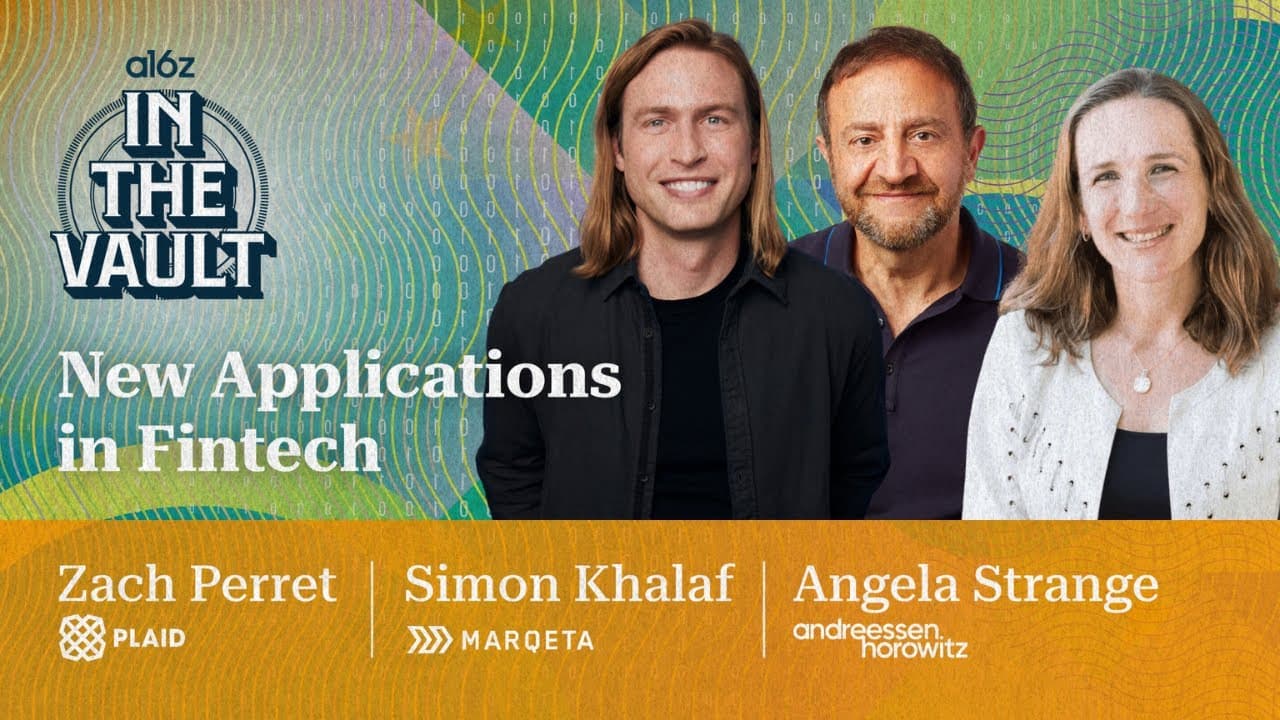
What Are the New Applications in Fintech for AI, Fraud Detection, and Digital Payment Cards?
TL;DR
New applications in fintech include AI-powered credit modeling, real-time fraud detection, cleaner transaction data, and digital payment cards that personalize rewards and influence purchases. Credit modeling could change significantly within 3 to 5 years, while AI-generated identity materials already threaten standard verification methods. Read on to understand how embedded finance and programmable cards could reshape financial services.
Transcript
that's why I hope in the next two years the word fintech will will disappear and it will be embedded Finance because they've got distributions they've got the consumer right so let's start with generative Ai No Joke you promised us you were starting with a joke I have I have many jokes none of them were uh quite acceptable for the audience I I do h... Read More
Key Insights
- 💳 Fintech is moving towards becoming fully fintech-enabled, leveraging AI to disrupt areas such as credit modeling and fraud detection.
- 👾 Embedded finance presents an opportunity for every company to enter the fintech space and leverage their existing distribution and consumer base.
- 🤗 The digitalization of payment cards opens up new avenues for consumer engagement and personalized rewards.
Install to Summarize YouTube Videos and Get Transcripts
Explore YouTube Video Summarizer or Get YouTube Transcript Extractor
Questions & Answers
Q: What are the new applications of AI in fintech?
The speakers identify credit modeling, fraud detection, transaction-data cleaning, customer support, and engineering efficiency as important applications. They expect credit modeling and fraud detection to undergo especially significant changes.
Q: How could AI transform credit modeling?
AI could drive major changes in credit modeling within roughly 3 to 5 years. The pace depends partly on regulation, with the speaker describing the United States as more constrained than much of Europe.
Q: Why is generative AI creating new identity-verification risks?
Common verification checks include an ID photo, data entry or document scanning, and a selfie liveness check. The speakers warn that every one of these elements can now be manufactured with AI, with generated liveness checks presenting the most concerning threat.
Q: How could fintech companies respond to AI-generated identity fraud?
Financial services companies need tools that can detect AI-generated verification materials. The discussion also suggests that the industry may need to shift toward passkeys if selfie liveness checks can no longer serve as a dependable pillar of fraud reduction.
Q: What role does embedded finance play in the future of fintech?
Embedded finance lets companies combine their existing distribution and consumer relationships with financial products. One speaker hopes the word fintech will disappear within the next two years because finance will become embedded across companies.
Q: Why are digital payment cards described as engagement products?
A payment card is used 2.2 times a day, compared with TikTok usage of 2.1 times a day after adjustment for the United States adult population reach. The speaker argues that turning the card from plastic into a digital product gives brands a frequently used channel for engagement.
Q: How can digital payment cards change consumer behavior?
A card can be generated instantly for the right consumer, merchant, purchase, and moment, with a tailored visual design. Its reward can also be dynamically selected to increase the consumer's propensity to purchase.
Q: How could personalized card rewards differ from standard cash back?
Instead of always providing a fixed 3% cash back, a machine-generated offer could sometimes return 40% and sometimes nothing. The reward would vary according to the goal of increasing purchase propensity.
Summary & Key Takeaways
-
Definition: Embedded finance combines financial products with a company's existing distribution and consumer relationships.
-
When: One speaker hopes the word fintech will disappear within the next two years as finance becomes embedded.
-
When: AI could massively transform credit modeling over the next 3 to 5 years, depending partly on regulation.
-
Tool: AI is being used to improve engineering efficiency, support, transaction-data cleaning, identity verification, and fraud detection.
-
Definition: Standard identity verification can involve an ID photo, data entry or document scanning, and a selfie liveness check.
-
Compare: AI can manufacture each standard verification element, with generated selfie liveness checks described as the scariest threat.
-
Number: Consumer fraud losses reached 10 billion dollars last year, according to the discussion.
-
Compare: TikTok usage is 2.1 times a day, while a payment card is used 2.2 times a day.
-
Definition: A digital payment card becomes an engagement product that brands can use to influence consumer behavior.
-
Tool: Cards can be generated for the right consumer, merchant, purchase, time, and visual appearance.
-
Compare: Machine-generated rewards could replace fixed 3% cash back with offers ranging from 40% back to nothing.
Read in Other Languages (beta)
Share This Summary 📚
Summarize YouTube Videos and Get Video Transcripts with 1-Click
Try YouTube Summary with ChatGPT & Claude or YouTube Transcript Generator
Explore More Summaries from a16z 📚






Summarize YouTube Videos and Get Video Transcripts with 1-Click
Try YouTube Summary with ChatGPT & Claude or YouTube Transcript Generator