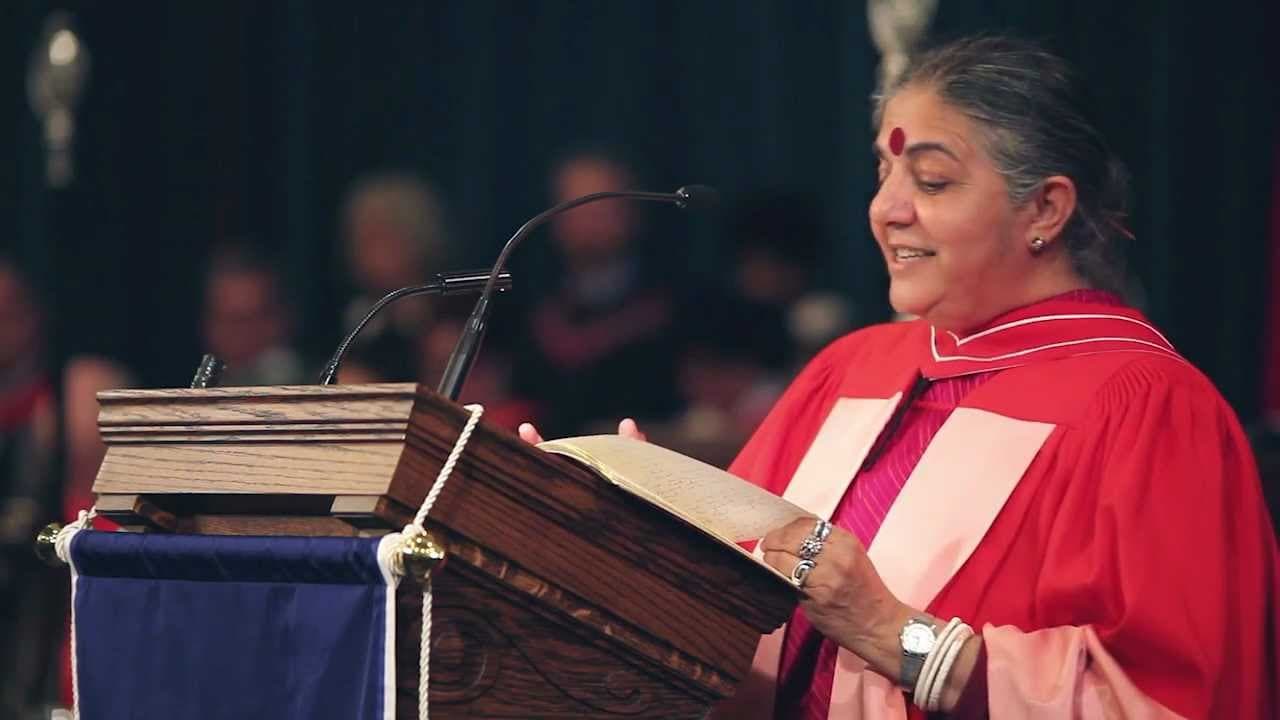
University of Toronto: Dr Vandana Shiva, Convocation 2012 Honorary Degree recipient
TL;DR
Dr Vandana Shiva argues that human well-being depends on recognizing the interconnectedness of nature, food, biodiversity, and society. Drawing on her PhD work on non-separability in quantum theory, she presents diversity as the basis of resilience and criticizes patents on life, monocultures, and food speculation. Her examples include millets that use one-tenth the water of industrial crops and provide 40 to 50 times more nutrition. Read on for her lessons on abundance, cooperation, and ecological responsibility.
Transcript
thank you very much mr chancellor and to the university of toronto for honoring me with this andrei doctorate and to the graduates who will receive their degrees today congratulations you're entering a new world and all i can do today is share with you my journey and how in that journey nothing was irrelevant one would imagine my phd in the foundat... Read More
Key Insights
- 😋 The speaker's journey from quantum theory to food and agriculture systems highlights the interconnectedness of different disciplines and areas of study.
- 😅 Our actions, including what we eat and how we interact with nature, have direct impacts on our bodies, communities, and the planet as a whole.
- 😋 Biodiversity is critical for food security and can be found in even the smallest and most overlooked components of ecosystems.
- 🖐️ Women's knowledge and contributions in agriculture often go unrecognized, yet they play a vital role in preserving biodiversity and traditional practices.
- 🤔 Linear thinking and monocultures are limiting and leave us vulnerable, while embracing diversity fosters resilience and abundance.
- 😋 Speculation in the food market can have real impacts on people's right to food, highlighting the need for a more sustainable and equitable approach to agriculture.
- 🥺 Recognizing the interconnectedness of life and embracing diversity can lead to a more sustainable and harmonious future.
Install to Summarize YouTube Videos and Get Transcripts
Explore YouTube Video Summarizer or Get YouTube Transcript Extractor
Questions & Answers
Q: What was Dr Vandana Shiva’s central message at the University of Toronto convocation?
Dr Vandana Shiva’s central message was that all life is interconnected and that humans are strands within the web of life, not separate from nature. She argued that recognizing this interdependence, and valuing biodiversity, cooperation, caring, and sharing, is essential for genuine abundance and well-being.
Q: How does Vandana Shiva connect quantum theory with food and agriculture?
Her PhD examined non-separability and non-locality in quantum phenomena. She connects non-separability with ecology’s principle that life is interconnected, making her background in quantum theory directly relevant to her work on food and agricultural systems.
Q: Why does Vandana Shiva consider biodiversity essential for food security?
She says even soil microbes that cannot be seen are a real source of food security, while tiny plants can provide vital healing. Diversity also creates resilience, whereas monocultures are highly vulnerable.
Q: What does Vandana Shiva say about patents on seeds and living resources?
She calls patents on plants, seeds, and biodiversity a deep aberration because people did not invent that life. She says that taking biological knowledge or resources from a community without permission is biopiracy.
Q: Why does Vandana Shiva describe millets as crops for the future?
She says millets use one-tenth of the water required by industrial crops and provide 40 to 50 times more nutrition. She also explains that each tiny seed produces a million seeds, making millets an example of natural abundance.
Q: What role do women play in preserving agricultural knowledge?
Shiva says rural women preserve knowledge about seeds, medicinal plants, and biodiversity across generations. Although these women may be labeled illiterate or unproductive, she describes them as daily teachers whose knowledge embodies centuries of continuity, caring, and sharing.
Q: How can food-market speculation affect access to food?
Shiva states that 33 percent of speculation is around food and notes that traders may trade wheat they will never see. She argues that such imaginary transactions still affect the price and availability of real wheat, influencing the right to food of people such as a child in Africa or a woman in India.
Q: Why does Vandana Shiva favor diversity over linearity and monoculture?
She argues that linear thinking narrows possibilities and creates panic when a single expected path disappears, while cycles demonstrate renewal. Diversity and multiplicity encourage cooperation and give-and-take, creating resilience in both ecology and culture; monocultures, by contrast, are highly vulnerable.
Summary & Key Takeaways
-
The speaker discusses the connection between their PhD in quantum theory and their work in food and agriculture systems, emphasizing the concept of interconnectedness.
-
They highlight the importance of recognizing our interdependence with nature and how every action we take affects the web of life.
-
The speaker emphasizes the significance of biodiversity, the role of women in agriculture, and the potential of diverse crops like millets for the future.
Read in Other Languages (beta)
Share This Summary 📚
Summarize YouTube Videos and Get Video Transcripts with 1-Click
Try YouTube Summary with ChatGPT & Claude or YouTube Transcript Generator
Explore More Summaries from University of Toronto 📚
Summarize YouTube Videos and Get Video Transcripts with 1-Click
Try YouTube Summary with ChatGPT & Claude or YouTube Transcript Generator