What Are 5 Games to Improve Thinking in English?
TL;DR
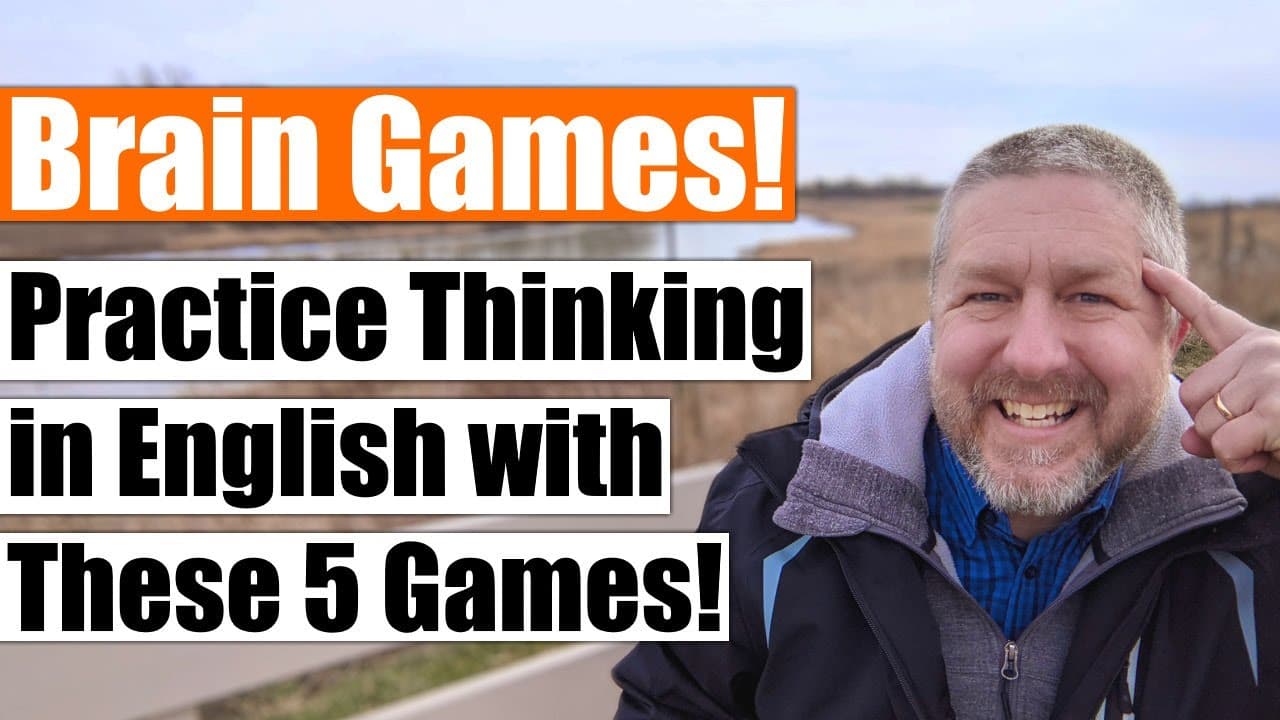
Five games can help improve your ability to think in English: the Alphabet Game, Connection Game, Opposites Game, Questions You Might Ask, and I Like, I Don’t Like. These games enable you to practice vocabulary, connections, descriptive language, and social questions, all while engaging your mind in various everyday situations.
Transcript
- Hi, Bob the Canadian here. Welcome to this English lesson where I'm going to teach you four different games that you can play with your own mind in order to practice and improve your English. These are games that you can play when you're by yourself, maybe sitting on the subway, maybe when you're driving, maybe if you're sitting on something like... Read More
Key Insights
- 🤯 Mind games provide a fun and convenient way to practice and improve English skills.
- 👷 The Alphabet Game helps with vocabulary and sentence construction.
- ❓ The Connection Game enhances cognitive ability and fluency.
- ❓ The Opposites Game expands vocabulary and reinforces understanding of antonyms.
- 🤔 The Questions You Might Ask Game improves conversational skills and the ability to think in English in social situations.
- 🎮 These games can be played alone and require only imagination, making them suitable for various settings.
- 🤔 Engaging in these games trains the mind to think in English, leading to better language proficiency.
Install to Summarize YouTube Videos and Get Transcripts
Explore YouTube Video Summarizer or Get YouTube Transcript Extractor
Questions & Answers
Q: What five brain games can help you learn to think in English?
The five games are the Alphabet Game, Connection Game, Opposites Game, Questions You Might Ask, and I Like, I Don’t Like. They prompt you to mentally produce English words, phrases, sentences, descriptions, questions, and reasons based on your surroundings.
Q: How do you play the Alphabet Game in English?
Look for something beginning with A, then something beginning with B, and continue through the alphabet. To make the game harder, say each word and use it in a sentence, such as “Apple” followed by “Apples are delicious.”
Q: How does the Connection Game work?
Start with something you see and create a chain of connected English words. For example, the transcript connects pizza, cheese, milk, cow, and farm.
Q: How can you make the Connection Game more difficult?
Use complete phrases or sentences instead of individual words. One example chain is: pizza has cheese on it, cheese is made from milk, milk comes from cows, and cows live on farms.
Q: How do you play the Opposites Game?
Describe a person or object, then immediately think of an English word with the opposite meaning. Examples include tall and short, fast and slow, or sunny and cloudy.
Q: How do you play the Questions You Might Ask game?
Look at people around you and mentally form questions you could ask them without actually asking. Examples include “What book are you reading?”, “How long have you worn glasses?”, and “Where did you buy that hat?”
Q: How do you play the I Like, I Don’t Like game?
Respond to each thing you see by deciding whether you like it or dislike it, then explain why in English. For example, you might say, “I don’t like pizza because I don’t like how it tastes.”
Q: Where and how can you practice these English brain games?
You can play them alone while sitting on the subway, driving, walking through a shopping mall, looking out a train window, or sitting on a park bench. You can imagine the responses silently, whisper or say them aloud, or write the words and phrases on paper.
Summary & Key Takeaways
-
Learn the Alphabet Game where you find objects starting with each letter of the alphabet and use them in sentences.
-
Play the Connection Game by connecting words or phrases that are related to each other.
-
Engage in the Opposites Game and think of the opposite word or phrase for a given description.
-
Practice the Questions You Might Ask Game by thinking of interesting questions for people you see around you.
Read in Other Languages (beta)
Share This Summary 📚
Summarize YouTube Videos and Get Video Transcripts with 1-Click
Try YouTube Summary with ChatGPT & Claude or YouTube Transcript Generator
Explore More Summaries from Learn English with Bob the Canadian 📚


Summarize YouTube Videos and Get Video Transcripts with 1-Click
Try YouTube Summary with ChatGPT & Claude or YouTube Transcript Generator