When Will Super Intelligence Arrive?
TL;DR
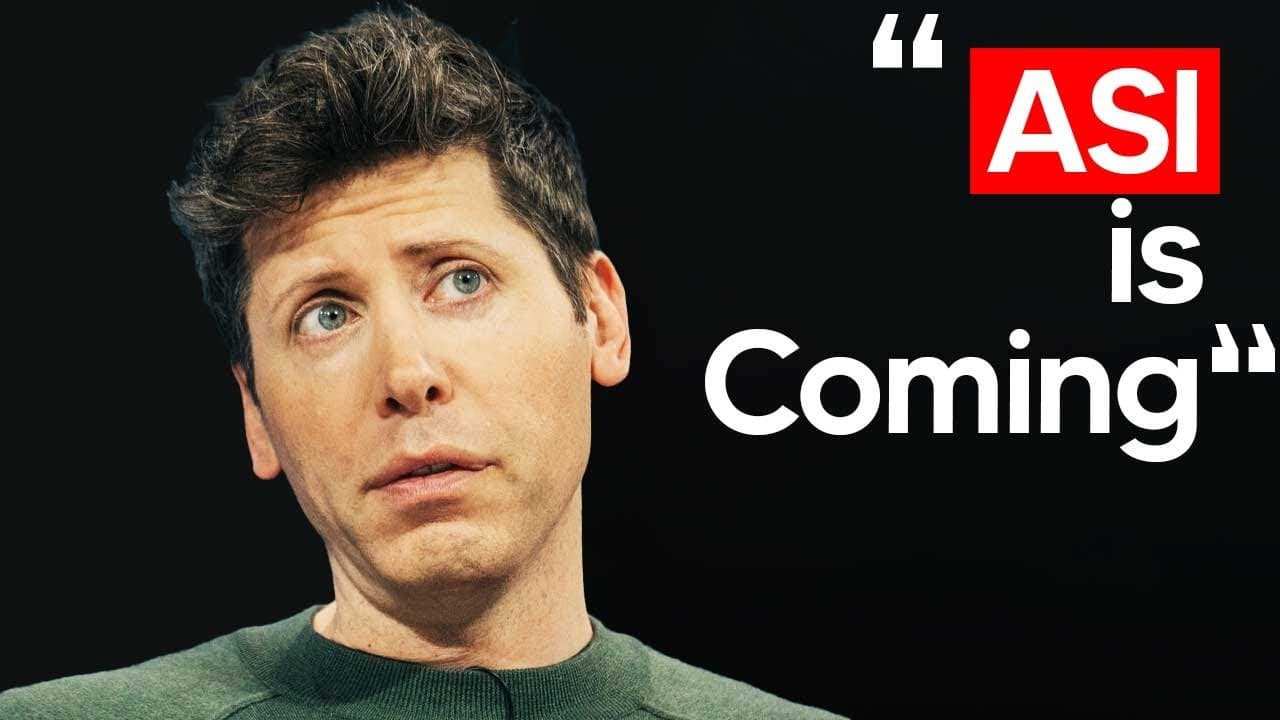
Super intelligence may soon be achievable, with Sam Altman suggesting a timeline of around 3,500 days. The September Manifesto sheds light on how AI advancements will shape society, especially in scientific progress. While optimism grows about reaching ASI, experts like Gary Marcus caution against overestimation of its capabilities by 2027.
Transcript
so recently Sam Alman was interviewed by the Free Press and it was a fascinating interview because for the first time he actually talked at length about super intelligence now super intelligence is something that we don't frequently get talks about because essentially that's something that's often seen as something that is t... Read More
Key Insights
- Sam Altman believes super intelligence may be achievable within a few thousand days, indicating rapid AI advancements.
- The September Manifesto provides a detailed outlook on the future societal impacts of AI, AGI, and ASI.
- Scientific progress is expected to accelerate significantly with ASI, potentially transforming research and development.
- The timeline for achieving ASI is speculative but could be around 3,500 days, as per Altman's estimates.
- AI systems are predicted to become agentic, capable of reasoning and self-awareness, leading to unpredictable behavior.
- There is a growing consensus among industry leaders that a direct path to ASI is becoming increasingly probable.
- AI's ability to achieve superhuman performance on benchmarks may lead to breakthroughs in various fields by 2027.
- Critics like Gary Marcus question AI's ability to perform complex tasks autonomously by 2027, highlighting ongoing challenges.
Install to Summarize YouTube Videos and Get Transcripts
Explore YouTube Video Summarizer or Get YouTube Transcript Extractor
Questions & Answers
Q: What is the significance of the September Manifesto mentioned by Sam Altman?
The September Manifesto is a significant document that provides a comprehensive outlook on the future implications of AI, AGI, and ASI. It offers insights into how these technologies will shape society and the economy, highlighting the rapid advancements and potential transformations in various fields. Altman emphasizes its importance in understanding the trajectory of AI development.
Q: How does Sam Altman envision the impact of ASI on scientific progress?
Sam Altman envisions ASI having a profound impact on scientific progress by significantly accelerating research and development. He suggests that ASI could enable scientific discoveries and technological advancements to occur at a much faster rate, potentially transforming the landscape of research. This acceleration could lead to breakthroughs that were previously unimaginable, reshaping various scientific fields.
Q: What timeline does Sam Altman suggest for the arrival of ASI?
Sam Altman suggests that ASI could potentially arrive within a few thousand days, with a speculative timeline of around 3,500 days. This estimate is based on the current rate of AI advancements and the potential for continued progress. However, he acknowledges that this timeline is subject to speculation and various factors could influence the actual arrival of ASI.
Q: What challenges are associated with making AI systems agentic and capable of reasoning?
Making AI systems agentic and capable of reasoning presents several challenges, including the unpredictability of reasoning processes. Current AI models exhibit superhuman performance on evaluations but lack true agency and reasoning capabilities. Achieving these qualities would require significant advancements in AI model design and training, as well as addressing issues related to self-awareness and decision-making processes.
Q: How do industry leaders view the possibility of a direct path to ASI?
Industry leaders are increasingly optimistic about the possibility of a direct path to ASI, driven by advancements in AI models, computing power, and scaling techniques. They believe that continued progress in these areas could lead to the realization of ASI within a foreseeable timeframe. However, this optimism is tempered by the recognition of potential challenges and uncertainties in achieving such a milestone.
Q: What concerns do critics like Gary Marcus have about AI's capabilities by 2027?
Critics like Gary Marcus express concerns about AI's ability to autonomously perform complex tasks by 2027. They question whether AI systems can achieve long-form coherence, creativity, and reasoning without significant human involvement. These concerns highlight ongoing challenges in AI development, including issues related to AI's predictability, understanding, and the ability to perform tasks at a human-like level.
Q: What insights does Logan Kilpatrick provide about the future of ASI?
Logan Kilpatrick, from Google AI, suggests that a direct path to ASI is becoming increasingly probable, supported by advancements in scaling test-time compute and AI models. He indicates that the success of these approaches could lead to significant breakthroughs, bringing ASI closer to reality. Kilpatrick's insights emphasize the importance of continued research and development in achieving ASI.
Q: What potential transformations could ASI bring to various fields by 2027?
By 2027, ASI could potentially transform various fields by achieving superhuman performance on benchmarks and enabling unprecedented advancements. This could lead to breakthroughs in scientific research, technological development, and problem-solving capabilities. ASI's impact could extend to areas such as healthcare, engineering, and data analysis, revolutionizing the way these fields operate and contributing to significant societal and economic changes.
Summary & Key Takeaways
-
Sam Altman discusses the potential arrival of artificial super intelligence (ASI) within a few thousand days, emphasizing rapid advancements in AI. The September Manifesto provides insights into how AI, AGI, and ASI will shape society. Altman highlights the significant impact ASI could have on scientific progress and research scalability.
-
The timeline for achieving ASI remains speculative, with Altman suggesting it could be around 3,500 days away. Industry leaders express optimism about a direct path to ASI, driven by advancements in AI models and computing power. However, challenges remain in making AI systems agentic, capable of reasoning and self-awareness.
-
Critics like Gary Marcus question AI's ability to autonomously perform complex tasks by 2027, highlighting potential limitations. Despite differing opinions, the discussion around ASI continues to evolve, with industry figures providing valuable insights into the future of AI and its transformative potential.
Read in Other Languages (beta)
Share This Summary 📚
Summarize YouTube Videos and Get Video Transcripts with 1-Click
Try YouTube Summary with ChatGPT & Claude or YouTube Transcript Generator
Explore More Summaries from TheAIGRID 📚




Summarize YouTube Videos and Get Video Transcripts with 1-Click
Try YouTube Summary with ChatGPT & Claude or YouTube Transcript Generator