The incredible sport of cup stacking, explained
TL;DR
Sport stacking is a competitive and mesmerizing activity gaining global popularity.
Transcript
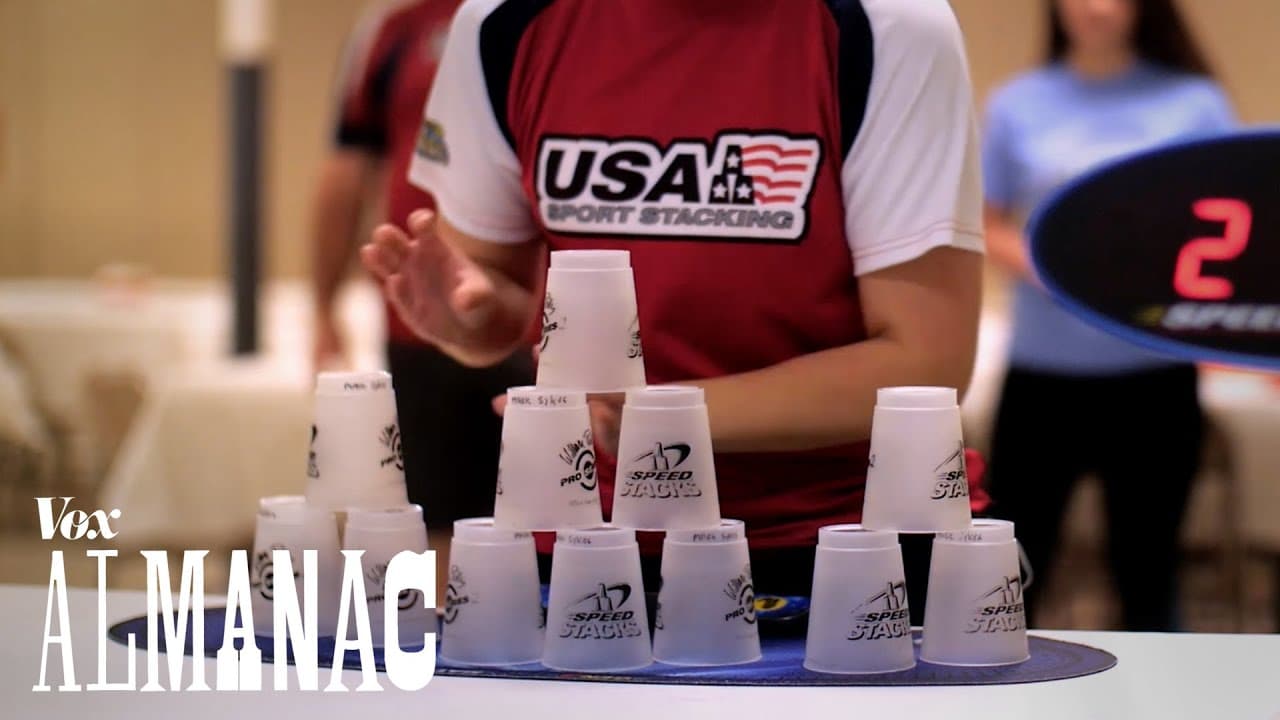
Did you miss that? Here it is again. And again. A little slower. It’s probably still not slow enough. This is sport stacking, or maybe you call it speed stacking, or cup stacking. But whatever you call it, it has become a huge sport. It’s in the Junior Olympics. Versions are taught in PE classes, and show up on The Tonight Show and Ellen. Last year... Read More
Key Insights
- Sport stacking, also known as cup stacking or speed stacking, has evolved into a significant sport, even featured in the Junior Olympics.
- The sport involves stacking cups in specific formations as quickly as possible, with common patterns like 3-6-3 and cycles involving multiple sequences.
- Top stackers, like Melissa Gomez and Mark Sykes, dedicate hours to practice, aiming to break personal and world records with advanced techniques.
- The sport's competitive nature requires stackers to optimize milliseconds through tactics like unconventional timer starts and specialized equipment.
- Speed stacking's origins trace back to a California Boys and Girls Club in the 1980s, with patents for stacking devices and mats contributing to its professionalization.
- The sport appeals to a wide range of participants, from competitive stackers to those enjoying the creative and non-competitive aspects.
- The sport's youthfulness means speed stacking and its associated brand are closely linked, raising questions about its future growth and maturity.
- Despite business concerns, the essence of sport stacking lies in personal improvement, competitive spirit, and the joy of the activity.
Install to Summarize YouTube Videos and Get Transcripts
Explore YouTube Video Summarizer or Get YouTube Transcript Extractor
Questions & Answers
Q: What is sport stacking and how did it become popular?
Sport stacking, also known as cup stacking or speed stacking, involves stacking cups in specific sequences as quickly as possible. It gained popularity after being introduced in a California Boys and Girls Club in the 1980s. Its inclusion in the Junior Olympics and media exposure on shows like The Tonight Show and Ellen have further contributed to its widespread appeal.
Q: What are the common patterns in sport stacking?
In sport stacking, participants typically perform sequences like the 3-6-3 pattern, which involves stacking three cups, six cups, and then three cups again. Another common sequence is the cycle, which includes a 3-6-3, followed by a 6-6, and then a 1-10-1. These patterns are performed as quickly as possible, with top stackers achieving mind-bendingly fast times.
Q: Who are some notable figures in the sport stacking community?
Notable figures in sport stacking include Melissa Gomez, a champion of the U.S. Nationals and Junior Olympics, and Mark Sykes, a former high school athlete and coach of the U.S. Sport Stacking team. Both have dedicated significant time to mastering the sport and have achieved impressive records through their advanced techniques and practices.
Q: What role does equipment play in sport stacking?
Equipment plays a crucial role in sport stacking, with specialized cups and stacking mats being essential for optimal performance. Pro cups have wider holes to allow more air to pass through, and different stackers prefer various cup designs. The stacking mat and timer are also vital, as they measure the time taken to complete sequences, and stackers use specific techniques to maximize their speed.
Q: How does the competitive nature of sport stacking impact its participants?
The competitive nature of sport stacking drives participants to constantly improve their times and techniques. Top stackers focus on optimizing milliseconds through unconventional methods, such as specific hand placements on the timer. The sport's intensity fosters a strong sense of competition, pushing stackers to break personal and world records while continuously honing their skills.
Q: What challenges does the sport face as it continues to grow?
As sport stacking continues to grow, it faces challenges related to its youthfulness and the close ties between the sport and its brand. The sport and its associated merchandise are closely linked, which could impact its future growth and maturity. However, these business concerns do not overshadow the core reasons why people participate in sport stacking, such as personal improvement and the joy of the activity.
Q: What attracts different participants to sport stacking?
Sport stacking attracts a wide range of participants for various reasons. Some enjoy the competitive aspect and the challenge of achieving faster times, while others appreciate the creative and non-competitive elements, such as building towers and pyramids. The sport's inclusivity allows individuals to engage with it in ways that align with their interests and motivations.
Q: How has the sport evolved in terms of professionalization and commercialization?
Sport stacking has evolved significantly in terms of professionalization and commercialization. The sport's origins in the 1980s led to the development of patented stacking devices and mats, contributing to its professionalization. The sport's brand is closely linked with its growth, resulting in a range of merchandise available for enthusiasts. This evolution reflects the sport's increasing legitimacy and appeal on a global scale.
Summary & Key Takeaways
-
Sport stacking, also known as cup stacking or speed stacking, has grown from a hobby into a recognized sport featured in events like the Junior Olympics. The activity involves stacking cups in specific sequences as quickly as possible, with top stackers dedicating hours to practice and employing advanced techniques to shave off milliseconds.
-
The sport's origins can be traced back to a California Boys and Girls Club in the 1980s, where it quickly gained popularity. The competitive nature of speed stacking requires stackers to optimize their performance through unconventional methods, specialized equipment, and a deep understanding of the sport's intricacies.
-
Sport stacking appeals to a diverse range of participants, from competitive athletes to those who enjoy its creative and non-competitive aspects. Despite its youthfulness and the close ties between the sport and its brand, the core of sport stacking remains in personal improvement, competitive spirit, and the joy it brings to participants.
Read in Other Languages (beta)
Share This Summary 📚
Summarize YouTube Videos and Get Video Transcripts with 1-Click
Try YouTube Summary with ChatGPT & Claude or YouTube Transcript Generator
Explore More Summaries from Vox 📚




Summarize YouTube Videos and Get Video Transcripts with 1-Click
Try YouTube Summary with ChatGPT & Claude or YouTube Transcript Generator