AI for Good: How Can AI Address Real-World Problems?
TL;DR
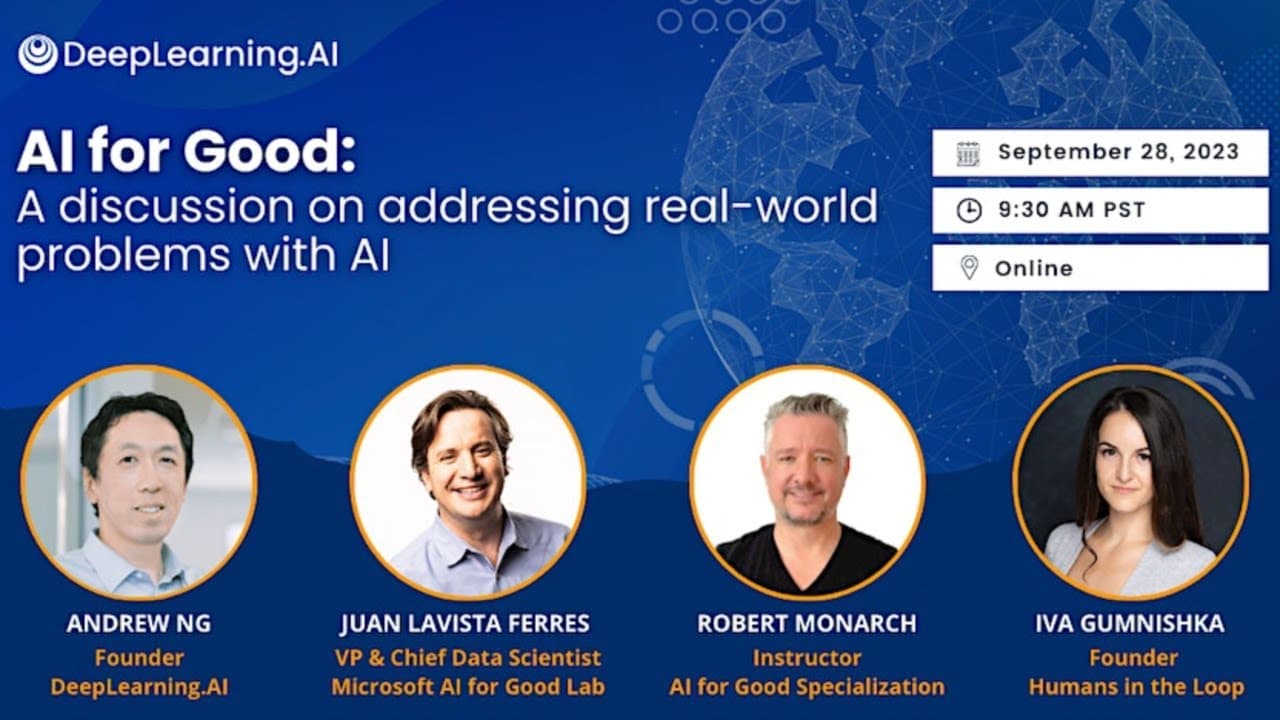
AI can address real-world problems by supporting renewable energy, multilingual access to reliable information, public health, and disaster planning, logistics, and resource allocation. The panel brings together experts who have led socially and environmentally beneficial AI projects, including Robert Monarch, Juan Lavista Ferres, Eva Kishka, and Andrew from DeepLearning.AI. Read on for concrete guidance about responsible development, collaboration, education, data practices, and human involvement.
Transcript
welcome to this panel discuss on AI for good I'm Ryan Keenan from deeplearning.ai and I'm really glad that you can join us for this event we have people joining us from all over the world today at least uh from the signups I think we have people representing more than 140 countries so good morning if you're in the western us like me or good afterno... Read More
Key Insights
- 🪡 AI needs to be developed responsibly, considering the potential impact on society and ethical implications.
- 📽️ Collaboration with domain experts and organizations is essential for impactful AI projects.
- 🌍 There is a need for AI engineers to focus on real-world problems and dedicate their skills to positive impact.
- 🌍 Education, skills development, and mentorship programs can help bridge the gap between AI engineers and real-world problem-solving.
- ❓ Data privacy and responsible AI practices should be prioritized.
Install to Summarize YouTube Videos and Get Transcripts
Explore YouTube Video Summarizer or Get YouTube Transcript Extractor
Questions & Answers
Q: How can AI help address real-world problems?
AI can support work in climate change, public health, and disaster management. Applications described in the discussion include making renewable energy more viable, expanding access to reliable information across languages, and improving disaster planning, logistics, and resource allocation.
Q: What does “AI for good” mean in this discussion?
AI for good refers to using available technology to benefit communities and address major social or environmental challenges. Robert Monarch frames it as the latest form of a centuries-old pattern of people applying technology to causes they care about.
Q: What risks of AI should developers take seriously?
The discussion identifies the potential replacement of humans in some jobs and the generation of videos or text that are difficult to distinguish from human-created content. It treats these as real risks that need serious attention alongside AI’s positive applications.
Q: Why is collaboration with domain experts important for AI-for-good projects?
The Microsoft AI for Good Lab partners with domain experts, researchers, and organizations around the world. This collaborative approach connects AI, machine learning, and statistical modeling expertise with knowledge of pressing real-world challenges.
Q: How can individuals get started working on AI projects for social good?
They should first understand the problem deeply and research existing solutions. They can then cooperate with organizations already addressing the issue and build around those organizations’ specific needs and challenges.
Q: How can the gap between AI engineers and real-world needs be addressed?
Greater access to AI education and training can help expand the available talent. Encouraging engineers to work with NGOs and other organizations tackling real-world problems can also better connect technical skills with practical demand.
Q: What role can humans play in responsible AI systems?
The panel includes expertise in combining human and machine intelligence, ethical data annotation, and human-in-the-loop pipelines. Eva Kishka’s social enterprise has provided online jobs and training in data labeling and human-in-the-loop work to more than a thousand refugees and conflict-affected people across Europe, the Middle East, and Africa.
Q: What is the AI for Good Specialization mentioned in the discussion?
DeepLearning.AI launched the AI for Good Specialization as a set of three courses on Coursera. The event concludes with a brief demonstration of course content and an explanation of how the panel discussion connects with those courses.
Summary & Key Takeaways
-
AI has the potential for both positive and negative impacts on society, with current discussions focusing on cutting-edge technologies and potential risks.
-
The panel discusses real-world AI projects that have had positive outcomes in areas such as renewable energy, language translation, and disaster response.
-
The importance of ethical AI development and responsible data usage is discussed, highlighting the need to consider the external impacts of AI systems.
Read in Other Languages (beta)
Share This Summary 📚
Summarize YouTube Videos and Get Video Transcripts with 1-Click
Try YouTube Summary with ChatGPT & Claude or YouTube Transcript Generator
Explore More Summaries from DeepLearningAI 📚




Summarize YouTube Videos and Get Video Transcripts with 1-Click
Try YouTube Summary with ChatGPT & Claude or YouTube Transcript Generator