How to Balance Chemical Equations Step-by-Step
TL;DR
To balance chemical equations, ensure the number of atoms on both sides is equal by adding coefficients in front of the reactants and products. Start with the least common multiple of atoms to find these coefficients, focusing first on carbon, then hydrogen, and finally oxygen in combustion reactions. If you encounter fractional coefficients, multiply all coefficients by the denominator to convert them into whole numbers.
Transcript
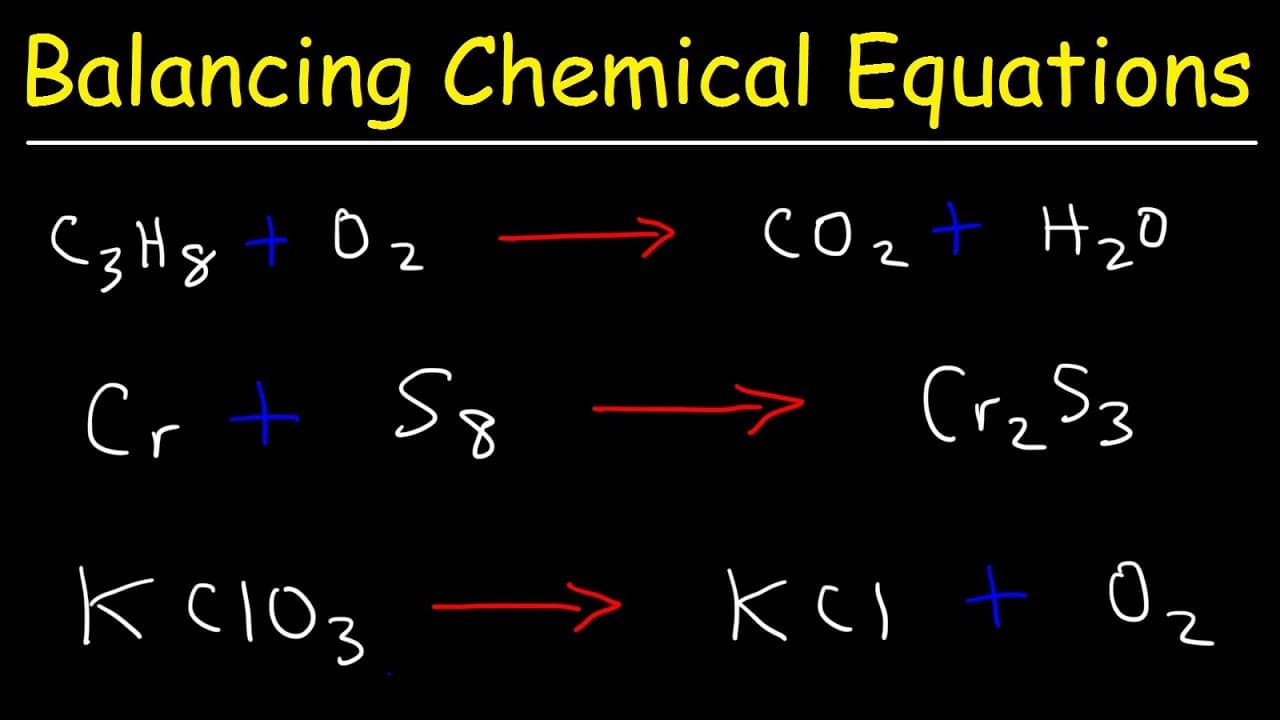
in this video we're going to focus on balancing chemical equations so let's start with this example chromium plus elemental sulfur reacts to form chromium-3 sulfide in order to balance the equation we need to make sure that the number of atoms on the left side is equal to the number of atoms on the right side and to do that we need to introduce coe... Read More
Key Insights
- 🙃 Balancing chemical equations involves introducing coefficients to ensure the same number of atoms on both sides of the equation.
- 🪡 The least common multiple is used to determine the coefficients needed to achieve balance.
- 🫀 Combustion reactions require balancing carbon atoms first, followed by hydrogen atoms, and then the remaining oxygen atoms.
- 🙃 Coefficients can be used to multiply the number of atoms to achieve equality on both sides of the equation.
- ✖️ Fractional coefficients can be eliminated by multiplying all coefficients by the denominator.
- 🅰️ Balancing equations may require different approaches depending on the types of reactants and products involved.
- 🫀 Practice and familiarity with chemical formulas and atomic masses help in effectively balancing equations.
Install to Summarize YouTube Videos and Get Transcripts
Explore YouTube Video Summarizer or Get YouTube Transcript Extractor
Questions & Answers
Q: How do you balance a chemical equation?
To balance a chemical equation, you need to ensure that the number of atoms on the left side is equal to the number on the right side. This is achieved by introducing coefficients to multiply the number of atoms.
Q: What does it mean to identify the least common multiple of atoms?
Identifying the least common multiple involves finding the smallest number that is divisible by the number of atoms on both sides. This helps determine the coefficients needed to balance the equation.
Q: What is the approach for balancing combustion reactions?
When balancing combustion reactions, it is recommended to balance carbon atoms first, followed by hydrogen atoms, and finally the remaining oxygen atoms. This approach ensures the equation is balanced.
Q: How do you handle fractions when balancing equations?
If you encounter fractions when balancing equations, multiply all coefficients by the denominator to eliminate the fraction. This will result in whole numbers for the coefficients.
Summary & Key Takeaways
-
Balancing chemical equations involves ensuring that the number of atoms on the left side is equal to the number on the right side by introducing coefficients.
-
Start by identifying the least common multiple of the atoms in question, and then use coefficients to multiply the number of atoms to achieve equality on both sides.
-
Combustion reactions involve balancing carbon atoms first, followed by hydrogen atoms, and then the remaining oxygen atoms.
Read in Other Languages (beta)
Share This Summary 📚
Summarize YouTube Videos and Get Video Transcripts with 1-Click
Try YouTube Summary with ChatGPT & Claude or YouTube Transcript Generator
Explore More Summaries from The Organic Chemistry Tutor 📚


Summarize YouTube Videos and Get Video Transcripts with 1-Click
Try YouTube Summary with ChatGPT & Claude or YouTube Transcript Generator