What Are PCA, ICA, and Factor Analysis?
TL;DR
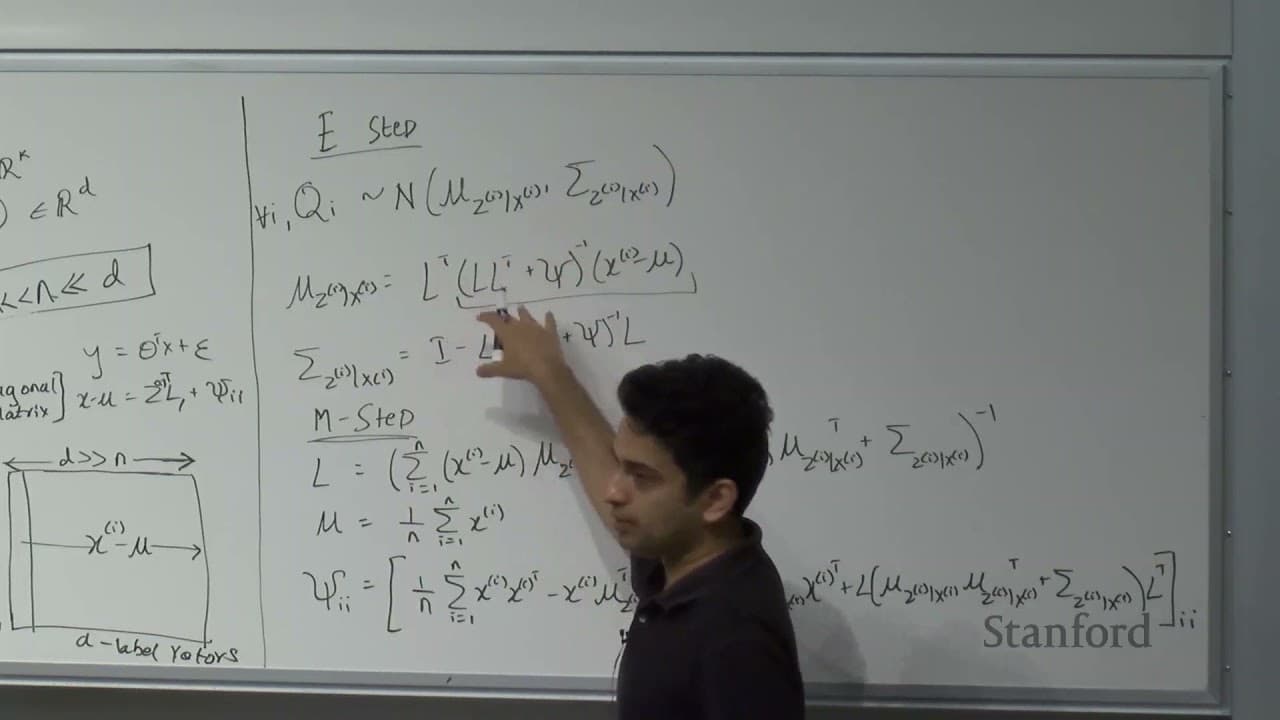
PCA identifies the low-dimensional subspace within high-dimensional data that retains maximum variance through eigenvalue decomposition. Factor Analysis models the relationships between observed and latent variables, particularly useful when observations are fewer than variables. ICA separates mixed signals by assuming statistical independence among sources, making it ideal for source separation tasks.
Transcript
cs229 lecture 18. the topic for today we'll be continuing our study of unsupervised learning so the topics today is we're going to wrap up factor analysis we mostly finished up factor analysis last time except we just stopped at the end where we finished the derivation and didn't really have have time to kind of ah answer some of the pending questi... Read More
Key Insights
- 👻 PCA is useful for dimensionality reduction and data visualization, allowing for the identification of the most important features of a dataset.
- #️⃣ Factor Analysis is effective when the number of observations is smaller than the number of variables, as it allows for the modeling of the covariance structure of the data.
- ℹ️ ICA is particularly powerful for source separation problems, where it can recover the original sources by assuming statistical independence between them.
Install to Summarize YouTube Videos and Get Transcripts
Explore YouTube Video Summarizer or Get YouTube Transcript Extractor
Questions & Answers
Q: What is the main objective of PCA?
The main objective of PCA is to find a lower-dimensional subspace in high-dimensional data that retains the most variance, allowing for dimensionality reduction and data visualization.
Q: How does Factor Analysis differ from PCA?
Factor Analysis is designed for cases where the number of observations is smaller than the number of variables. It assumes a linear relationship between latent variables and observed variables and focuses on modeling the covariance structure of the data, while PCA focuses on finding the principal components that capture the most variance.
Q: What is the application of ICA?
ICA is commonly used for source separation problems, such as recovering original audio signals from mixed recordings. It assumes that the sources are statistically independent and aims to find an unmixing matrix that can separate the mixed signals into their original sources.
Q: How does ICA handle the problem of signal independence?
ICA assumes that the sources are statistically independent, meaning that the value of one source does not provide any information about the value of the other sources. By leveraging this assumption, ICA can separate mixed signals into their original sources.
Summary & Key Takeaways
-
PCA is used to find a low-dimensional subspace in high-dimensional data that retains the maximum amount of variance. It uses eigenvectors and eigenvalues to determine the principal components.
-
Factor Analysis is useful when the number of observations is smaller than the number of variables. It assumes a linear relationship between latent variables and observed variables and aims to model the covariance structure of the data.
-
ICA is used for source separation problems, such as recovering original audio signals from mixed recordings. It assumes independence between the sources and aims to find an unmixing matrix to separate the sources.
Read in Other Languages (beta)
Share This Summary 📚
Summarize YouTube Videos and Get Video Transcripts with 1-Click
Try YouTube Summary with ChatGPT & Claude or YouTube Transcript Generator
Explore More Summaries from Stanford Online 📚


Summarize YouTube Videos and Get Video Transcripts with 1-Click
Try YouTube Summary with ChatGPT & Claude or YouTube Transcript Generator