What Is Carcinization and Why Are Crabs So Popular?
TL;DR
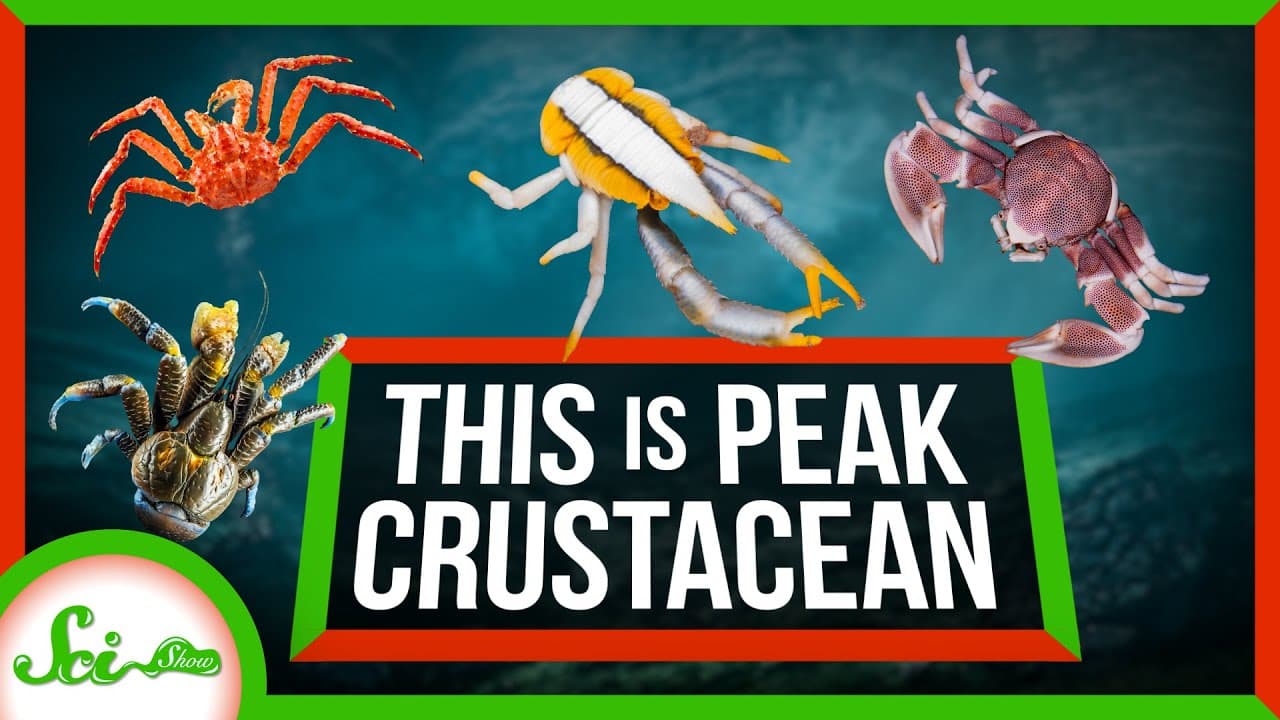
Carcinization is the process of crustaceans evolving a crab-like form independently, which has occurred at least five times in history. This body shape offers better protection for their pleon and increased mobility on land, making it advantageous for survival against predators. Only the suborder Brachyura contains true crabs, while others like king crabs and coconut crabs are not classified as true crabs despite their similar appearances.
Transcript
This episode is sponsored by Awesome Socks Club, a sock subscription for charity! Click the link in the description and sign up between now and December 11th to get a new pair of fun socks each month in 2021. [♪ INTRO] If I asked you to picture a crab, chances are you would imagine a creature with a flat, hard shell, legs sticking out to t... Read More
Key Insights
- 💁 Carcinization, the evolution of a crab-like form, has occurred independently multiple times in crustaceans.
- 🌱 The crab-like body plan provides better protection for the pleon and increased mobility on land.
- 🦀 True crabs, belonging to the suborder Brachyura, are the only crustaceans considered true crabs.
- 🦀 Other crab-like critters, such as king crabs and coconut crabs, are part of the group Anomura and have a similar body plan but aren't true crabs.
- 🦀 Squat lobsters, related to porcelain crabs, may be halfway on the evolutionary road to becoming crabs.
- ❓ Convergent evolution has occurred in various species throughout evolutionary history.
- 🥺 Similar environmental pressures have led to the repeated occurrence of carcinization in crustaceans, indicating the benefits of a crab-like body plan.
Install to Summarize YouTube Videos and Get Transcripts
Explore YouTube Video Summarizer or Get YouTube Transcript Extractor
Questions & Answers
Q: Why do so many crustaceans have a crab-like body plan?
Many crustaceans evolved a crab-like shape to protect their pleon, which contains vital organs, from predators. The folded pleon and flattened body provide better protection and allow for increased mobility on the ground.
Q: Why did crustaceans with a crab-like body shape lose the ability to swim?
Crustaceans with a crab-like body shape lost the ability to swim because their bodies flattened out, causing them to lose the tail fan that helps with swimming. However, the flattened body and folded pleon provide better mobility and speed on the ground.
Q: What distinguishes true crabs from other crab-like critters?
True crabs, belonging to the suborder Brachyura, are the only crustaceans considered true crabs. Other crab-like critters, such as king crabs, porcelain crabs, and coconut crabs, are part of the group Anomura and have a similar crab-like body plan but aren't true crabs.
Q: Why aren't all crab-shaped animals considered true crabs?
Taxonomists consider shared ancestry more important than appearances when classifying organisms. If an organism evolved to look like a crab independently, it is not classified as a true crab unless it has a direct genetic relationship with true crabs.
Summary & Key Takeaways
-
Crustaceans like king crabs, coconut crabs, and porcelain crabs have all undergone carcinization, the convergent evolution of a crab-like form.
-
The evolution of a crab-like body plan provided better protection for the pleon, the back section of a crustacean that contains important organs.
-
The crab-like body shape allowed crustaceans to spend more time on the bottom, providing them with better protection from predators and increasing their mobility on land.
Read in Other Languages (beta)
Share This Summary 📚
Summarize YouTube Videos and Get Video Transcripts with 1-Click
Try YouTube Summary with ChatGPT & Claude or YouTube Transcript Generator
Explore More Summaries from SciShow 📚
Summarize YouTube Videos and Get Video Transcripts with 1-Click
Try YouTube Summary with ChatGPT & Claude or YouTube Transcript Generator