How to Convert Millimeters to Inches Easily
TL;DR
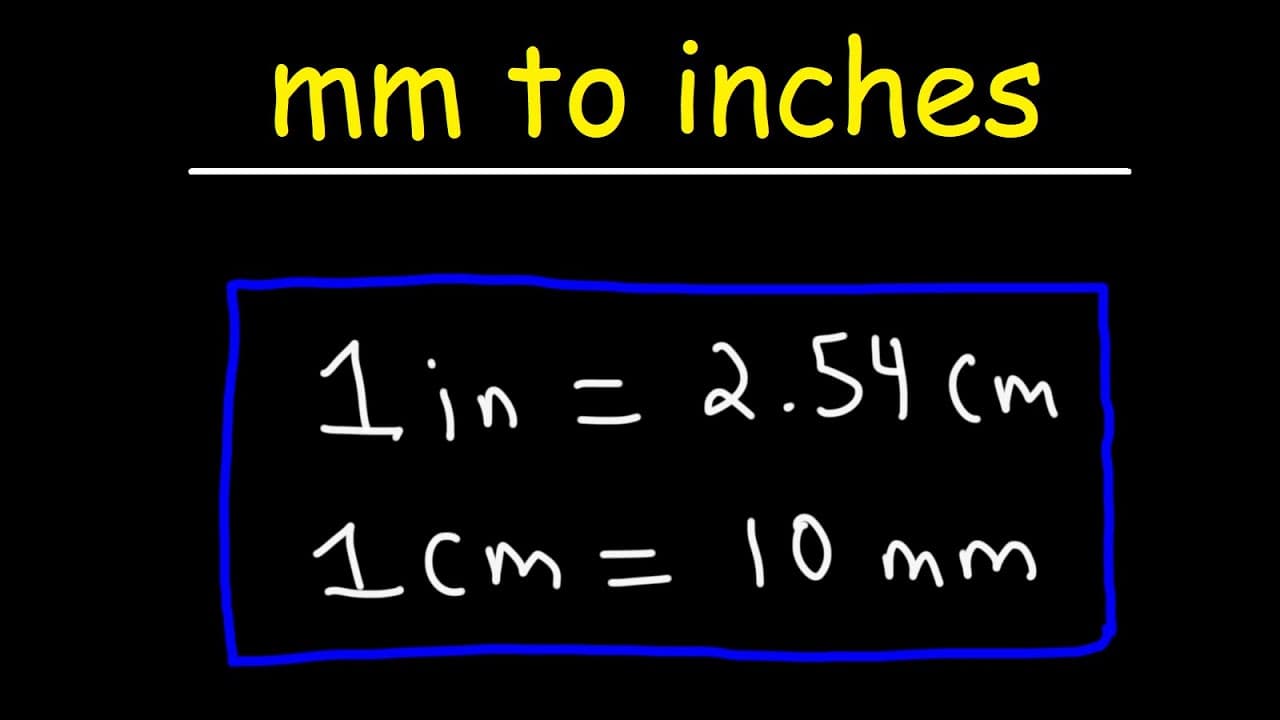
To convert millimeters to inches, use the conversion factors: 1 centimeter equals 10 millimeters and 1 inch equals 2.54 centimeters. For example, 50 millimeters is approximately 1.97 inches when you first convert it to centimeters and then to inches using these factors.
Transcript
let's say we have 50 millimeters and we want to convert that to inches how can we do that how many inches is equivalent to 50 millimeters in order to do this we need to be familiar with the conversion factors that will help us to get there what I'm going to do in this video I'm going to convert millimeters to centimeters first and then from centime... Read More
Key Insights
- 🤌 The conversion process from millimeters to inches involves utilizing conversion factors to simplify the steps and ensure accurate results.
- 🧑🏭 Converting to centimeters acts as an intermediary step, allowing for the application of an additional conversion factor to reach the desired inch value.
- 🟰 The conversion factors used, 1 centimeter equaling 10 millimeters and 1 inch equaling 2.54 centimeters, are fundamental and widely applicable.
- 🧑🏭 It is important to understand that these conversion factors are fixed and do not change regardless of the specific millimeter measurement.
- 🤌 The given example of converting 50 millimeters to 1.97 inches demonstrates the practical application of the conversion process.
- 🧑🏭 Any millimeter measurement can be converted using the same conversion factors and steps demonstrated in the video.
- 🤌 The final inch value should retain the appropriate number of significant figures from the original millimeter measurement.
Install to Summarize YouTube Videos and Get Transcripts
Explore YouTube Video Summarizer or Get YouTube Transcript Extractor
Questions & Answers
Q: Why is it necessary to convert millimeters to centimeters before converting to inches?
Converting millimeters to centimeters allows us to apply another conversion factor and simplify the process. It acts as an intermediary step that helps in canceling out units and obtaining the desired answer in inches.
Q: Can these conversion factors be used for any millimeter to inch conversion?
Yes, the conversion factors mentioned in the video are applicable for all millimeter to inch conversions because they are based on fixed ratios and do not change.
Q: What if the millimeter value is not a multiple of 10, like 53 millimeters?
If the millimeter value is not divisible by 10, you would still use the conversion factor of 1 centimeter equals 10 millimeters. Simply divide the given value by 10 and proceed with the conversion as demonstrated in the video.
Q: How many significant figures should be considered in the final inch value?
The final inch value should retain the same number of significant figures as the original millimeter measurement. In this case, since 50 millimeters has two significant figures, the converted inch value can be reported as approximately 1.97 inches.
Summary & Key Takeaways
-
The video explains the process of converting millimeters to inches through centimeters as an intermediary step.
-
Two conversion factors are essential: 1 centimeter equals 10 millimeters and 1 inch equals 2.54 centimeters.
-
By applying these conversion factors and performing the necessary operations, you can accurately convert 50 millimeters to approximately 1.97 inches.
Read in Other Languages (beta)
Share This Summary 📚
Summarize YouTube Videos and Get Video Transcripts with 1-Click
Try YouTube Summary with ChatGPT & Claude or YouTube Transcript Generator
Explore More Summaries from The Organic Chemistry Tutor 📚




Summarize YouTube Videos and Get Video Transcripts with 1-Click
Try YouTube Summary with ChatGPT & Claude or YouTube Transcript Generator