How to Add Two 4-Bit Binary Numbers Using a Parallel Adder?
TL;DR
To add two 4-bit binary numbers using a parallel adder, align the bits, add corresponding pairs using full adders, and handle any carries generated at each stage. The complete process is known as a Ripple Carry Adder, where each carry-out influences the next bit's addition, leading to potential delays in multi-bit operations.
Transcript
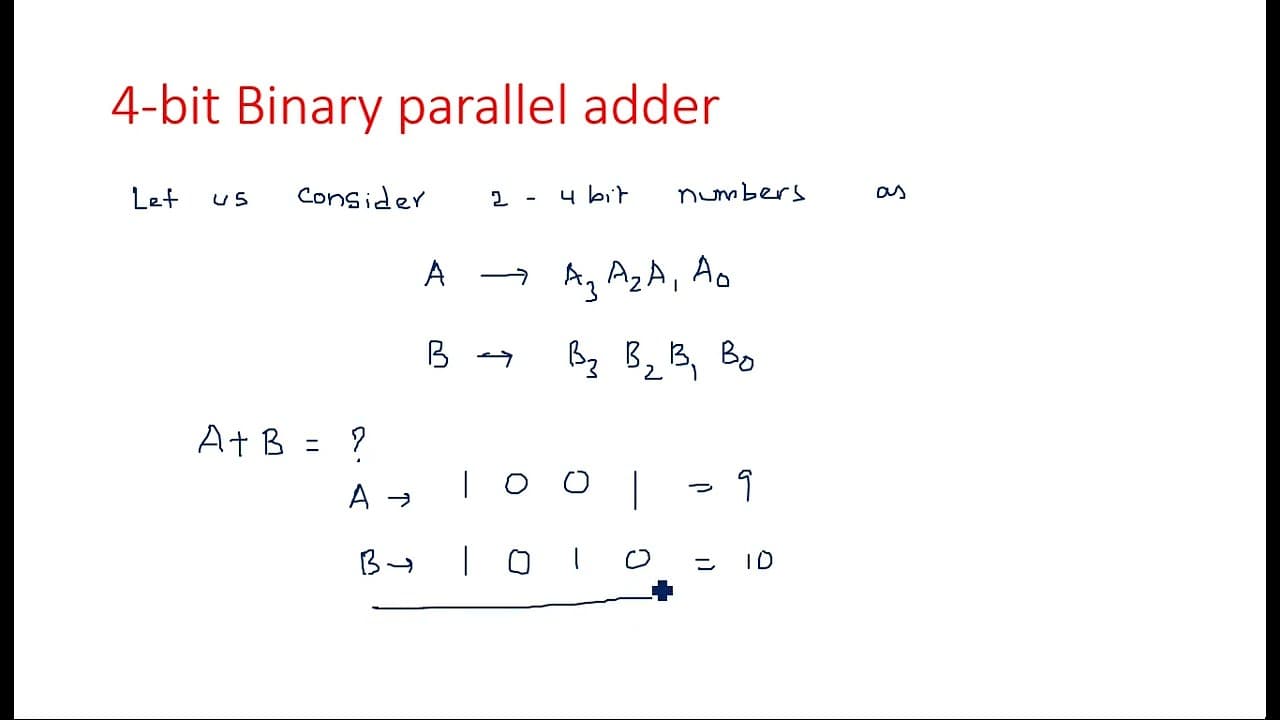
hi everyone in this video I'm going to explain about 4bit binary parall ladder let us consider two 4bit numbers let us consider two 4bit numbers as C a is one 4bit number and b is another 4bit number that means two 4bit numbers I taking so how it is a 4bit number how can you say it is a four bit number it consists of four bits inside a not A1 A2 A3... Read More
Key Insights
- 🫦 A 4-bit binary number consists of four individual bits, allowing representation of values from 0 to 15.
- 🪜 The process of adding binary numbers in a 4-bit parallel adder requires full adders for each bit and managing carry propagation.
- ⛓️ Ripple Carry Adders are efficient for basic binary addition but suffer from delays due to the carry chain dependencies.
- 🫦 Adding higher bit-width numbers necessitates the use of more full adders to accommodate the increased bit count and potential carries.
- 😒 The use of a half adder at the first stage is practical when there is no carry input.
- 👷 Understanding the design and operation of parallel adders is fundamental in constructing circuits for arithmetic operations in digital systems.
- 🪜 As more bits are added in a parallel adder, the potential for delays increases, making it critical to recognize when optimizations are needed.
Install to Summarize YouTube Videos and Get Transcripts
Explore YouTube Video Summarizer or Get YouTube Transcript Extractor
Questions & Answers
Q: What is a 4-bit binary number?
A 4-bit binary number consists of four bits that represent a numerical value in binary format. Each bit can hold a value of either 0 or 1, and in total, a 4-bit number can represent values ranging from 0 (0000) to 15 (1111) in decimal.
Q: How does binary addition work in a 4-bit parallel adder?
In a 4-bit parallel adder, each corresponding bit of the two 4-bit numbers is added together. If the addition of two bits results in a carry, it is propagated to the next higher bit. The addition is done using full adders for each bit, which takes into account the bits to be added and any incoming carry from the previous addition.
Q: Why is the Ripple Carry Adder (RCA) prone to delays?
The RCA experiences delays due to the sequential dependency of carries between the stages of addition. Each full adder must wait for the carry from the previous stage to compute its output, leading to a cumulative delay as the number of bits increases, affecting overall processing speed.
Q: Can a half adder be used in the 4-bit parallel adder design?
Yes, a half adder can be implemented in the initial stage of the 4-bit parallel adder when no carry input is present. It is used to add the least significant bits. However, subsequent stages require full adders to accommodate the generation of carries.
Q: What components are used in a 4-bit parallel adder?
A 4-bit parallel adder typically consists of multiple full adders, where each full adder takes in two bits and a carry bit. The resulting output is a sum bit and a carry bit that is input to the next full adder in the sequence.
Q: What is the significance of the initial carry in binary addition?
The initial carry, typically denoted as C_in or C0, is important because it accounts for any existing carry before the addition starts. If there is no prior carry, it is often set to zero. This initial carry plays a critical role in determining the outcome of the first addition operation.
Summary & Key Takeaways
-
The video introduces 4-bit binary numbers and explains how to perform binary addition using a parallel adder, illustrated through specific examples.
-
It describes the components involved in a 4-bit parallel adder, including carries generated during the addition process and their effect on subsequent stages.
-
The concept of Ripple Carry Adder (RCA) is discussed, including its benefits and inherent delays due to dependency on carry propagation through successive stages.
Read in Other Languages (beta)
Share This Summary 📚
Summarize YouTube Videos and Get Video Transcripts with 1-Click
Try YouTube Summary with ChatGPT & Claude or YouTube Transcript Generator