Why Are Some Science Papers Cited So Often?
TL;DR
The most cited scientific papers become influential by providing methods, models, or materials that researchers can reuse across many applications. The examples highlighted include graphene, residual learning, a simplified electron-density approximation, SDS-PAGE, and the Lowry assay, spanning materials science, computer science, physics, biology, and chemistry.
Transcript
This is the most popular science of all time. Makes sense that SciShow is covering it. Pop sci is kind of our thing, but I mean something different when I say this video is about the most popular science ever. I mean, it's the most popular science according to scientists based on data. Here are the most cited publications of all time from five big ... Read More
Key Insights
- Scientific popularity is measured here by citation count, meaning the number of other academic papers that reference a publication. An April 2025 Nature paper ranked publications using citations going back to the beginning of its databases, revealing leaders that remain largely unknown to the public.
- Graphene is a one-atom-thick carbon sheet whose atoms form a flat hexagonal honeycomb pattern. Researchers successfully made it in 2004, despite earlier doubts that such a thin material could remain stable, and its unusual structure supports numerous practical uses.
- Graphene is useful because it combines conductivity, thinness, strength, and stability. Its atomic arrangement lets electrons move across the surface with little interference, while its physical properties suit nearly transparent coatings, smartphone screens, and reinforcement for high-force areas of tennis rackets.
- Residual learning is a method that groups neural-network layers into chunks and adds shortcut paths between them. These shortcuts supplement the direct route through every layer, reducing the risk that information will be lost as very deep networks repeatedly transform image data.
- Deep neural networks are valuable for image recognition because their many layers can identify numerous details in complex images. The 2015 residual-learning paper became computer science's most cited publication in the presented ranking, accumulating more than 116,000 citations.
- Generalized gradient approximation is a streamlined approach for estimating electron density within density functional theory. The cited paper replaced calculations tailored to every molecular environment with an equation depending only on physical constants, making important quantum-mechanical estimates easier to perform.
- Electron-density calculations are useful for understanding interactions involving atoms and molecules. The simplified approximation has supported research into current moving through semiconductors, improved pharmaceuticals, and more breathable sneaker fabric, helping its paper surpass 174,000 citations.
- SDS-PAGE is a method introduced in a paper about bacteriophage T4 protein cleavage, and it separates proteins by mass. The method addresses the variability of protein charge and shape, has been used almost unchanged since 1970, and helped its paper receive more than 250,000 citations.
Install to Summarize YouTube Videos and Get Transcripts
Explore YouTube Video Summarizer or Get YouTube Transcript Extractor
Questions & Answers
Q: What makes a scientific paper highly cited?
A scientific paper can become highly cited when it provides a broadly useful method, model, approximation, or material that many later researchers depend on. The examples presented are useful across numerous applications, from image recognition and electron-density calculations to protein separation. Their influence comes from repeated practical use in subsequent research, even when their titles are unfamiliar to the general public.
Q: How was scientific popularity measured in the ranking?
Scientific popularity was measured by the number of citations a publication received from other academic papers. A paper published in Nature in April 2025 ranked publications by citations going back to the beginning of its databases. The video then selected the number-one cited publication from materials science, computer science, physics, biology, and chemistry for comparison.
Q: Why is graphene important in materials science?
Graphene is important because it is a one-atom-thick carbon sheet that combines conductivity, thinness, strength, and stability. Its carbon atoms form a flat hexagonal honeycomb pattern that allows electrons to move across the surface without much interference. These properties support uses including nearly transparent coatings, smartphone screens, and reinforcement in parts of tennis rackets that experience strong forces.
Q: How does residual learning improve deep neural networks?
Residual learning improves deep neural networks by grouping layers into chunks and creating shortcut paths from one chunk to the next. Information can still follow the direct path through every layer, but the shortcuts provide an additional route that helps prevent details from being lost during repeated transformations. This is especially helpful for complex images that require networks with many layers.
Q: Why did the residual-learning paper receive so many citations?
The 2015 paper became influential because it proposed an easier way to build deep models for image recognition. Very deep networks can perform well on complex images, but they may lose information as it passes through many layers. Residual learning addresses that problem, supporting applications such as self-driving cars and identifying tumors on medical scans, while also extending beyond image recognition.
Q: What does generalized gradient approximation simplify?
Generalized gradient approximation simplifies estimates of electron density used in density functional theory. Previously, accurate modeling required researchers to account for each molecule's specific arrangement of atoms and its unique environment. The paper proposed a more streamlined equation that depends only on physical constants, reducing the complexity of calculations used to understand electron behavior, energy, and interactions.
Q: What applications use the simplified electron-density calculations?
The simplified electron-density calculations help researchers investigate several practical problems involving atoms, molecules, and electrons. The transcript identifies understanding how current moves through semiconductors, developing better pharmaceuticals, and producing more breathable fabric for sneakers. This broad range of applications contributed to the physics paper accumulating more than 174,000 citations and becoming the field's most cited publication in the ranking.
Q: What is SDS-PAGE and why is it widely cited?
SDS-PAGE is a method for separating proteins by their mass. Protein size is valuable for characterizing biological molecules, but proteins are harder to assess than DNA because their charge and shape vary more. The method was introduced in a paper about structural-protein cleavage during bacteriophage T4 head assembly, has remained almost unchanged since 1970, and helped that paper exceed 250,000 citations.
Summary & Key Takeaways
-
A Nature paper published in April 2025 ranked academic publications by how often other papers cited them across its databases. The selected leaders from five major scientific fields are not necessarily familiar to the public, but their citation totals reflect how frequently researchers rely on their methods, models, and findings.
-
The materials science and computer science leaders concern graphene and deep residual learning. Graphene combines conductivity, extreme thinness, strength, and stability. Residual learning gives deep neural networks shortcut paths between groups of layers, helping preserve information while processing complex images for applications such as tumor identification and self-driving cars.
-
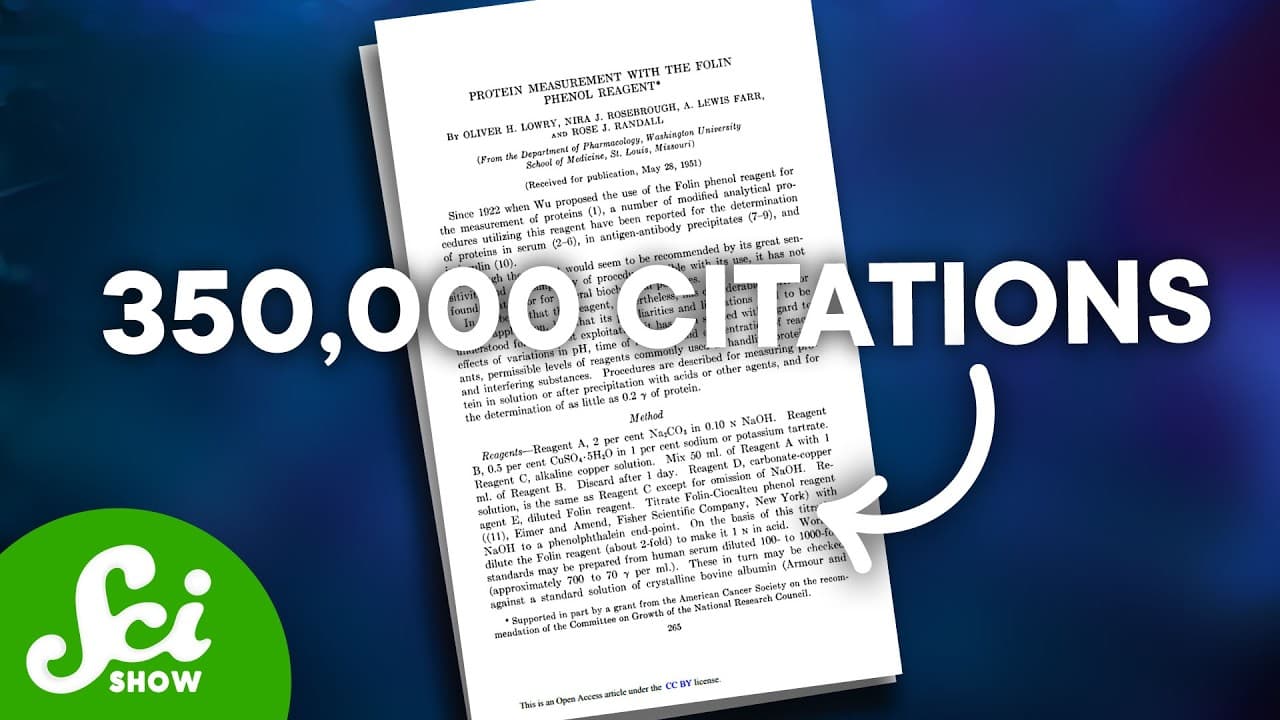
The physics leader streamlined calculations within density functional theory, while the biology leader introduced SDS-PAGE for separating proteins by mass. Together with the chemistry-leading Lowry assay named in the description, these examples show that broadly reusable research tools can accumulate exceptional citation counts even when their titles and subjects remain obscure outside science.
Read in Other Languages (beta)
Share This Summary 📚
Summarize YouTube Videos and Get Video Transcripts with 1-Click
Try YouTube Summary with ChatGPT & Claude or YouTube Transcript Generator
Explore More Summaries from SciShow 📚


Summarize YouTube Videos and Get Video Transcripts with 1-Click
Try YouTube Summary with ChatGPT & Claude or YouTube Transcript Generator