What Does an Electron Look Like at a Quantum Level?
TL;DR
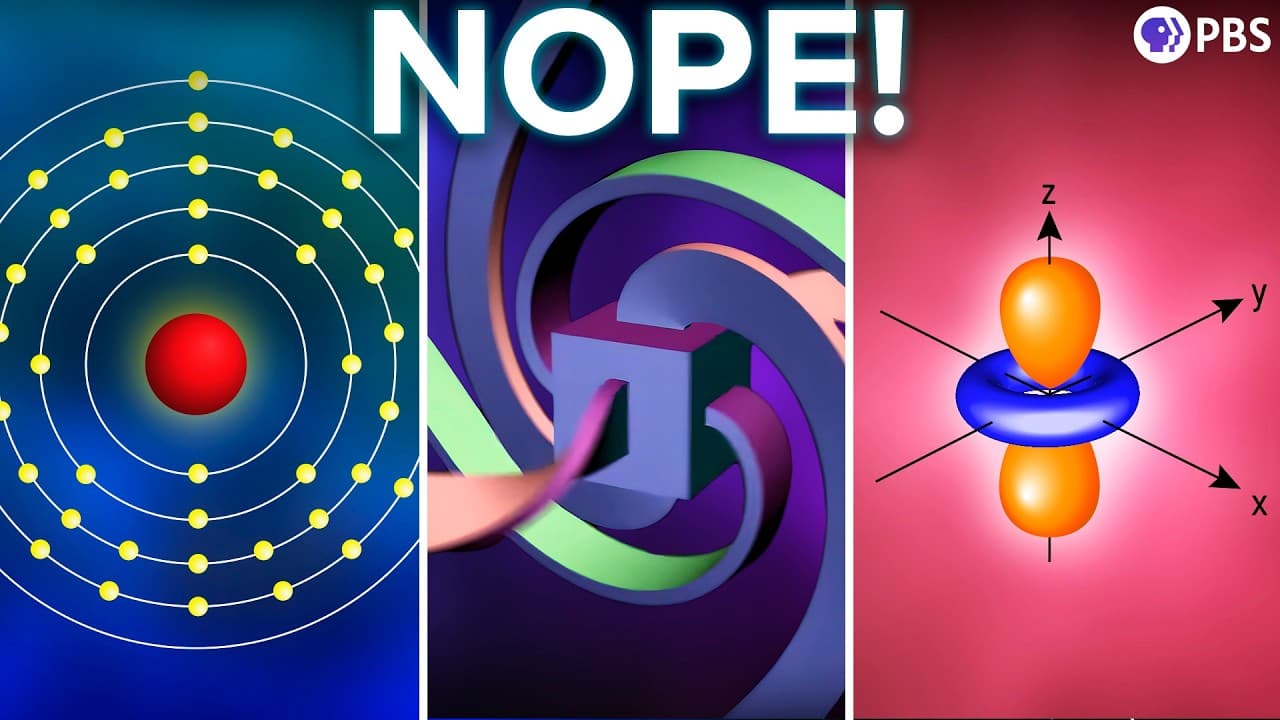
An electron cannot be visualized as a simple particle; it is better described as a wave function representing probabilities of its location and properties. In quantum field theory, electrons are seen as excitations in a field, influenced by virtual particles and quantum fluctuations, complicating their measurement and depiction due to inherent uncertainties.
Transcript
Thank you to novium for supporting PBS. What does an electron really look like? I mean if we zoom in all the way is it a sizeless speck of charge? Or is it a multi-dimensional vortex of quantum strangeness? Is it the boundary of a tiny universe with universe electrons of its own? Let's find out. There isn't much that's simpler than the it's on... Read More
Key Insights
- Electrons are elementary particles, not made of smaller components, challenging traditional atomic models depicting them as orbiting balls.
- In quantum mechanics, electrons are described by wave functions, indicating probabilities of their location and properties rather than fixed points.
- The classical electron radius is a theoretical construct; actual electron size is much smaller, complicating its depiction.
- Quantum field theory describes electrons as excitations in a quantum field, interacting with virtual particles, affecting their observed properties.
- Zooming into an electron reveals quantum fluctuations and interactions, influenced by the Heisenberg uncertainty principle, affecting precision in measurement.
- Virtual particle interactions, such as electron-positron pairs, contribute to the electron's mass and charge distribution, complicating its visualization.
- Renormalization in quantum field theory helps reconcile infinite properties predicted by classical physics with observed electron behavior.
- The electron's complex nature reflects broader challenges in physics, hinting at unresolved issues like the hierarchy problem.
Install to Summarize YouTube Videos and Get Transcripts
Explore YouTube Video Summarizer or Get YouTube Transcript Extractor
Questions & Answers
Q: What is the classical electron radius?
The classical electron radius is a theoretical size an electron would have if its mass was entirely from the potential energy of its charge. Calculated using classical physics, it is about 2.8 x 10^-5 meters, much larger than the actual size of an electron as determined by experiments.
Q: How does quantum field theory describe electrons?
Quantum field theory describes electrons as excitations in their own quantum field. Unlike classical particles, electrons interact with virtual particles in the field, influencing their observable properties like mass and charge. This framework provides a more accurate depiction of their behavior compared to classical models.
Q: What role do virtual particles play in electron behavior?
Virtual particles, such as electron-positron pairs, interact with real electrons, contributing to their mass and charge distribution. These interactions, described by quantum field theory, create a cloud of activity around electrons, influencing their observed properties and complicating efforts to visualize them as simple particles.
Q: How does the Heisenberg uncertainty principle affect electron observation?
The Heisenberg uncertainty principle states that increasing precision in measuring an electron's position leads to greater uncertainty in its momentum and energy. This principle means that the more we try to pinpoint an electron's location, the more its quantum fluctuations and interactions become pronounced, affecting our ability to observe it clearly.
Q: What is renormalization in quantum field theory?
Renormalization is a mathematical tool used in quantum field theory to address infinities that arise when calculating properties like mass and charge. By adjusting parameters, it reconciles these theoretical predictions with observed values, allowing for more accurate models of particles like electrons, despite their complex quantum interactions.
Q: Why is the electron's charge considered smeared out?
The electron's charge appears smeared out due to interactions with virtual particles and the surrounding electromagnetic field. This effect, known as vacuum polarization, involves virtual positrons and electrons shifting in response to the field, influencing the effective charge observed at different distances from the electron.
Q: What challenges arise from trying to visualize electrons?
Visualizing electrons poses challenges due to their quantum nature, where they are not fixed points but probability distributions. Quantum interactions and the Heisenberg uncertainty principle further complicate this, as precise measurements amplify quantum fluctuations, resulting in a complex, dynamic depiction rather than a simple particle image.
Q: How does the electron's complexity relate to broader physics issues?
The electron's complexity, with its quantum interactions and theoretical challenges, reflects broader unresolved issues in physics, such as the hierarchy problem. This problem involves understanding why fundamental forces vary in strength, and the electron's behavior provides insights into these deeper questions, highlighting the need for further theoretical advancements.
Summary & Key Takeaways
-
Electrons, as elementary particles, defy simple visualizations, with quantum mechanics revealing them as wave functions rather than fixed points.
-
Quantum field theory portrays electrons as excitations in a field, interacting with virtual particles, complicating their depiction and measurement.
-
Despite theoretical challenges, tools like renormalization help align quantum predictions with observations, highlighting unresolved physics issues.
Read in Other Languages (beta)
Share This Summary 📚
Summarize YouTube Videos and Get Video Transcripts with 1-Click
Try YouTube Summary with ChatGPT & Claude or YouTube Transcript Generator
Explore More Summaries from PBS Space Time 📚


Summarize YouTube Videos and Get Video Transcripts with 1-Click
Try YouTube Summary with ChatGPT & Claude or YouTube Transcript Generator