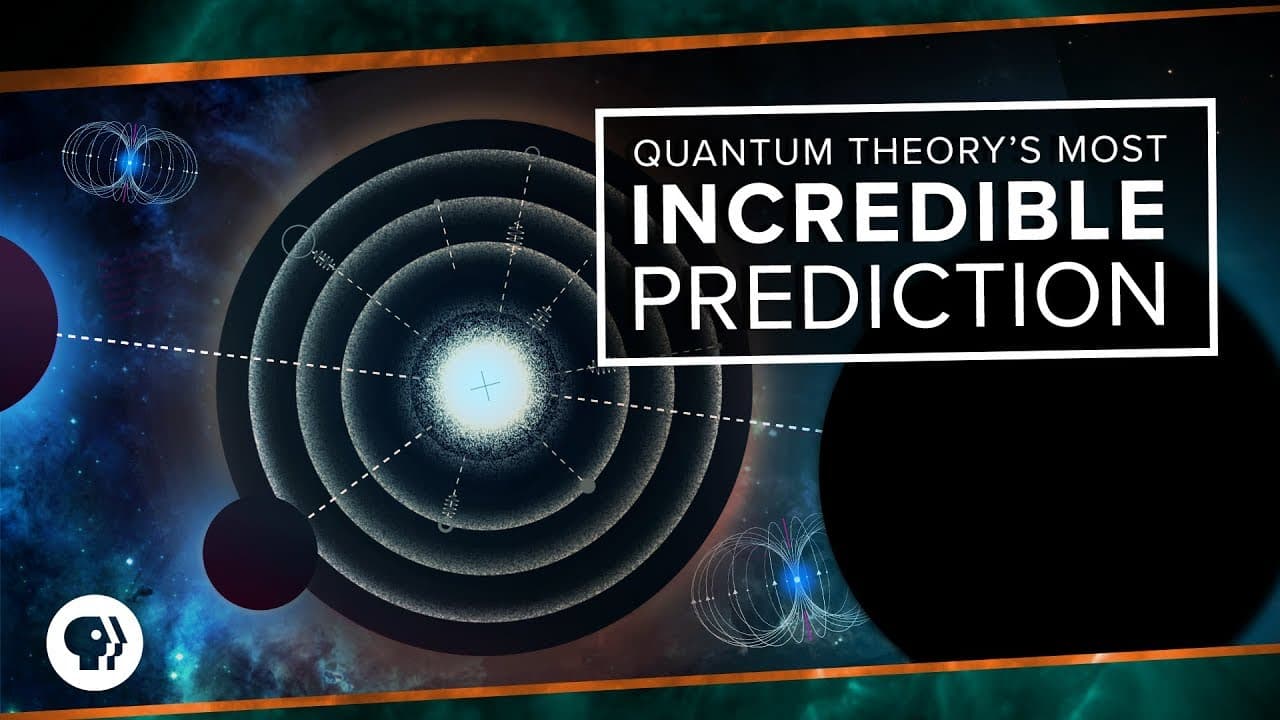
Quantum Theory's Most Incredible Prediction | Space Time
TL;DR
Quantum field theory's predictions are experimentally verified, showcasing its accuracy.
Transcript
Thanks to The Great Courses Plus for supporting PBS Digital Studios. Let's talk about the best evidence we have that the theories of quantum physics truly represent the underlying workings of reality. Quantum field theory is notoriously complicated, built from mind-bendingly abstract mathematics. But could it be that the underlying rules that gove... Read More
Key Insights
- Quantum field theory (QFT) is a complex framework using abstract mathematics to describe the universe's quantum fields, where particles are excitations of these fields.
- Quantum electrodynamics (QED), a subset of QFT, provides a more intricate understanding of electromagnetism than classical physics, explaining interactions at the quantum level.
- The anomalous magnetic dipole moment of electrons, or g-factor, is a key test of QED's predictions, differing slightly from classical expectations due to quantum effects.
- The g-factor anomaly arises from the quantum nature of electromagnetic fields, with virtual photons and quantum buzz contributing to a slight deviation from classical values.
- Feynman diagrams help manage the complexity of quantum interactions, illustrating the myriad ways particles can interact within quantum fields.
- The precision of QED's predictions, verified to ten decimal places, underscores the theory's robustness and its representation of reality.
- The fine structure constant is crucial in calculating the g-factor, representing the strength of electromagnetic interactions and requiring independent experimental measurement.
- Quantum field theory's success in experimental verification suggests it accurately represents the underlying mechanics of space-time.
Install to Summarize YouTube Videos and Get Transcripts
Explore YouTube Video Summarizer or Get YouTube Transcript Extractor
Questions & Answers
Q: What is quantum field theory?
Quantum field theory (QFT) is a framework in physics that describes the universe in terms of quantum fields. These fields permeate space, with particles being excitations or quantized vibrations of these fields. QFT combines quantum mechanics and special relativity, providing a comprehensive description of fundamental forces and particles, forming the basis for understanding interactions at the quantum level.
Q: How does quantum electrodynamics differ from classical electrodynamics?
Quantum electrodynamics (QED) is a quantum field theory that provides a detailed description of electromagnetic interactions. Unlike classical electrodynamics, which relies on the concept of electric and magnetic fields, QED accounts for the quantum nature of these fields and the interactions of charged particles through the exchange of virtual photons. This leads to more accurate predictions, verified through experiments, particularly in phenomena like the anomalous magnetic dipole moment.
Q: What is the anomalous magnetic dipole moment?
The anomalous magnetic dipole moment refers to the slight deviation in the magnetic moment of electrons from classical predictions. This anomaly arises due to quantum effects within the electromagnetic field, where virtual photons and other quantum interactions contribute to a g-factor slightly greater than 2. This discrepancy is a key test of quantum electrodynamics, demonstrating the theory's accuracy in describing quantum interactions.
Q: How do Feynman diagrams assist in quantum field theory calculations?
Feynman diagrams are visual representations that simplify the complex interactions within quantum fields. They illustrate how particles interact through the exchange of virtual particles, such as photons, in quantum electrodynamics. These diagrams help physicists manage the complexity of calculations by identifying significant interactions, allowing for precise predictions of phenomena like the electron's g-factor and streamlining the computational process.
Q: What role does the fine structure constant play in QED calculations?
The fine structure constant is a fundamental constant in physics that characterizes the strength of electromagnetic interactions between charged particles. In quantum electrodynamics, it is crucial for calculating the g-factor of electrons and other predictions. Accurate experimental measurement of this constant is necessary to verify QED's predictions, as it directly influences the precision of calculated values in electromagnetic phenomena.
Q: Why is the g-factor significant in testing quantum electrodynamics?
The g-factor is significant because it provides a precise test of quantum electrodynamics' predictions. The slight deviation from the classical value, due to quantum effects, allows physicists to verify the accuracy of QED. The agreement between calculated and experimentally measured g-factors, to ten decimal places, underscores the robustness of QED and its depiction of the quantum nature of electromagnetic interactions.
Q: How does quantum field theory's success in predictions impact our understanding of reality?
Quantum field theory's success in making precise predictions, verified through experiments, suggests it accurately represents the fundamental workings of reality. Its ability to describe interactions at the quantum level, such as those in quantum electrodynamics, demonstrates the theory's robustness and supports its role in explaining the underlying mechanics of space-time, bringing us closer to understanding the universe's true nature.
Q: What is the significance of virtual photons in quantum field theory?
Virtual photons play a crucial role in quantum field theory, particularly in quantum electrodynamics, where they mediate electromagnetic interactions between charged particles. These virtual particles are not directly observable but are essential in describing the quantum buzz and interactions within fields. They contribute to phenomena like the anomalous magnetic dipole moment, illustrating the quantum nature of electromagnetic fields and validating QED's predictions through experimental verification.
Summary & Key Takeaways
-
Quantum field theory (QFT) describes the universe as composed of quantum fields, with particles as excitations. Quantum electrodynamics (QED), a part of QFT, provides a detailed understanding of electromagnetism, surpassing classical physics by accounting for quantum interactions.
-
The anomalous magnetic dipole moment, or g-factor, of electrons is a critical test of QED, showcasing a slight deviation from classical expectations due to the quantum nature of electromagnetic fields and interactions mediated by virtual photons.
-
Feynman diagrams are essential tools for managing the complexity of quantum interactions, allowing physicists to calculate the g-factor with high precision. QED's predictions, verified to ten decimal places, demonstrate the theory's accuracy and its depiction of reality.
Read in Other Languages (beta)
Share This Summary 📚
Summarize YouTube Videos and Get Video Transcripts with 1-Click
Try YouTube Summary with ChatGPT & Claude or YouTube Transcript Generator
Explore More Summaries from PBS Space Time 📚




Summarize YouTube Videos and Get Video Transcripts with 1-Click
Try YouTube Summary with ChatGPT & Claude or YouTube Transcript Generator