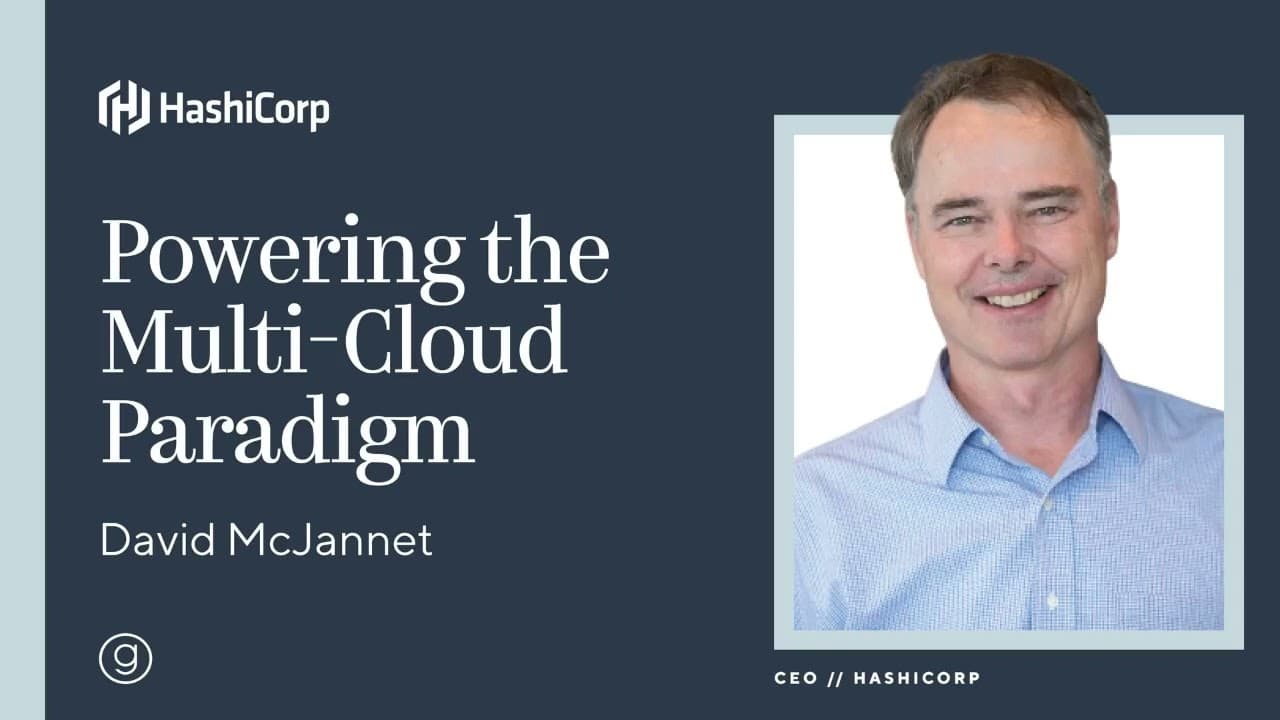
HashiCorp CEO David McJannet | Powering the Multi Cloud Paradigm
TL;DR
HashiCorp is integral to the multi-cloud landscape, providing tools like Terraform and Vault that simplify infrastructure provisioning and security across multiple cloud environments. Its focus on open source promotes standardization and allows organizations to adapt their cloud strategies flexibly, addressing the diverse needs of distributed systems while mitigating vendor lock-in fears.
Transcript
hi everyone welcome to gray matter the podcast from greylock where we share stories about company builders and business leaders i'm jerry chen general partner greylock and today my guest is david mcjanet ceo hashicorp a hashtag corp is one of the defining companies in the cloud and we're super excited to have david today hashtag was started in 2012... Read More
Key Insights
- 😀 The transition to cloud infrastructure has created opportunities for companies like HashiCorp to provide tools that address the challenges of running and securing apps in distributed systems.
- 🤗 Open source plays a crucial role in driving standardization and ecosystem collaboration in the cloud infrastructure market.
- 😶🌫️ The cloud landscape is becoming increasingly multi-cloud, with companies adopting a mix of cloud providers and private data centers to meet their specific needs.
Install to Summarize YouTube Videos and Get Transcripts
Explore YouTube Video Summarizer or Get YouTube Transcript Extractor
Questions & Answers
Q: How has the cloud landscape evolved over the past decade?
The cloud landscape has transitioned from traditional data centers to cloud infrastructure, with companies adopting a multi-cloud approach to meet their specific needs.
Q: What role does open source play in the cloud infrastructure market?
Open source has become a fundamental component in the cloud infrastructure market, providing development leverage, ecosystem standardization, and driving innovation.
Q: How does HashiCorp compete with major cloud providers like Amazon, Azure, and Google?
HashiCorp works closely with major cloud providers, providing infrastructure tools that bridge different cloud environments and enable consistent provisioning and management.
Q: What are some potential opportunities for startups in the cloud infrastructure space?
Startups can focus on providing specialized solutions in areas such as networking, security, data management, and edge computing, as the cloud market continues to evolve and create new demands.
Summary
In this podcast episode, Greylock General Partner Jerry Chen interviews David McJannet, the CEO of HashiCorp, a cloud infrastructure company. They discuss topics such as their time working together at VMware, the success of Cloud Foundry, the journey of HashiCorp, the importance of open source in infrastructure companies, the rise of multi-cloud adoption, and the unbundling of cloud services.
Questions & Answers
Q: What were the main goals and successes of Cloud Foundry during your time at VMware?
Cloud Foundry was built as a platform as a service (PaaS) solution to address the shift in application deployment from traditional app servers to a highly curated runtime platform. This new platform was designed with the intention of simplifying the application deployment process by allowing developers to focus on the code rather than the underlying infrastructure. Cloud Foundry got this right by providing developers with an easy way to deploy their applications through a simple push command. The platform became successful because it addressed the changing needs of developers and provided a more modern approach to app server management.
Q: How did HashiCorp come about and what products does it offer?
HashiCorp was founded with the belief that the transition in infrastructure was shifting from private data centers to the cloud. They developed a suite of products to address the challenges of running and securing apps in distributed systems outside of the data center. Their products include Terraform for infrastructure provisioning, Vault for identity-based security, Consul for networking, and Nomad for job scheduling. These products work together to create a distributed compute fabric that underpins the operations of large-scale companies.
Q: How does HashiCorp approach open source and how does it benefit the company?
HashiCorp is committed to open source because they believe it is essential for building an infrastructure company in today's market. They invite collaboration from the community to build and enhance their projects, while maintaining control over the direction of the projects. This approach allows them to leverage community development and achieve distribution and ecosystem standardization. By making their products open source, they can drive standardization and provide a consistent experience for users. They monetize their products by offering additional features and services for enterprises, while still providing the core functionality as open source.
Q: Is it necessary for infrastructure companies to be open source in order to succeed?
It is harder to drive market standardization without being open source, especially in the infrastructure layer. The core elements of infrastructure, such as security and networking, benefit from open source as it allows for ecosystem standardization. However, in the application layer, where there is less need for standardization, being open source is not necessarily a requirement for success. Companies like Snowflake and Confluent have achieved success without being open source because they offer specialized services that address specific needs.
Q: How does HashiCorp work with big cloud providers like AWS, Azure, and Google Cloud?
HashiCorp partners with and enables big cloud providers rather than competing with them. Their products act as the railroad tracks to cloud, allowing customers to have a consistent way to provision and manage applications across different cloud providers. This collaboration benefits both parties, as HashiCorp enables the adoption of cloud and the cloud providers benefit from increased usage of their infrastructure.
Q: Is multi-cloud adoption becoming the norm?
Yes, multi-cloud adoption has become the reality for most companies. While many companies try to standardize on a few cloud providers, they often end up using multiple clouds due to the diverse needs of different applications and the desire to avoid vendor lock-in. Companies are strategically dealing with this multi-cloud reality, with some preferring different clouds for different workloads or specific regions, resulting in a software stack that runs across multiple clouds.
Q: Are there any risks or challenges associated with using multiple cloud providers?
The biggest challenge is managing the heterogeneity and complexity that comes with using multiple cloud providers. Companies need to establish a common foundation and software stack that can be used across different clouds to ensure consistency and ease of management. Having a consistent stack allows companies to bridge between different clouds, making it easier to build and manage applications that span across multiple clouds.
Q: Are cloud costs decreasing as more workloads are moved to the cloud?
Yes, companies that have moved a significant portion of their workloads to the cloud are starting to see cost savings. The cost of storage, compute, and networking in the cloud is often cheaper than running it in private data centers, even with the cost of cloud services factored in. With good optimization practices, companies can significantly reduce their cloud spending, leading to year-over-year cost savings.
Q: How does the increasing unbundling of cloud services affect companies like HashiCorp?
The unbundling of cloud services is a natural progression as the cloud market evolves. HashiCorp's products, such as Terraform, Vault, and Consul, bridge the gap between different cloud services and provide a unified experience for managing applications across multiple clouds. As cloud providers unbundle their services, there is an increased need for independent solutions that can abstract the complexities of managing applications in a multi-cloud environment.
Q: How does the rise of edge computing and the expansion of the cloud to the edge impact the cloud landscape?
Edge computing is an emerging trend that introduces additional complexity to the cloud landscape. The software stack required for edge environments is similar to what is used in the cloud but with additional considerations for the specific edge targets. This unbundling of services for edge computing brings about new opportunities and challenges, as companies need to adapt their infrastructure and applications to operate effectively in edge environments.
Takeaways
The transition from private data centers to the cloud has driven the need for flexible infrastructure and management solutions. HashiCorp has been at the forefront of providing tools and software stacks that enable companies to run applications in distributed systems securely and efficiently. With the rise of multi-cloud adoption, companies are seeking solutions that bridge the gap between different cloud providers. Open source has played a significant role in the success of HashiCorp and other infrastructure companies, as it drives ecosystem standardization and allows for community collaboration. The unbundling of cloud services has created opportunities for companies like HashiCorp to provide specialized solutions that address specific needs. As the cloud landscape continues to evolve, companies must navigate the complexities of managing applications across multiple clouds and adopt strategies to optimize cloud spending. Edge computing is also a growing trend that introduces new challenges and opportunities for companies looking to extend their infrastructure to the edge.
Summary & Key Takeaways
-
HashiCorp provides a suite of products that address the challenges of running and securing apps in distributed systems, specifically in the transition from private data centers to cloud.
-
The company follows an open source approach, with open source products for development and a commercial model focused on monetizing the usage of products for organizations.
-
The cloud landscape is becoming increasingly multi-cloud, with companies adopting multiple cloud providers and private data centers to meet their specific needs.
-
The unbundling of services in the cloud is creating opportunities for startups to provide specialized solutions in areas such as networking, security, and data management.
Read in Other Languages (beta)
Share This Summary 📚
Summarize YouTube Videos and Get Video Transcripts with 1-Click
Try YouTube Summary with ChatGPT & Claude or YouTube Transcript Generator
Explore More Summaries from Greymatter Podcast (Audio) 📚






Summarize YouTube Videos and Get Video Transcripts with 1-Click
Try YouTube Summary with ChatGPT & Claude or YouTube Transcript Generator