What Is Basic Probability and How Is It Calculated?
TL;DR
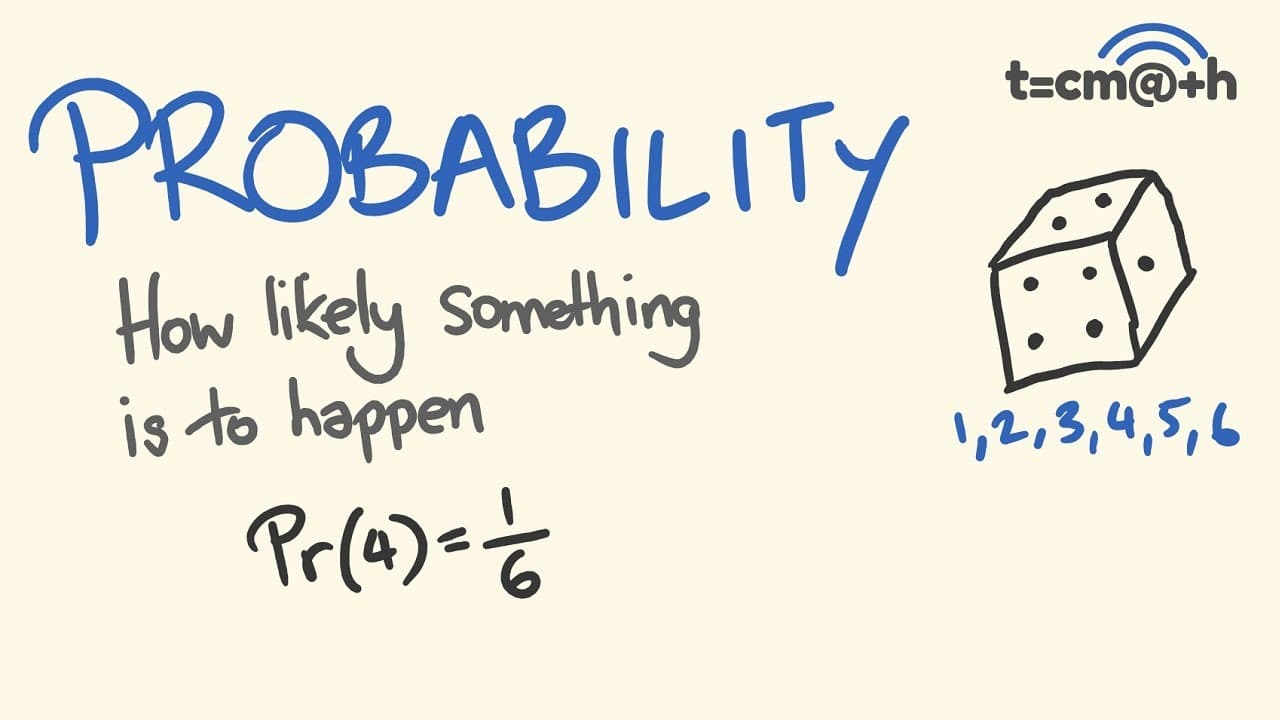
Basic probability measures the likelihood of events occurring and is calculated by dividing the number of favorable outcomes by the total number of possible outcomes. For example, when flipping a coin, there is a 50% chance of landing heads or tails. Understanding the range of probabilities, from 0% (impossible) to 100% (certain), is essential for making decisions based on chance.
Transcript
good day welcome to Tech math channnel what we're going to be having a look at in this video is just basic probability uh it's a nice introduction to probability and there's going to be a series of probability videos coming out so if you're new probability this is probably a really really good start for you so first off in mat when we are talking p... Read More
Key Insights
- ❓ Probability measures the likelihood of events happening.
- #️⃣ The probability of an event is calculated by the number of desired outcomes divided by the total number of possible outcomes.
- 🤪 The range of probabilities goes from 0% chance (impossible) to 100% chance (certain).
- 🟰 Equal chances have a probability of 50%.
- 🆘 Calculating probabilities helps make informed decisions in various scenarios.
- 🤣 Probabilities can be applied to coin flips, dice rolls, and other situations involving random outcomes.
- ❓ Understanding basic probability concepts is essential for more advanced probability calculations.
Install to Summarize YouTube Videos and Get Transcripts
Explore YouTube Video Summarizer or Get YouTube Transcript Extractor
Questions & Answers
Q: What is probability?
Probability is a measure of how likely something is to happen. It quantifies the chances of specific outcomes within a set of possibilities.
Q: How do you calculate probabilities for coin flips and dice rolls?
For coin flips, if there are two possible outcomes (heads or tails), each outcome has a 50% chance or a probability of 0.5. For dice rolls, the probability of rolling a specific number is the number of favorable outcomes divided by the total number of outcomes.
Q: What is the range of probabilities?
The range of probabilities goes from impossible events with 0% chance to certain events with 100% chance. In between, there are equal chances (50%) and varying degrees of likelihood.
Q: How can probabilities be applied to different scenarios?
Probabilities can be used to analyze the likelihood of outcomes in various situations, such as picking marbles randomly or selecting letters from a set. Calculating probabilities helps in making informed decisions.
Summary & Key Takeaways
-
The video introduces probability as a measure of how likely something is to happen, using examples of coin flips and dice rolls.
-
It explains how to calculate the probability of specific outcomes occurring in a given set of possibilities.
-
The video highlights the importance of understanding the range of probabilities, from impossible events (0% chance) to certain events (100% chance).
Read in Other Languages (beta)
Share This Summary 📚
Summarize YouTube Videos and Get Video Transcripts with 1-Click
Try YouTube Summary with ChatGPT & Claude or YouTube Transcript Generator
Explore More Summaries from tecmath 📚



Summarize YouTube Videos and Get Video Transcripts with 1-Click
Try YouTube Summary with ChatGPT & Claude or YouTube Transcript Generator