How To Solve Linear Equations In Algebra
TL;DR
Solve a one-step linear equation by isolating the variable with the opposite operation and applying that operation to both sides. For example, x + 4 = 7 becomes x = 3 after subtracting 4 from each side. You can also reason intuitively, use a number line, and substitute the answer into the original equation, so read on for eight concrete examples and techniques.
Transcript
in this video we're going to focus on solving linear equations so let's begin with this example x plus 4 is equal to 7. how can we solve this linear equation the goal here is to calculate the value of x now you might be wondering what is x x is a variable it has a value that we currently don't know and x is just basically a number we just got to fi... Read More
Key Insights
- ☺️ Linear equations involve finding the value of a variable (x) by manipulating the equation through opposite operations.
- 🤘 Moving variables from one side of the equation to the other changes their sign.
- 🫥 Number lines can be a helpful visual tool to understand and solve linear equations.
- ❓ One can solve linear equations through step-by-step techniques or using intuitive understanding.
- ➗ The division property of equality is used to isolate variables in equations involving multiplication or division.
- 🆘 Simplifying fractions can help in finding the solution to linear equations.
- ❓ Solving linear equations involves reasoning and problem-solving skills.
Install to Summarize YouTube Videos and Get Transcripts
Explore YouTube Video Summarizer or Get YouTube Transcript Extractor
Questions & Answers
Q: How do you solve one-step linear equations in algebra?
Get the variable by itself on one side by performing the opposite operation. Apply the same operation to both sides of the equation; for x + 4 = 7, subtracting 4 from both sides gives x = 3.
Q: What is a variable in a linear equation?
A variable such as x represents a number whose value is currently unknown. Solving the equation means finding that value.
Q: How do you solve x + 9 = 15?
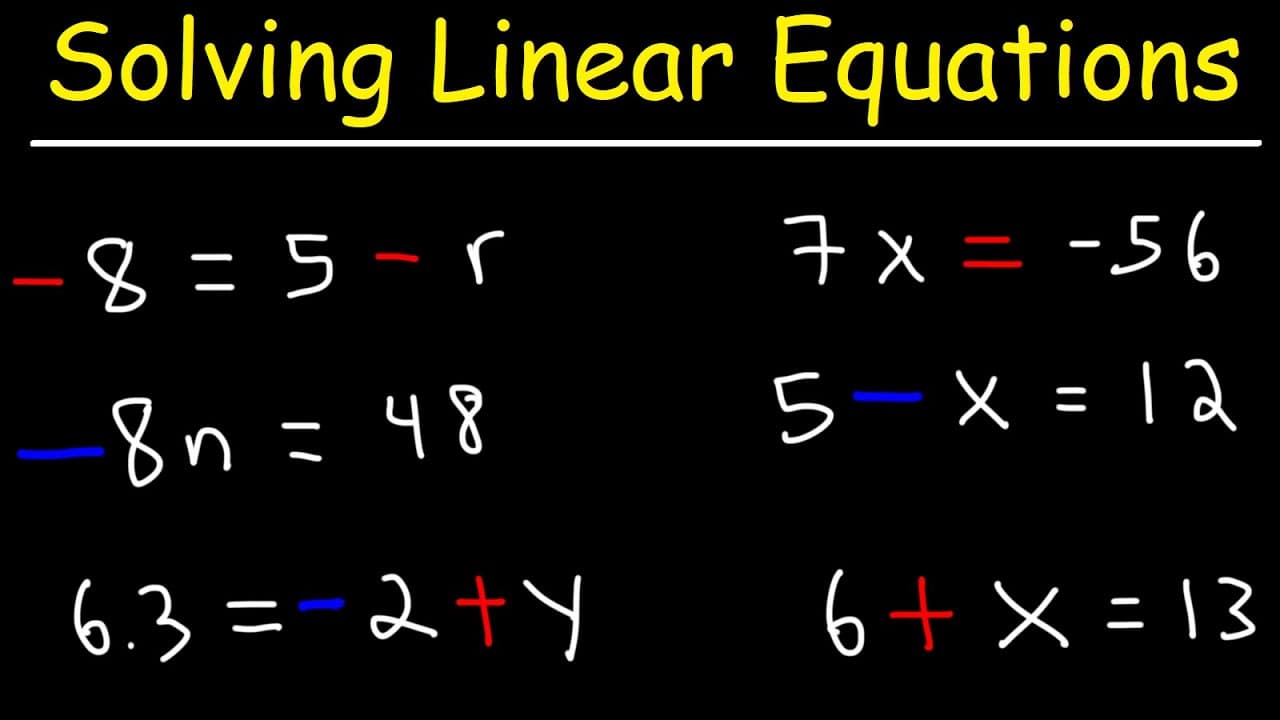
Subtract 9 from both sides so the positive 9 and negative 9 cancel. The result is x = 15 - 9, so x = 6.
Q: How do you solve 6 + x = 13?
Subtract 6 from both sides to isolate x. This gives x = 13 - 6, so x = 7.
Q: How do you solve x - 3 = 9?
Add 3 to both sides because addition is the opposite of subtraction. This gives x = 9 + 3, so x = 12; substituting 12 back confirms that 12 - 3 = 9.
Q: How do you solve an equation when the variable is on the right side?
Use the same opposite-operation process while keeping the variable on the right. For 6.3 = -2 + y, adding 2 to both sides cancels -2 and gives y = 8.3.
Q: How can a number line help with solving linear equations?
A number line can visualize the addition or subtraction used to isolate a variable. Move left when subtracting and right when adding; for example, moving 9 units left from 15 gives 6.
Q: What happens when you move a number to the other side of an equation?
The transcript presents a technique in which the sign changes when a number or variable moves from one side to the other. Moving -7 from the left side to the right makes it +7, so x - 7 = 4 becomes x = 4 + 7 = 11.
Summary & Key Takeaways
-
The video focuses on solving one-step linear equations through examples and step-by-step explanations.
-
It emphasizes the goal of calculating the value of the variable in the equation.
-
The video demonstrates intuitive understanding, opposite operations, and the use of number lines to solve linear equations.
Read in Other Languages (beta)
Share This Summary 📚
Summarize YouTube Videos and Get Video Transcripts with 1-Click
Try YouTube Summary with ChatGPT & Claude or YouTube Transcript Generator
Explore More Summaries from The Organic Chemistry Tutor 📚

Summarize YouTube Videos and Get Video Transcripts with 1-Click
Try YouTube Summary with ChatGPT & Claude or YouTube Transcript Generator