What Are Non-Quadratic Regularizers in Machine Learning?
TL;DR
Non-quadratic regularizers, including one-norm and non-negative regularizers, are crucial for regularized empirical risk minimization. They help reduce overfitting and enhance model generalization by limiting the sensitivity of predictions to changes in input data.
Transcript
hello and welcome to the section on non-quadratic regularizers so remember the idea of regularization we want to choose a theta which both minimizes the empirical risk and also makes the predictor be not too sensitive so if i've got an x near an x tilde then we'd like g theta of x to also be close to g theta of x tilde and the reason for this reduc... Read More
Key Insights
- 🛄 Regularization aims to reduce sensitivity of the predictor and prevent overfitting.
- 🗯️ Choosing the right regularizer requires validation based on the test performance.
- ❓ Lasso regression can be effective in selecting relevant features and improving interpretability of the model.
- 🚱 Non-negative regularizers can enforce constraints on parameter values.
- 🎰 Different regularizers have different characteristics and performance in different machine learning problems.
- 🙈 Regularizers can be seen as encoding prior information or assumptions about the model parameters.
- ™️ The choice between regularizers should consider the trade-off between performance and interpretability.
Install to Summarize YouTube Videos and Get Transcripts
Explore YouTube Video Summarizer or Get YouTube Transcript Extractor
Questions & Answers
Q: What is the purpose of regularization in machine learning?
Regularization is used to minimize empirical risk and prevent overfitting by reducing the sensitivity of the predictor to the training data.
Q: How does regularization work to improve generalization performance?
By adding a regularizer to the objective function, regularization encourages the selection of smaller parameter values, leading to less sensitivity to the training data and better generalization performance.
Q: What is the difference between ridge regression and lasso regression?
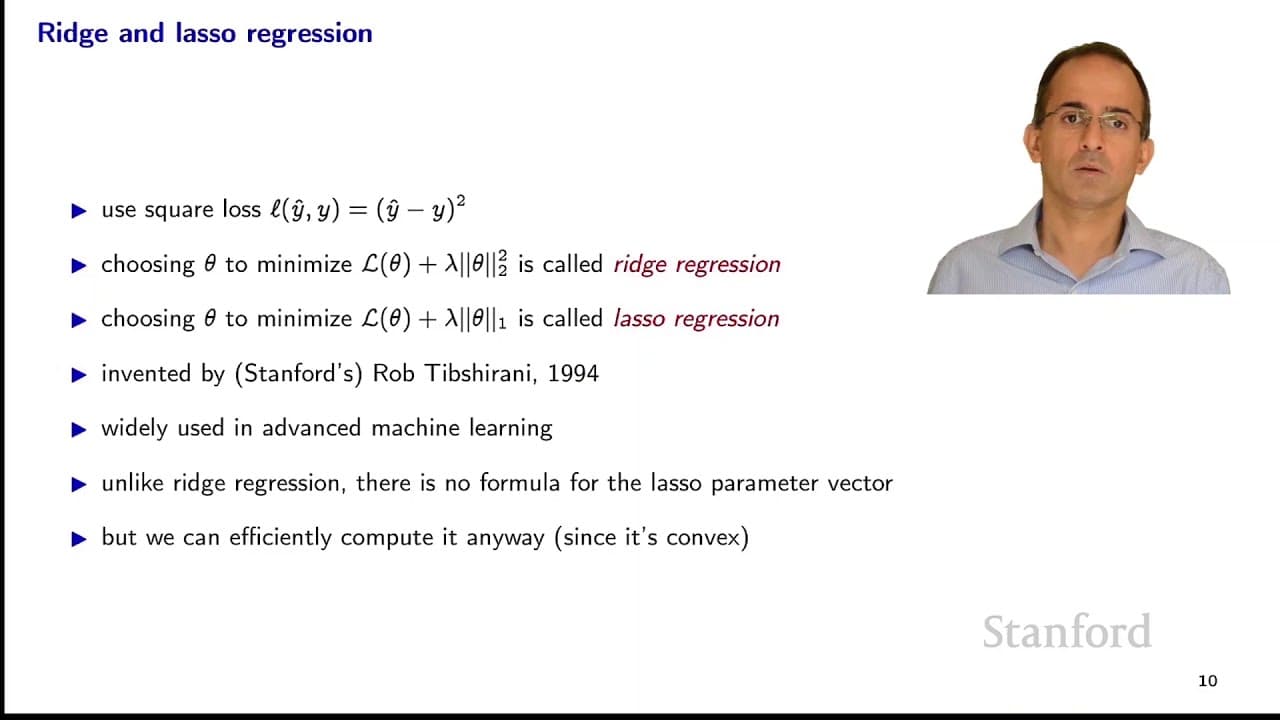
Ridge regression uses the two norm as a regularizer, while lasso regression uses the one norm. Ridge regression tends to shrink parameter values towards zero but does not set them exactly to zero, whereas lasso regression encourages sparsity by setting some parameter values to zero.
Q: How can regularizers be interpreted as prior information about the parameters?
Regularizers can be seen as encoding prior beliefs or assumptions about the model parameters. For example, the one norm regularizer assumes that only a few components of the parameter vector are relevant, promoting sparsity.
Summary & Key Takeaways
-
Regularization aims to minimize empirical risk and reduce sensitivity of the predictor to prevent overfitting.
-
Regularizers, such as the two norm (ridge regression) and the one norm (lasso regression), measure sensitivity and encode prior information about the predictor.
-
The choice between regularizers should be validated using the test set performance.
Read in Other Languages (beta)
Share This Summary 📚
Summarize YouTube Videos and Get Video Transcripts with 1-Click
Try YouTube Summary with ChatGPT & Claude or YouTube Transcript Generator
Explore More Summaries from Stanford Online 📚


Summarize YouTube Videos and Get Video Transcripts with 1-Click
Try YouTube Summary with ChatGPT & Claude or YouTube Transcript Generator