Stanford CS229 Machine Learning I Bias - Variance, Regularization I 2022 I Lecture 10
TL;DR
The bias-variance trade-off explores the relationship between model complexity and performance, while the double descent phenomenon challenges the belief that increasing model complexity always leads to overfitting.
Transcript
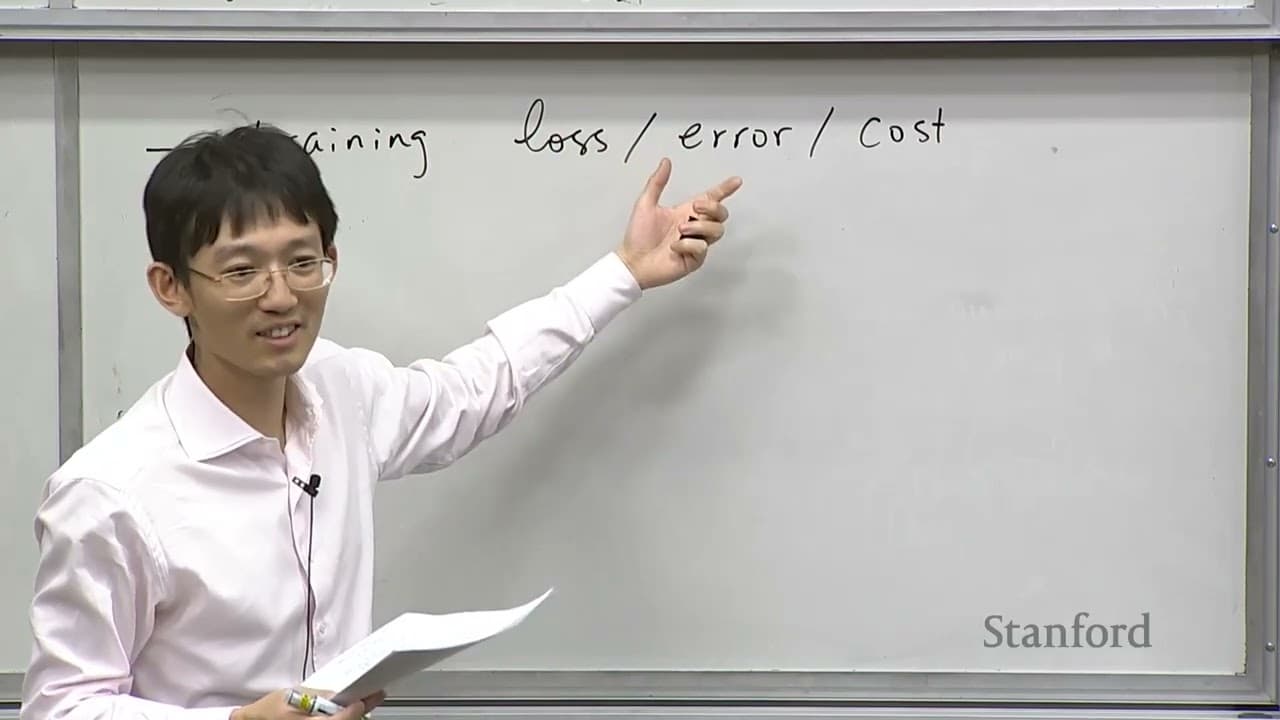
so I think I'll still spend like five minutes just briefly review um on the the bad propagation last time I think I I was running behind last time so so I didn't have time to explain this figure which I think probably would be useful as a high level summary of what's Happening uh I'm going to Omit all the details so so I guess I'm drawing this in t... Read More
Key Insights
- ™️ The bias-variance trade-off is a fundamental concept in modeling, highlighting the trade-off between model complexity, bias, and variance.
- 🛀 The double descent phenomenon challenges the traditional understanding by showing that increasing model complexity can improve performance in certain scenarios.
- 😥 The double descent phenomenon is observed when the number of parameters or data points surpasses a certain threshold.
Install to Summarize YouTube Videos and Get Transcripts
Explore YouTube Video Summarizer or Get YouTube Transcript Extractor
Questions & Answers
Q: What is the bias-variance trade-off?
The bias-variance trade-off refers to the relationship between bias and variance in a model. Bias measures how well the model fits the training data, while variance measures how sensitive the model is to changes in the training data. Increasing model complexity reduces bias but increases variance.
Q: What is the double descent phenomenon?
The double descent phenomenon challenges the traditional belief that increasing model complexity always leads to overfitting. It refers to the occurrence of a second descent in the test error curve when the number of parameters or data points surpasses a certain threshold.
Q: How are bias and variance related?
Bias and variance have an inverse relationship. As bias decreases, variance increases, and vice versa. Finding the right balance between bias and variance is crucial for optimal model performance.
Q: What causes the double descent phenomenon?
The exact cause of the double descent phenomenon is still being explored, but it is believed to be influenced by factors such as model architecture, optimization algorithms, and the interplay between the number of parameters and the amount of available data.
Q: How can the bias-variance trade-off be mitigated?
To mitigate the bias-variance trade-off, one can consider techniques such as regularization, ensemble learning, and cross-validation. Regularization helps reduce variance, while ensemble learning combines multiple models to reduce bias.
Summary & Key Takeaways
-
The bias-variance trade-off demonstrates that as model complexity increases, bias decreases but variance increases. Optimization is required to find the right balance between the two.
-
The double descent phenomenon defies the traditional understanding by showing that increasing model complexity beyond the traditional "optimal" point can actually improve performance.
-
The double descent phenomenon is observed when the number of parameters or data points surpasses a certain threshold, leading to a second descent in the test error curve.
Read in Other Languages (beta)
Share This Summary 📚
Summarize YouTube Videos and Get Video Transcripts with 1-Click
Try YouTube Summary with ChatGPT & Claude or YouTube Transcript Generator
Explore More Summaries from Stanford Online 📚



Summarize YouTube Videos and Get Video Transcripts with 1-Click
Try YouTube Summary with ChatGPT & Claude or YouTube Transcript Generator