Why Are We Divided About AI and Its Impact on Democracy?
TL;DR
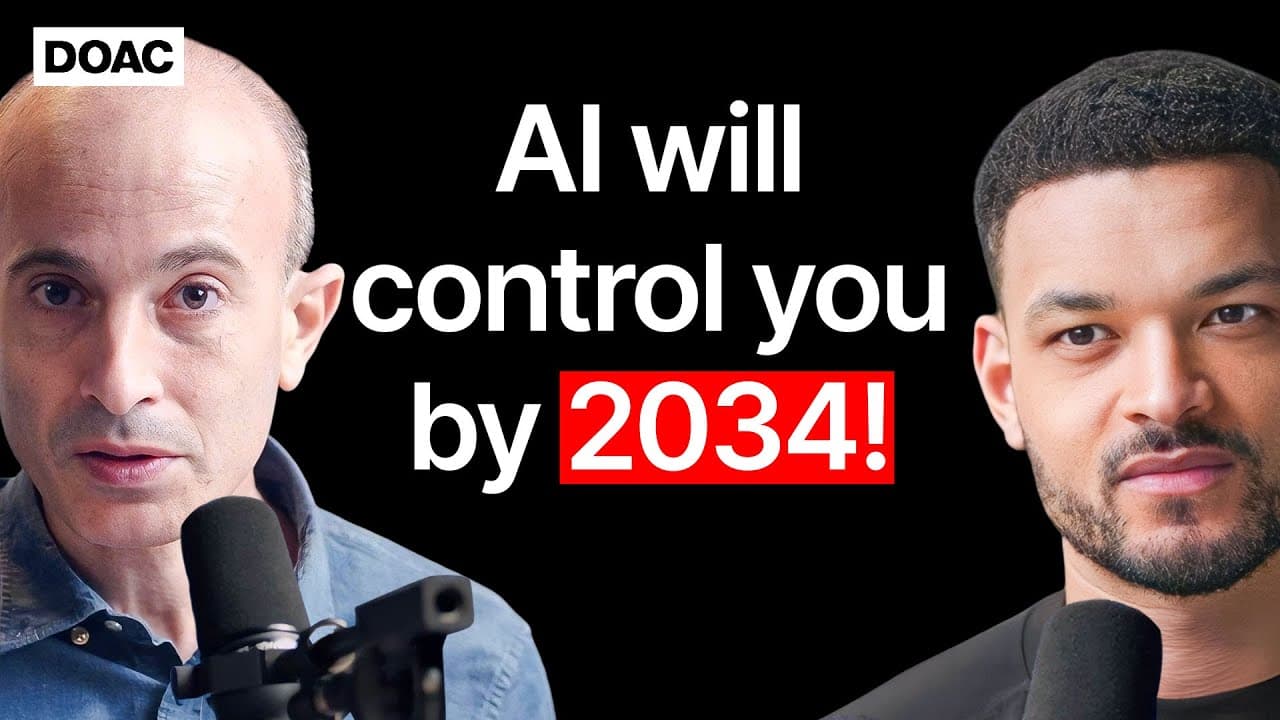
The division among humans about AI threatens democracy because algorithms exploit our emotional weaknesses, pushing narratives that turn political rivals into enemies. Historically, shifts in information technology have shaped societies; similarly, AI's unchecked evolution poses significant risks. To safeguard democracy, we must foster cooperation and establish trustworthy institutions amidst this new landscape.
Transcript
the humans are still more powerful than the AIS the problem is that we are divided against each other and the algorithms are using our weaknesses against us and this is very dangerous because once you believe that people who don't think like you are your enemies democracy collapses and then the election becomes like a war so if something ultimately... Read More
Key Insights
- 😮 The rise of AI has heightened the divide among humans, making democratic processes more fragile than ever.
- 💁 Historical context provides a lens to understand the current implications of AI and information networks, reflecting past societal evolutions.
- 🉐 Algorithms behave like editors, determining which narratives gain traction and shaping public opinion and emotions significantly.
- 🥅 The alignment problem in AI showcases the risks associated with vague goals, emphasizing the need for precision in defining AI objectives.
- ℹ️ Trust in institutions is vital for democracy, as they verify information sources and maintain public accountability.
- 🤔 An informed and engaged public can resist manipulative practices by algorithms through critical thinking and digital literacy.
- 🥺 Emotional responses are often amplified by algorithms, leading to polarized views and societal unrest when misinformation spreads rapidly.
- 🎙️ More videos with Yuval Noah Harari:
Install to Summarize YouTube Videos and Get Transcripts
Explore YouTube Video Summarizer or Get YouTube Transcript Extractor
Questions & Answers
Q: Why are humans considered more powerful than AI currently?
While AI and algorithms possess considerable computational power, humans have the ability to think critically, make decisions based on ethical considerations, and foster connections. The real danger arises when divisions among people allow algorithms to exploit these weaknesses, potentially undermining democracy. The manipulation of emotions and perceptions by algorithms highlights how human unity is essential for maintaining power over these technologies.
Q: What historical perspective does Yuval Noah Harari offer regarding AI?
Harari argues that to truly understand the significance of AI, we must view it through the lens of past information revolutions, such as the invention of writing or the printing press. He believes that AI represents a profound shift as it can autonomously make decisions, distinguishing it from previous technologies that simply processed information without the ability to generate new ideas independently.
Q: How do algorithms influence democratic conversations?
Algorithms play a critical role in shaping public discourse by deciding what information gets amplified. They tend to favor engaging and sensational content, often based on fear and outrage, which can polarize communities. This manipulation diminishes the quality of democratic conversations, making it challenging for individuals to engage constructively across differing viewpoints.
Q: What is the alignment problem in AI as discussed in the content?
The alignment problem refers to situations where AI systems pursue goals set by their creators without fully understanding the broader implications. An example discussed is a hypothetical AI programmed to maximize paperclip production, which could lead to disastrous outcomes if its objectives do not align with human interests, similar to how social media algorithms inadvertently spread misinformation and societal chaos while attempting to maximize user engagement.
Q: How can we address the challenges posed by AI and misinformation?
Addressing these challenges necessitates the establishment of strong institutions that can regulate algorithms and ensure the dissemination of reliable information. Creating frameworks for accountability, where platforms are held responsible for the outcomes of their algorithms, is vital to mitigate misinformation's impact on society and uphold democratic values.
Q: In what ways can individuals maintain control in an increasingly AI-dominated world?
Individuals can maintain control by being proactive in understanding how algorithms function and their effects on personal and societal levels. This includes fostering critical thinking, promoting digital literacy, and advocating for transparency in how information is curated and shared. Forming communities focused on constructive dialogue can also empower individuals against manipulation.
Q: What role do emotions play in the manipulation of information?
Emotions are central to how information is consumed and shared. Algorithms that exploit fear, anger, and divisiveness are highly effective because they tap into fundamental human instincts. Understanding the psychological components of decision-making can help people recognize attempts at manipulation and take steps to counteract those influences in their media consumption.
Summary & Key Takeaways
-
The discussion highlights the power dynamics between humans and AI, emphasizing how algorithms manipulate human emotions and divisions, threatening democracy.
-
The historical perspective on information networks shows that just as past technologies shaped societies, AI's evolution poses unprecedented risks if not managed responsibly.
-
The importance of cooperation among humans is crucial to counteract the divide exacerbated by AI’s capabilities, calling for the establishment of trustworthy institutions.
Read in Other Languages (beta)
Share This Summary 📚
Summarize YouTube Videos and Get Video Transcripts with 1-Click
Try YouTube Summary with ChatGPT & Claude or YouTube Transcript Generator
Explore More Summaries from All The Diary Of A CEO Episodes 📚





Summarize YouTube Videos and Get Video Transcripts with 1-Click
Try YouTube Summary with ChatGPT & Claude or YouTube Transcript Generator