How to Build an AI Agent for Financial Reports
TL;DR
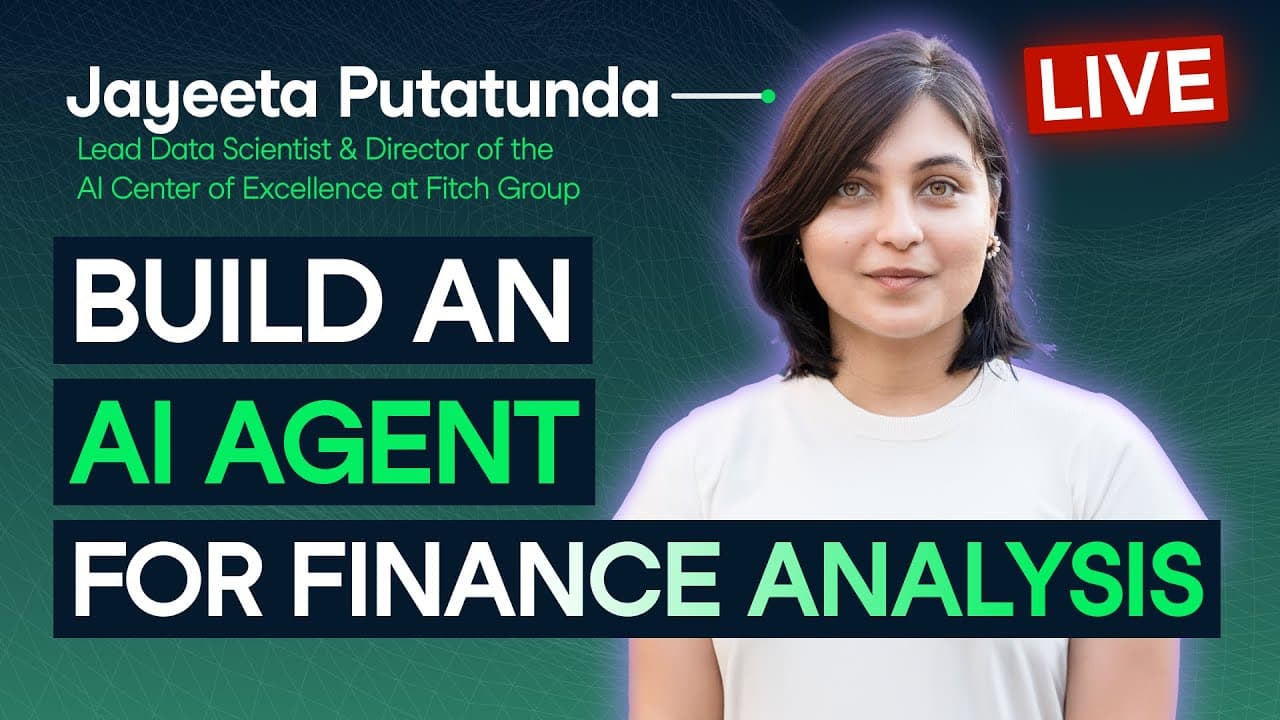
Build a financial report analysis agent by defining a valuable task, connecting appropriate tools and knowledge sources, and breaking the workflow into manageable steps. Keep human oversight at every evaluation layer, measure performance before production, and avoid adding an agent when a traditional machine learning model can solve the problem more simply.
Transcript
hi there data scamps and data champs this is Richie now before we get started I just want to say it's pretty amazing the uh comments here are started by someone called starter Joe that's felt very impressive to me uh so hi Joe hi to everyone else who's joining uh I'm very excited for this session uh and the reason for that is that AI agents are the... Read More
Key Insights
- AI agents are task-oriented systems that automate defined pieces of work by coordinating tools, memory, planning, and reasoning. Their purpose is to reduce manual orchestration of steps that people would otherwise perform sequentially or in parallel.
- Financial report analysis is a suitable agent use case because reporting includes repetitive work that software can assist with. The intended benefit is less manual effort, while analysts retain responsibility for oversight and focus on more engaging activities.
- A problem-first approach is essential when choosing an AI agent use case. An organization should confirm that the agent adds business value instead of forcing an agent into a workflow that a traditional machine learning model could solve more simply.
- Tools allow an agent to interact with external functions and gather information from other sources. Examples in the session include looking up unfamiliar concepts, identifying links, producing summaries, and searching for recently released papers within a coded workflow.
- Memory provides the context available to an agent, including databases, knowledge bases, instructions, and conversation history. This stored context helps the language model understand the task, relevant information, and earlier interactions when producing a response.
- Planning breaks complicated instructions into smaller, ordered actions. Instead of treating a broad goal such as booking a ticket as one operation, the agent determines the necessary steps and invokes tools or memory as required throughout the workflow.
- Reasoning supports the agent as it moves through a plan and determines what should happen after each completed step. Breaking large prompts into smaller components also reduces the chance that a language model will miss nuanced instructions.
- Human oversight remains necessary even when an agent operates independently within individual workflow steps. Results must be reviewed through an evaluation framework, and an agent should not be placed into production before its services and performance have been assessed.
Install to Summarize YouTube Videos and Get Transcripts
Explore YouTube Video Summarizer or Get YouTube Transcript Extractor
Questions & Answers
Q: What are the main components of an AI agent?
The three baseline components presented are tools, memory, and planning, with reasoning also supporting the workflow. Tools perform external functions or retrieve information. Memory provides databases, knowledge bases, instructions, and chat history. Planning divides a complicated request into manageable steps, while reasoning helps the agent decide how to proceed through those steps until the defined task is complete.
Q: How can AI agents improve financial report analysis?
AI agents can automate repetitive parts of financial reporting and coordinate processes that analysts might otherwise manage manually. This assistance can reduce tedious work and let analysts concentrate on more engaging activities. The description also connects report analysis with downstream work such as market research, credit scoring, and report generation, while emphasizing that human supervision and performance evaluation remain necessary.
Q: How should a financial AI agent use tools?
A financial AI agent should use tools when the workflow requires external functions or information beyond its immediate context. The session gives examples such as looking up a concept, identifying relevant links, writing a summary, and searching for recently released papers. Tool calls allow these activities to occur within the coded workflow instead of requiring a person to create and manage a separate process.
Q: What does memory do in an AI agent?
Memory supplies the information and context an agent needs to understand and execute a request. It can include an organizational database, a knowledge base, prior instructions, details about the problem, and the history of a conversation. By accessing this material, the language model can connect the current task with information that was supplied earlier and use relevant context throughout the workflow.
Q: How does planning help an AI agent complete complex tasks?
Planning converts a broad instruction into a sequence of smaller actions. For a request such as booking a ticket, the agent must determine how to move from the initial goal to visiting a suitable resource, searching with relevant terms, and completing later steps. During that sequence, it can use tools or memory wherever needed instead of attempting to solve the entire request at once.
Q: Why is human oversight required for financial AI agents?
Human oversight is required because limited autonomy does not mean that an entire process should run without supervision. The session states that people should remain involved at each workflow and evaluation layer to confirm that results are correct and that the system is moving in the right direction. Services and agent performance also need evaluation before the system is placed into production.
Q: What is the difference between AI agents and agentic AI?
AI agents are described as task-oriented systems with limited autonomy. They learn from the instructions and knowledge base available to them, but they do not automatically optimize their own output or performance at that level. Agentic AI is presented as more goal-oriented, with broader behavior that can include performance optimization rather than execution of only a narrowly defined task.
Q: When should a business avoid building an AI agent?
A business should avoid building an agent when the proposed use case does not add meaningful value or when a traditional machine learning model can solve the problem adequately. The recommended approach begins with the business problem, not with a desire to deploy a fashionable technology. This prevents unnecessary complication and reduces the risk of overengineering a workflow that needs a simpler solution.
Summary & Key Takeaways
-
AI agents can reduce the repetitive work involved in financial reporting, allowing analysts to spend more time on engaging or valuable activities. The session presents a step-by-step, open-source approach designed to make the architecture understandable and implementable without requiring an overly complicated infrastructure or an end-to-end autonomous system.
-
An agent receives a user request and coordinates tools, memory, planning, and reasoning to complete a defined task. Tools provide external functions, memory supplies context and prior information, and planning divides complex instructions into smaller steps. Reasoning then helps the system proceed through those steps in an appropriate sequence.
-
Financial agents should be developed with a problem-first approach and evaluated before production use. Human supervision remains necessary at workflow and evaluation layers, even when individual steps operate with limited autonomy. The session distinguishes task-oriented AI agents from broader agentic AI systems that pursue goals and can optimize their performance.
Read in Other Languages (beta)
Share This Summary 📚
Summarize YouTube Videos and Get Video Transcripts with 1-Click
Try YouTube Summary with ChatGPT & Claude or YouTube Transcript Generator