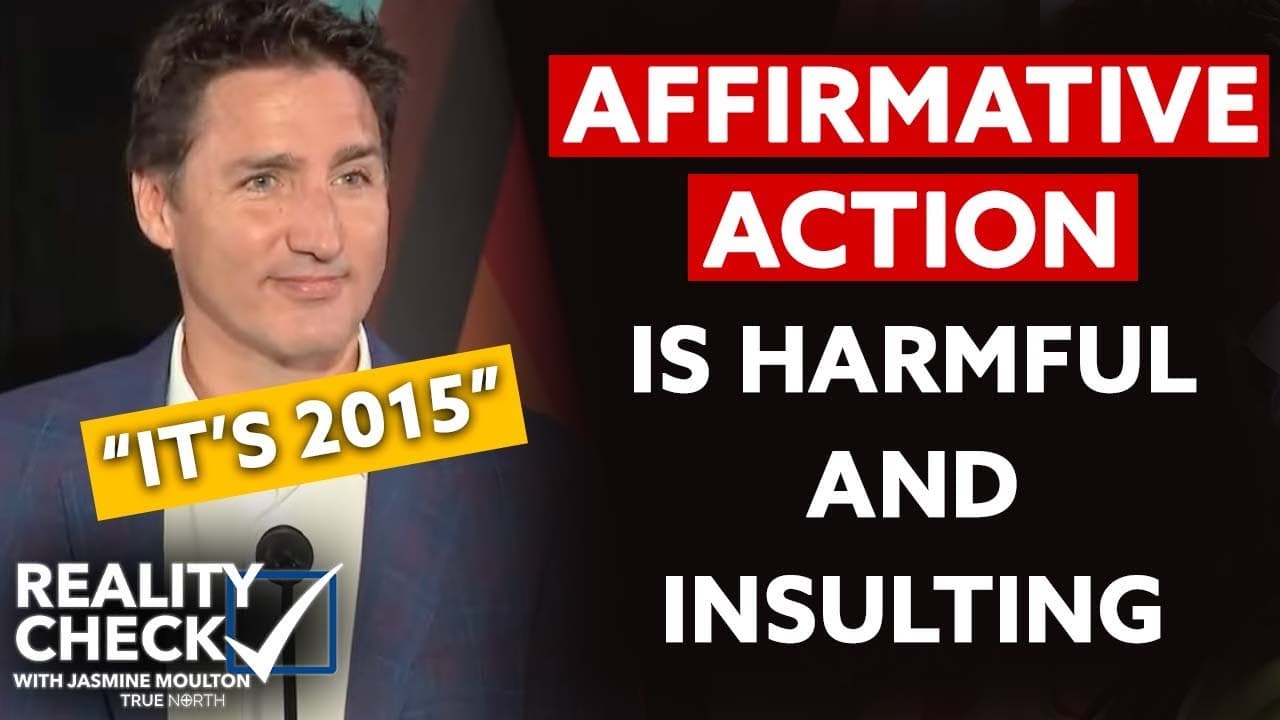
Affirmative Action is harmful and insulting
TL;DR
Government policies on diversity and inclusion may perpetuate discrimination rather than address real inequities.
Transcript
the government's commitment to diversity equity and inclusion sounds great on paper but in reality it's identity politics which is discriminatory and bad for Canada I'm Jasmine Moulton and it's time for another episode of reality check every week on reality check we take on one leftist argument and this week we're taking on affirmative action now l... Read More
Key Insights
- 🥺 Diversity, equity, and inclusion policies are critiqued for prioritizing group identity over individual merit, leading to superficial understandings of diverse representation.
- 👥 Affirmative action measures claimed to redress historical inequalities may, in practice, perpetuate discrimination and undermine the credibility of those within the designated groups.
- ❓ The concept of equity as envisioned in policy often overlooks individual differences, suggesting unrealistic solutions to complex societal issues.
- ⚾ Government attempts to address gender and racial representation in leadership roles may result in tokenism rather than genuine inclusion based on qualifications and capabilities.
- 🧑🏭 The challenges associated with the wage gap are framed as more complex than mere discrimination, requiring a nuanced approach that considers various contributing factors beyond identity.
- 🖤 Moulton presents the argument that existing diversity initiatives often lack critical engagement with the root causes of inequality, focusing instead on appearance rather than substantial change.
- ❓ There is a call for the prioritization of merit over identity politics in government hiring practices to promote true equality and individual recognition.
Install to Summarize YouTube Videos and Get Transcripts
Explore YouTube Video Summarizer or Get YouTube Transcript Extractor
Questions & Answers
Q: What argument is Jasmine Moulton making against affirmative action in Canada?
Jasmine Moulton argues that affirmative action policies, designed to address historical inequities, actually perpetuate discrimination and undermine the credibility of groups they aim to help. She believes that these policies rely too heavily on superficial identity markers rather than addressing the root causes of inequality, thus failing to support true meritocracy.
Q: How does Moulton critique the concept of diversity as defined by the government?
Moulton critiques the government's definition of diversity as being superficial and limited to characteristics such as race and gender. She argues that it fails to encompass diversity of thought and individual experiences. The government's approach, according to her, equates diversity with a visual representation of different identities rather than acknowledging varied perspectives and ideas.
Q: What issues does Moulton raise about the concept of equity as part of government policy?
She explains that the concept of equity, depicted through common graphics, is flawed as it implies that all individuals can be placed on the same level regardless of their unique circumstances and choices. Moulton contends that attempting to achieve equity ignores inherent differences among people, rendering attempts to equalize outcomes inherently unrealistic and potentially harmful.
Q: In what way does Moulton suggest that current inclusion policies may harm the very groups they aim to help?
Moulton suggests that inclusion policies, which prioritize hiring based on immutable characteristics, can lead to tokenism and a feeling of inferiority among appointees. She argues that these policies imply that individuals from designated groups need extra help to succeed, which could undermine their self-esteem and diminish their perceived merit in their roles.
Summary & Key Takeaways
-
The content critiques the government's focus on diversity, equity, and inclusion, arguing that these measures often ignore individual circumstances and perpetuate superficial identity politics rather than addressing real issues of inequality.
-
It highlights specific examples from Canadian policy, including gender-balanced cabinets and initiatives aimed at reducing wage gaps, questioning the effectiveness and ethical implications of such approaches on actual discrimination.
-
The episode underscores the need for merit-based systems, suggesting that current affirmative action policies risk tokenism and undermine the achievements of those from designated groups.
Read in Other Languages (beta)
Share This Summary 📚
Summarize YouTube Videos and Get Video Transcripts with 1-Click
Try YouTube Summary with ChatGPT & Claude or YouTube Transcript Generator
Explore More Summaries from True North 📚





Summarize YouTube Videos and Get Video Transcripts with 1-Click
Try YouTube Summary with ChatGPT & Claude or YouTube Transcript Generator