How Humidity and Droplet Size Affect Pathogen Viability
TL;DR
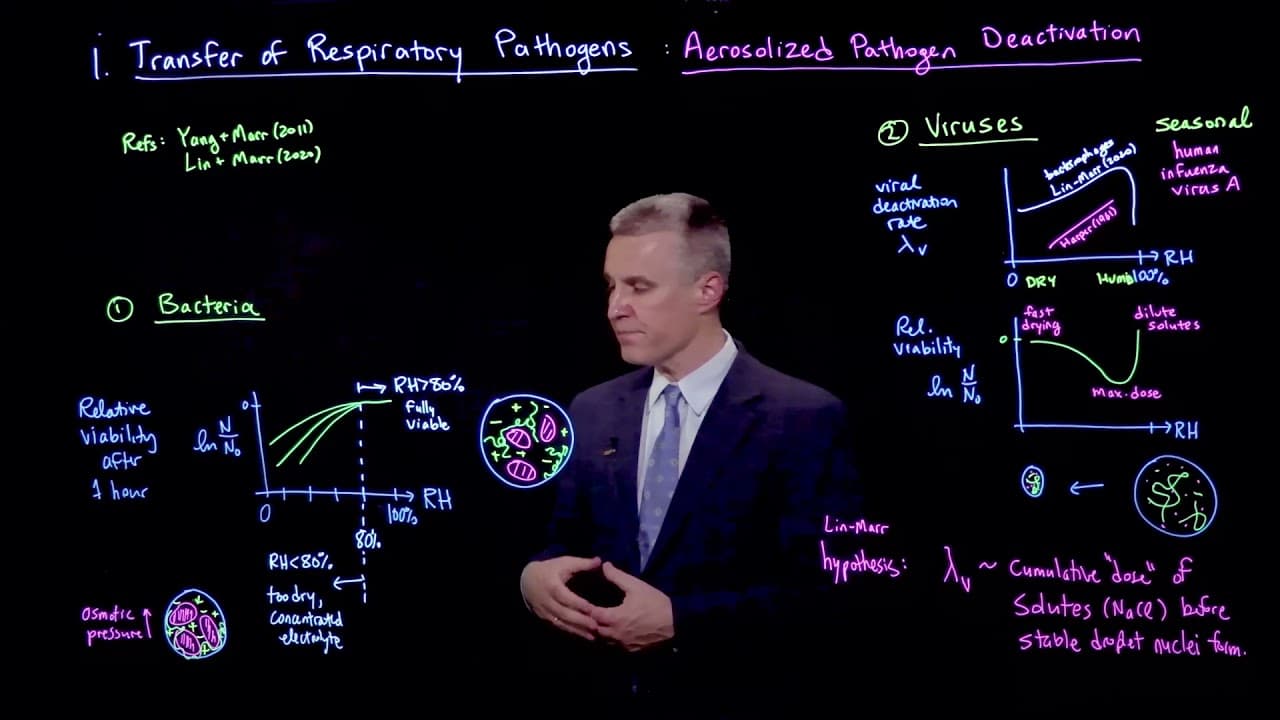
Humidity and droplet size significantly influence the viability of respiratory pathogens. While bacteria thrive at higher humidity levels, their viability decreases in dry conditions due to osmotic pressure. Interestingly, viruses deactivation rates are higher in humid air, with an optimal range of 60% to 80% humidity actually minimizing their viability.
Transcript
PROFESSOR: So we've discussed the extent to which the size of a droplet can influence the infectivity or the ability of a virion to escape from that droplet and, also, to be transmitted to the deepest, smallest passages in the lungs as a function of its size. There is also a dependence on the relative humidity of the air, which is related to size. ... Read More
Key Insights
- 💦 Droplet size and humidity play crucial roles in pathogen viability and transmission.
- 😘 Bacteria viability decreases at lower humidity levels due to increased osmotic pressure.
- ☠️ Viral deactivation rates are higher in more humid air, but there is an optimal range for minimizing viability.
Install to Summarize YouTube Videos and Get Transcripts
Explore YouTube Video Summarizer or Get YouTube Transcript Extractor
Questions & Answers
Q: How does droplet size influence pathogen infectivity?
Droplet size plays a role in the viability and transmission of pathogens. As droplets shrink, the concentration of solutes increases, leading to higher osmotic pressure on bacteria. This can cause stress on the cell and result in deactivation.
Q: What is the relationship between humidity and bacterial viability?
Above a threshold of around 80% relative humidity, bacterial viability remains unchanged. However, as humidity decreases, the viability drops significantly. This is due to the increase in osmotic pressure caused by shrinking droplets and higher solute concentration.
Q: How does humidity affect viral deactivation?
Viral deactivation rates are faster in humid air and slower in dry air. The seasonal nature of the flu can be partly explained by this relationship. In more humid environments, the virus deactivates faster, leading to a lower transmission rate.
Q: What is the optimal humidity range for minimizing viral viability?
Recent experiments with bacteriophages suggest that there is an optimal range of around 70% to 80% humidity for minimizing viral viability. This range ensures a sufficient exposure to solutes present in the droplets, leading to higher deactivation rates.
Summary & Key Takeaways
-
Droplet size and humidity can affect the infectivity and transmission of pathogens.
-
Bacteria viability is reduced at lower humidity levels due to an increase in osmotic pressure, leading to cell stress and deactivation.
-
Viral deactivation rates are higher in more humid air, but there is a non-monotonic dependence on humidity, with an optimal range of 70% to 80% for minimizing viability.
Read in Other Languages (beta)
Share This Summary 📚
Summarize YouTube Videos and Get Video Transcripts with 1-Click
Try YouTube Summary with ChatGPT & Claude or YouTube Transcript Generator
Explore More Summaries from MIT OpenCourseWare 📚


Summarize YouTube Videos and Get Video Transcripts with 1-Click
Try YouTube Summary with ChatGPT & Claude or YouTube Transcript Generator