What Are Semaphores and How Do They Work?
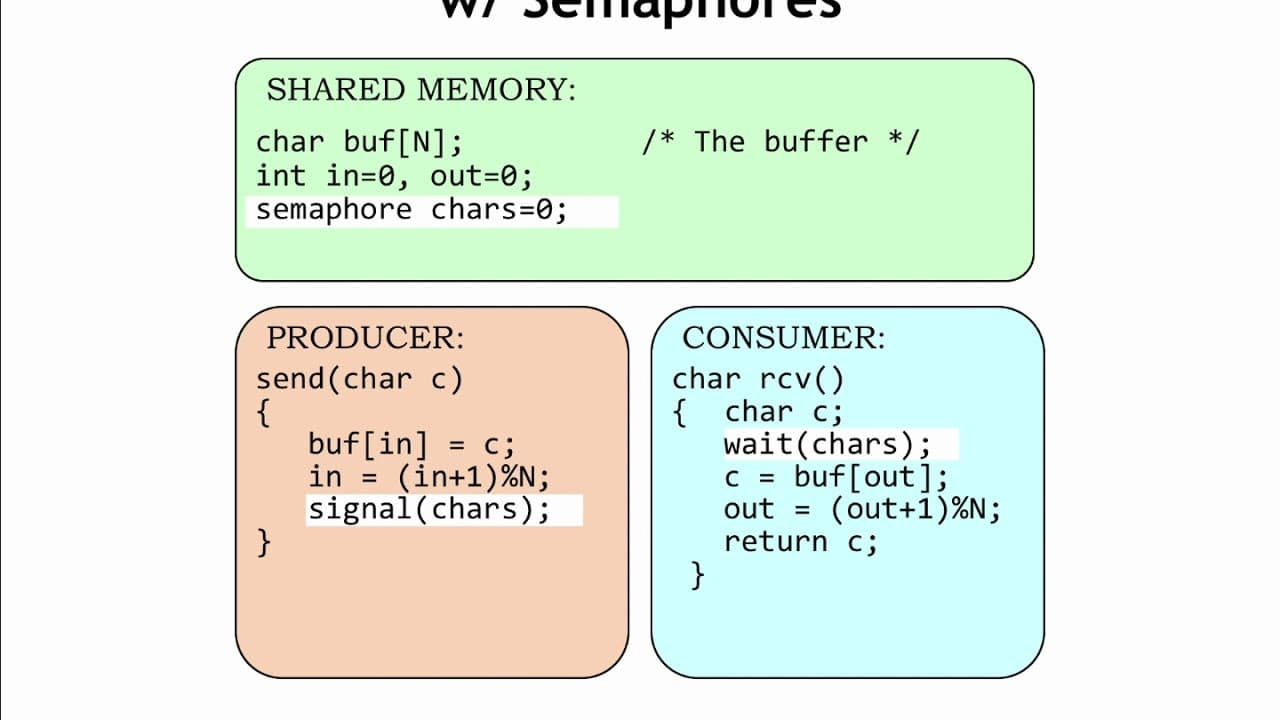
TL;DR
Semaphores are synchronization tools that manage access to shared resources in programming, using two operations: WAIT and SIGNAL. WAIT decrements the semaphore value when it's greater than zero, while SIGNAL increments it, thus controlling process execution order. They help prevent issues like buffer overflow and ensure proper synchronization within concurrent programs.
Transcript
What we'd like to do is to create a single abstraction that can be used to address all our synchronization needs. In the early 1960's, the Dutch computer scientist Edsger Dijkstra proposed a new abstract data type called the semaphore, which has an integer value greater than or equal to 0. A programmer can declare a semaphore as shown here, specify... Read More
Key Insights
- 🚦 Semaphores are an abstract data type introduced by Edsger Dijkstra in the 1960s as a synchronization mechanism.
- 🚦 WAIT and SIGNAL operations are used to control semaphore values and synchronize processes.
- 🚦 Semaphores can be used to implement precedence constraints and manage shared resources.
- 🔨 They are an essential tool for ensuring correct synchronization and coordination in concurrent programs.
- 😒 The use of semaphores helps prevent issues such as buffer overflow and ensure proper order of execution.
- 🚦 Semaphores are versatile and can be used in various programming languages and environments.
- 🚦 Understanding semaphores is crucial for developing efficient and reliable concurrent systems.
Install to Summarize YouTube Videos and Get Transcripts
Explore YouTube Video Summarizer or Get YouTube Transcript Extractor
Questions & Answers
Q: What is the purpose of semaphores in computer programming?
Semaphores are used to synchronize the execution of multiple processes or threads and control access to shared resources.
Q: How can semaphores be used to implement precedence constraints?
By using semaphores, programmers can enforce the order of execution between processes or statements, ensuring that one completes before another begins.
Q: What is the role of the WAIT operation in semaphores?
The WAIT operation in semaphores suspends execution until the semaphore value is non-zero, guaranteeing synchronization between processes or threads.
Q: How can semaphores help manage shared resources?
Semaphores can be used to allocate and return resources from a shared pool, ensuring that a specified number of resources are available for exclusive use.
Summary & Key Takeaways
-
Semaphores are an abstract data type used for synchronization in computer programs.
-
They have an integer value greater than or equal to 0 and can be accessed with the WAIT and SIGNAL operations.
-
WAIT waits until the semaphore has a value greater than 0 and decrements it, while SIGNAL increments the semaphore value.
Read in Other Languages (beta)
Share This Summary 📚
Summarize YouTube Videos and Get Video Transcripts with 1-Click
Try YouTube Summary with ChatGPT & Claude or YouTube Transcript Generator
Explore More Summaries from MIT OpenCourseWare 📚


Summarize YouTube Videos and Get Video Transcripts with 1-Click
Try YouTube Summary with ChatGPT & Claude or YouTube Transcript Generator