Lewitt LCT 440 Pure vs Rode NT1: Which Microphone Is Better?
TL;DR
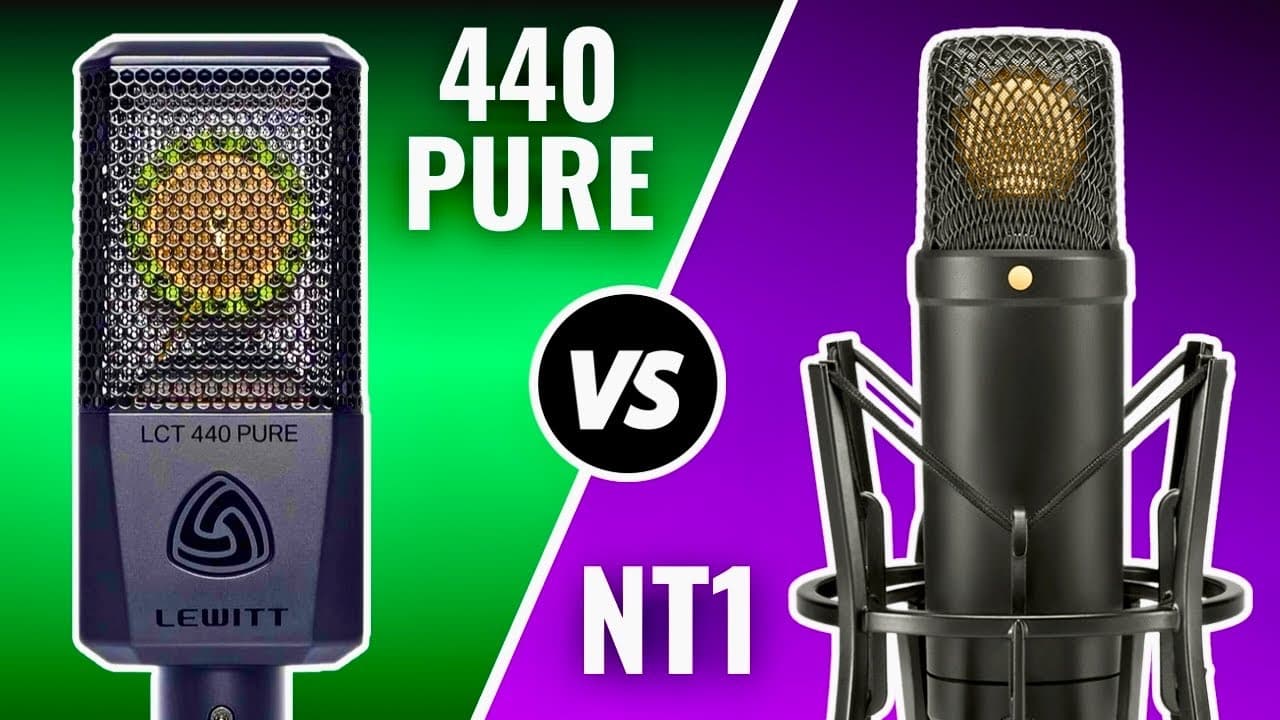
The Rode NT1 is ideal for a neutral sound profile, making it great for voice-over applications, while the Lewitt LCT 440 Pure offers a brighter tone, suitable for vocals and acoustic instruments. Prices are $269 for the NT1 and $289 for the LCT 440 Pure, with the Rode model including an XLR cable, adding to its value for home studio setups.
Transcript
in this video we're going to be comparing the LD LCT for 40 pure and the rodent T1 4 generation to help you decide if you should consider one of these mics for your home studio first let's talk about the price the rodent T1 fourth generation currently retails for $269 and in the box you'll get the microphone a cloth pouch to store the microphone an... Read More
Key Insights
- 🔊 Both microphones offer high-quality audio capture, but their sound characteristics cater to different recording needs and preferences.
- 😯 The Rodent T1 is best for users needing a flat response for clarity while recording speech; it excels in voice-over applications.
- 👂 The LD LCT 440 Pure is recommended for vocalists who want a prominent sound in their recordings, highlighting its suitability for music applications.
- 👤 Users should consider the associated costs of additional accessories, which the Rodent T1 mitigates with its included XLR cable package.
- 😒 The choice between these microphones ultimately hinges on personal sound preferences and the specific use case, highlighting the importance of matching equipment to recording objectives.
- 🎙️ Both microphones require phantom power, emphasizing the need for dedicated audio interfaces in home studio setups.
- 👂 Recording environments and types of sound sources also heavily influence which microphone may be preferable, especially in acoustic settings.
Install to Summarize YouTube Videos and Get Transcripts
Explore YouTube Video Summarizer or Get YouTube Transcript Extractor
Questions & Answers
Q: What are the main features of the Rodent T1 microphone?
The Rodent T1 is a fourth-generation condenser microphone with a cardioid polar pattern, requiring phantom power. It boasts a frequency response that is fairly flat, which allows it to capture vocals and spoken word applications without colorizing the sound. It includes a cloth pouch, XLR cable, and shock mount with a pop filter, making it a value option for users focused on clarity in their recordings.
Q: How does the sound quality differ between the Rodent T1 and the LD LCT 440 Pure?
The Rodent T1 provides a neutral sound profile with a flat frequency response, making it ideal for applications where clarity is key. In contrast, the LD LCT 440 Pure has a treble boost, offering a brighter and modern sound, particularly enhancing vocals and instruments that require vocal forwardness. This fundamental difference influences how each microphone performs in various recording scenarios.
Q: Who would benefit most from using the Rodent T1 microphone?
The Rodent T1 is recommended for users who prefer neutral sound qualities in their recordings, particularly for voice-over or spoken word applications. It’s also suitable for those who do not want to invest much in additional accessories, given that it comes with a complete kit, including an XLR cable. It excels in vocal applications but may need some EQ adjustments when mixing.
Q: What are the advantages of the LD LCT 440 Pure microphone?
The LD LCT 440 Pure microphone is advantageous for those seeking brighter sound reproduction, making it suitable for singing vocals and acoustic instruments. It comes with higher-quality accessories, like a leather pouch and compact shock mount, ensuring portability. Its frequency boost can benefit users who want their voice to stand out in a mix, making it versatile for different recording needs.
Q: What type of recording applications are best suited for the LD LCT 440 Pure?
The LD LCT 440 Pure is particularly well-suited for singing vocals, as its treble boost helps voices cut through mixes effectively. It’s also excellent for capturing acoustic instruments, adding a desirable sparkle to high-end tones. However, it may not perform as well in long-form spoken word scenarios due to its brightness, which could emphasize sibilance.
Q: How do the included accessories for each microphone compare?
The Rodent T1 comes with a basic set of accessories including a cloth pouch, which offers minimal protection, and a larger shock mount. The LD LCT 440 Pure, however, includes a leather pouch and a more compact shock mount along with a magnetic pop filter, enhancing its value for those who prioritize accessory quality and convenience for on-camera recordings.
Q: do the rode nt1 and lewitt lct 440 pure need phantom power?
Yes, both microphones require phantom power and need a dedicated audio interface to work. They are condenser microphones with cardioid polar patterns, so they capture detail, are most sensitive from the front, and reject sound from the back.
Q: is the rode nt1 or lewitt lct 440 pure better for acoustic guitar?
The Lewitt LCT 440 Pure is the better choice for acoustic guitar according to the reviewer. Its treble boost adds sparkle to the top end without requiring post-production, while the Rode NT1 leaves a bit to be desired in the high frequencies on acoustic instruments.
Q: which has lower self noise rode nt1 or lewitt lct 440 pure?
The Rode NT1 has lower self-noise at 4.5 dBA, compared with 7 dBA for the Lewitt LCT 440 Pure. Both microphones are described as having extremely low self-noise.
Summary & Key Takeaways
-
The Rodent T1 retails for $269 and comes with essential accessories, while the LD LCT 440 Pure is priced at $289 and includes premium accessories, highlighting their differing value propositions.
-
Both microphones are condenser types with cardioid patterns and require phantom power, offering low self-noise levels, but vary significantly in sound characteristic and frequency response.
-
The Rodent T1 provides a flatter, more neutral sound ideal for vocal recordings, while the LD LCT 440 Pure offers a brighter tone, making it more suitable for singing and acoustic instruments.
Read in Other Languages (beta)
Share This Summary 📚
Summarize YouTube Videos and Get Video Transcripts with 1-Click
Try YouTube Summary with ChatGPT & Claude or YouTube Transcript Generator
Explore More Summaries from Home Studio Academy 📚

Summarize YouTube Videos and Get Video Transcripts with 1-Click
Try YouTube Summary with ChatGPT & Claude or YouTube Transcript Generator