Why Does Making Language Models Wider Hit a Limit?
TL;DR
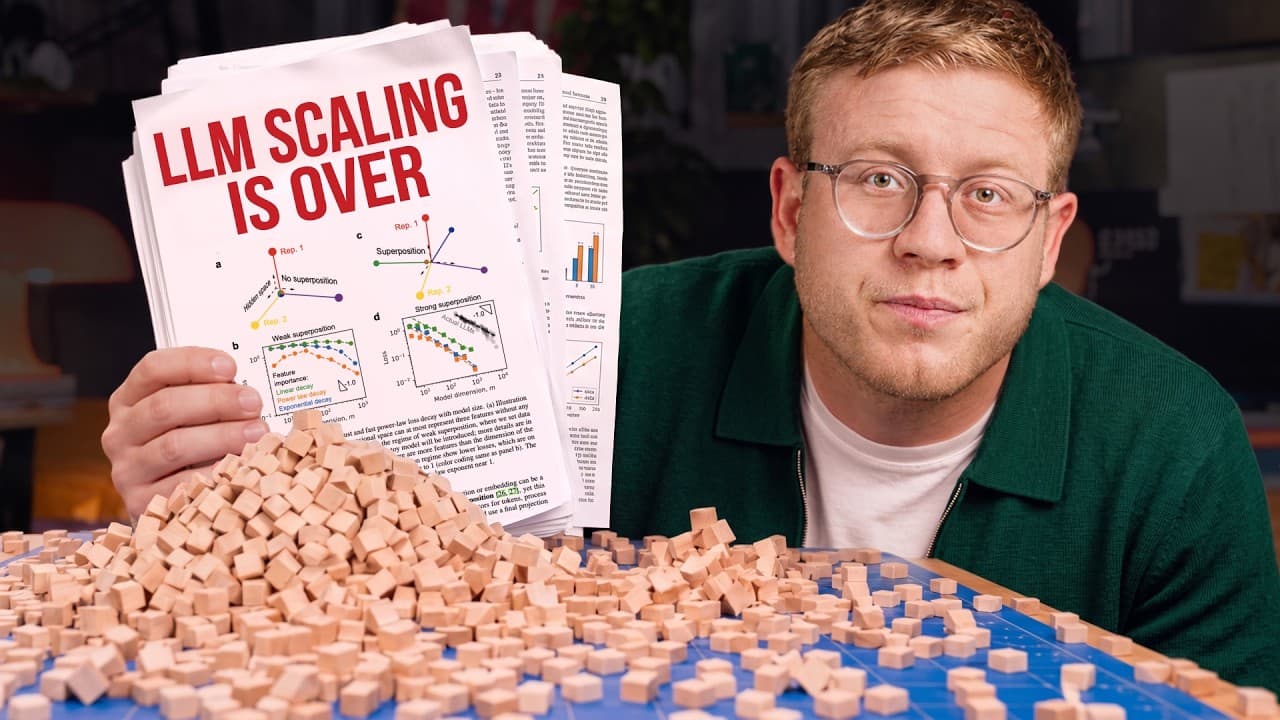
Making a language model wider reduces interference between overlapping concepts, but doubling its width only halves that interference while increasing training cost by an estimated sixfold. Scaling eventually reaches a ceiling when every genuinely independent concept has its own direction, leaving no superposition-related interference to remove, while language’s inherent ambiguity means total error never falls to zero.
Transcript
This represents the total size of GPT-1. A year later, GPT-2 was about this big. Another year after that, GPT-3, the AI model that would eventually power the first version of ChatGPT, was about this big. >> [music] >> And as these models got bigger, so did the performance. And the lesson everyone took from this was bigger equals better, and much bi... Read More
Key Insights
- Self-supervised learning lets language models use enormous collections of text as training data without requiring someone to teach them individual grammar rules. From sources including Wikipedia, books, and the filtered public internet, a model builds a mathematical map connecting words and concepts.
- A language model’s internal width is smaller than the number of concepts it must represent. The transcript describes more than 50,000 distinct words and concepts as a conservative estimate, while a GPT-3-sized model has an internal width of only a little over 12,000 dimensions.
- Superposition is the practice of representing multiple concepts with overlapping directions inside a model’s mathematical space. Instead of discarding less valuable concepts when dimensions become scarce, the model compresses concepts together because they are not all required at exactly the same moment in a sentence.
- Interference occurs when activating one concept partially activates nearby overlapping concepts. This conceptual bleed can cause a model to select a word that is slightly inappropriate or completely wrong, making superposition both a source of representational efficiency and a source of errors.
- Doubling a model’s width halves the interference attributed to overlapping concept representations, according to the formula presented from the MIT research. This relationship explains why wider models can perform better: they give the same crowded collection of concepts more room to separate.
- The estimated training cost rises sixfold whenever model width doubles, even though interference falls only by half. Starting from a stated frontier-model cost of around $300 million, successive doublings are projected to cost approximately $1.8 billion, $11 billion, $65 billion, and $390 billion.
- Zipf’s law constrains the rate at which interference declines because human language contains a small number of extremely frequent words and a large number of rare words. The transcript says this frequency distribution locks the improvement exponent at one over model width.
- The scaling ceiling arrives when model width matches the number of genuinely independent concepts in language. Every concept can then occupy its own direction, eliminating superposition and its associated interference. Further increases in width cannot reduce an interference source that no longer exists.
Install to Summarize YouTube Videos and Get Transcripts
Explore YouTube Video Summarizer or Get YouTube Transcript Extractor
Questions & Answers
Q: Why does increasing a language model’s width improve it?
Increasing a language model’s width gives its learned concepts more room inside the model’s mathematical space. Concepts that previously occupied overlapping directions can spread farther apart, reducing the interference that occurs when one concept accidentally activates another. According to the MIT result described in the transcript, doubling width halves this interference and therefore halves the errors attributed to it.
Q: What is superposition in a language model?
Superposition is the model’s method of fitting more concepts into its internal space than it has independent dimensions. Rather than abandoning less valuable concepts, the model assigns several concepts to overlapping mathematical directions. This arrangement works because every concept is not normally needed at the same instant, but the overlap can make nearby concepts bleed into one another during activation.
Q: How does interference cause language-model errors?
Interference happens because concepts stored in overlapping or nearby directions are not completely independent. When the model tries to activate a specific concept, such as elephant, other concepts sharing similar directions may become slightly active as well. That unwanted activation can influence the model’s prediction, sometimes producing a word that is merely a little off and sometimes one that is completely wrong.
Q: How much does doubling model width reduce interference?
Doubling model width cuts interference in half, according to the mathematical relationship presented from the MIT study. Because the described errors arise from interference among overlapping concepts, those errors are also cut in half. The benefit comes from distributing the same crowded collection of concepts across a wider internal space, allowing their mathematical directions to become more separated.
Q: Why does wider model training become so expensive?
The transcript estimates that every doubling of model width multiplies training cost by six, while reducing interference by only half. A frontier model costing around $300 million to train would therefore rise to about $1.8 billion after one doubling, then approximately $11 billion, $65 billion, and $390 billion after additional doublings, making continued brute-force scaling increasingly difficult.
Q: Why can unlimited funding not remove all model errors?
Unlimited funding could support wider models, but it would not change the stated rate at which interference declines. The exponent is described as being constrained by Zipf’s law and the frequency distribution of human language. Total error also does not reach zero because language often allows several plausible continuations, such as cats, dogs, or pizza after the phrase “I really like.”
Q: How does Zipf’s law limit language-model scaling?
Zipf’s law describes a frequency pattern in which a small number of words are used extremely often while a much larger number are used rarely. The transcript states that this uneven distribution locks the interference-reduction exponent at one over model width. As a result, adding money or computing power cannot make errors decline faster through width scaling alone.
Q: When does widening a language model stop helping?
Widening stops providing this particular benefit when the model has enough dimensions for every genuinely independent concept to occupy its own direction. At that point, the model no longer needs superposition, so there is no overlapping representation and no related interference left to reduce. Making the model wider beyond that ceiling therefore buys nothing through the mechanism described in the study.
Summary & Key Takeaways
-
Language models learn mathematical relationships among words and concepts through self-supervised learning on sources such as Wikipedia, books, and the public internet. Because their internal spaces have fewer dimensions than the concepts they represent, models place multiple concepts in overlapping directions, a strategy known as superposition that enables efficient representation but creates interference.
-
The MIT study described in the transcript gives a mathematical exchange rate for scaling: doubling a model’s width halves interference and related errors. However, each doubling is estimated to multiply training cost by six, potentially raising a roughly $300 million frontier training run to $1.8 billion, then $11 billion, $65 billion, and $390 billion.
-
Scaling cannot eliminate every language-model error because ordinary language often permits several reasonable continuations rather than one uniquely correct answer. It also reaches a structural ceiling when model width equals the number of genuinely independent linguistic concepts. At that point, superposition and its interference disappear, so additional width provides no further benefit through this mechanism.
Read in Other Languages (beta)
Share This Summary 📚
Summarize YouTube Videos and Get Video Transcripts with 1-Click
Try YouTube Summary with ChatGPT & Claude or YouTube Transcript Generator