How to Grow Passive Income With Dividends
TL;DR
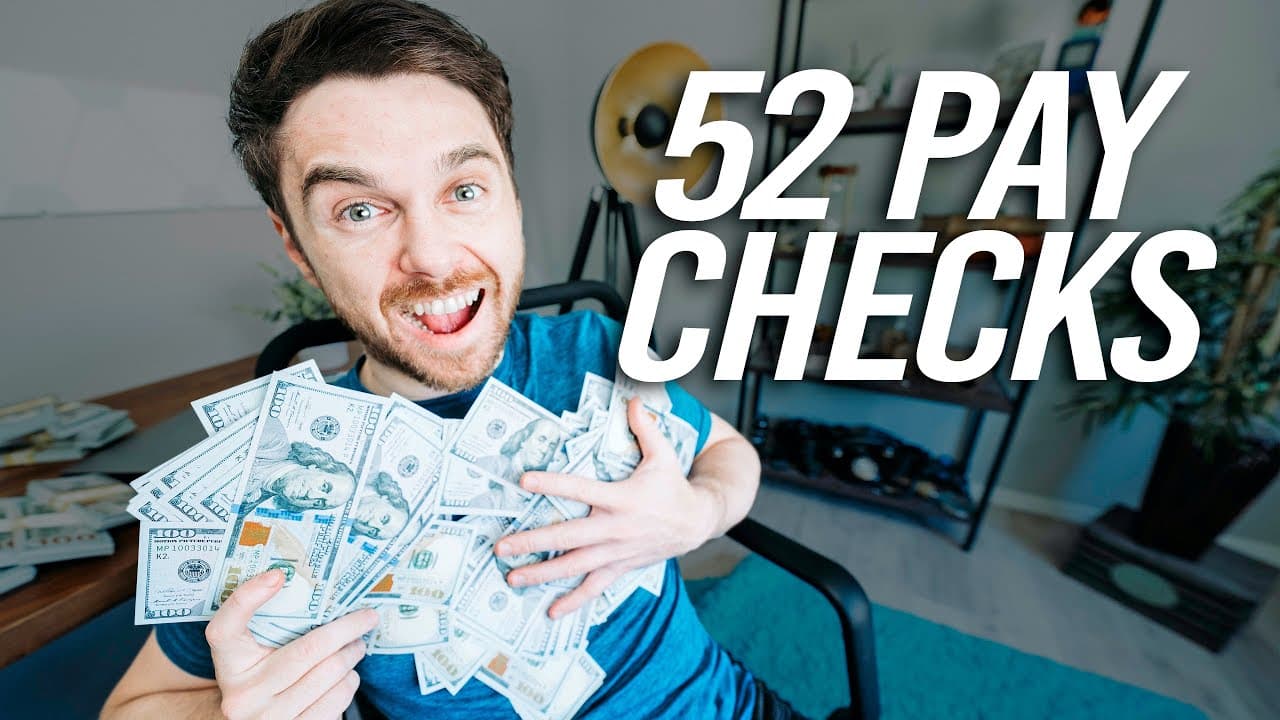
Dividend income can grow through time, company payout increases, regular contributions, and reinvesting every payment. A portfolio worth about $235,000 produced 52 dividend payments during September, while the creator projected that contributing $2,000 monthly and reinvesting dividends could build a $1.2 million portfolio paying $111,000 annually after 20 years, based on his stated assumptions.
Transcript
They say that when it comes to investing your money, you should pay yourself first and then put your money to work for you, and here's how you can do that. Lay it flat on your hand, and then tell it to go to work. Check this out. Isn't that the most beautiful analogy that explains absolutely nothing at all? Let's actually talk about how to invest y... Read More
Key Insights
- Dividend investing is a long-term strategy in which income may rise through payout growth, reinvestment, continued contributions, and time. The creator says it took him 10 years to reach a Robinhood portfolio worth about $235,000, showing that he did not begin with the displayed balance.
- A 5.4% annual income growth rate could increase the creator's dividend income to roughly $11,000 in five years, $15,000 in 10 years, and $25,000 in 20 years without additional contributions or reinvestment. He also acknowledges that future dollars would have less purchasing power.
- Reinvesting dividends and contributing $2,000 monthly could produce a projected $1.2 million portfolio paying $111,000 per year after 20 years. The creator presents this as an illustration of compounding rather than a guaranteed outcome and warns viewers against copying his investments without research.
- Dividend income is not guaranteed to remain stable because distributions can rise or fall. Accenture, General Mills, WP Carey, and Philip Morris added projected annual income, while VTI, VYM, and South32 recorded decreases, leaving a net increase of $21 per year for the month.
- A $21 increase in annual dividend income is equivalent to the income from investing $525 at a 4% yield. The creator emphasizes that this additional income came from company payout changes rather than a new $525 contribution, illustrating why small dividend increases can matter over time.
- SPHD is described as a dividend ETF containing 50 high-yield companies selected for relatively low price volatility. The creator does not consider it his favorite dividend ETF because its yield is high but its growth is slow, while he prefers a combination of yield and growth.
- Monthly dividend payments do not inherently create more total income because the same distribution can simply be divided into more frequent installments. Their stated advantage is timing: cash received monthly can be reinvested sooner, potentially allowing compounding to begin earlier than with less frequent payments.
- An IBM spin-off would separate a division into a new company, leaving existing shareholders with ownership in IBM and the newly created business. The creator says the two separate companies can collectively become more valuable, while shareholders may continue receiving dividends, though the outcome is not presented as guaranteed.
Install to Summarize YouTube Videos and Get Transcripts
Explore YouTube Video Summarizer or Get YouTube Transcript Extractor
Questions & Answers
Q: How can dividend income grow over time?
Dividend income can grow when companies raise their payouts, investors reinvest the cash they receive, new money is contributed regularly, and the portfolio remains invested for many years. Using his stated 5.4% annual growth rate, the creator estimates that his income could rise to about $11,000 in five years, $15,000 in 10 years, and $25,000 in 20 years without reinvestment.
Q: How much money was in the dividend portfolio?
The creator showed approximately $235,000 in his Robinhood account and said reaching that level took about 10 years. He directly addresses the concern that most people do not have more than $200,000 available to invest at the beginning. His central point is that the displayed portfolio was accumulated over time rather than funded all at once.
Q: What happens if dividends are reinvested with monthly contributions?
The creator estimates that reinvesting dividend income and contributing at least $2,000 each month could result in a portfolio worth $1.2 million after 20 years. Under his projection, that portfolio would pay approximately $111,000 per year. He presents the scenario to illustrate the combined effect of time, recurring contributions, compound growth, and dividend reinvestment, not as a guaranteed return.
Q: How many dividend payments did the portfolio receive in September?
The portfolio received 52 dividend payments during September, which the creator describes as a new passive income record. Individual payment days varied considerably. He reports $30.11 on September 1, $75.25 on September 2, $119.24 on September 9, and $251.88 across eight payments on September 10, among several other payment dates discussed in the transcript.
Q: Can dividend payments decrease as well as increase?
Dividend payments can fluctuate, so a dividend investor is not guaranteed stable income. During the month discussed, increases from Accenture, General Mills, WP Carey, and Philip Morris added $28 in projected annual income. Decreases associated with VTI, VYM, and South32 removed $7, leaving the portfolio with a net annual income increase of $21 for the month.
Q: Are monthly dividend stocks better than other dividend stocks?
Monthly dividend stocks do not necessarily pay more total income than companies or funds using another payment schedule. The creator explains that the same annual amount can simply be divided into more frequent installments. The practical advantage is that monthly cash payments can be reinvested sooner, which may give the invested money additional time to compound. Payment frequency alone is not a reason to buy.
Q: What is SPHD, and why was it not the creator's favorite ETF?
SPHD is described as a dividend ETF that combines 50 companies selected for high dividend yields and relatively low price volatility. Although its yield is high, the creator says its growth is very slow. He prefers investments that can offer both a strong yield and strong growth, so he does not rank SPHD as his favorite dividend ETF at that time.
Q: What happens to shareholders when a company completes a spin-off?
A spin-off occurs when a company separates one of its divisions and turns it into an independent company. In the IBM example, someone owning IBM before the transaction would receive ownership in both IBM and the newly created company. The creator says the separate businesses often become collectively more valuable and that dividends may continue, but he does not describe either result as certain.
Summary & Key Takeaways
-
The portfolio contained about $235,000 in a Robinhood account after roughly 10 years of investing. Based on the creator's stated 5.4% annual income growth, doing nothing and not reinvesting could raise annual income to about $11,000 after five years, $15,000 after 10 years, and $25,000 after 20 years.
-
Reinvesting dividends and continuing to contribute can accelerate portfolio growth. The creator estimated that reinvesting income while adding at least $2,000 per month could produce a $1.2 million portfolio paying $111,000 annually after 20 years. These figures are projections based on his assumptions, not guaranteed investment results.
-
September produced 52 dividend payments, including $251.88 on September 10 and $119.24 on September 9. Dividend increases added a net $21 in projected annual income after several decreases. The portfolio discussion also covered ETFs, monthly distributions, healthcare stocks, an IBM spin-off, utility mergers, and risks facing oil companies.
Read in Other Languages (beta)
Share This Summary 📚
Summarize YouTube Videos and Get Video Transcripts with 1-Click
Try YouTube Summary with ChatGPT & Claude or YouTube Transcript Generator
Explore More Summaries from Andrei Jikh 📚

Summarize YouTube Videos and Get Video Transcripts with 1-Click
Try YouTube Summary with ChatGPT & Claude or YouTube Transcript Generator