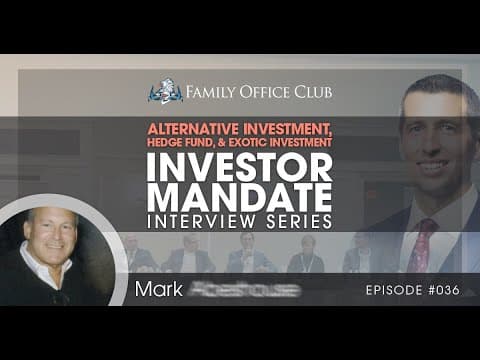
Midwest Single Family Office Investor Mandate Interview - Technology, Oil Mineral Rights Investments

TL;DR
The Midwest single family office targets emerging technologies and sectors while continuing to pursue private oil opportunities rooted in its multigenerational history. Its investments have included about $1 million in a carbon-nanotube company, graphite mines, hemp, cannabis, and mineral interests that could be acquired for around $5,000. Read on for its mandate, oil strategy, investment horizon, and approach to identifying the next disruptive market.
Transcript
closest richard wilson at the family office club with an investor mandate interview with fourth of the family office welcome for it alright how are you Richard great well thanks for joining us here today yeah it's great thank you so much for having me sure and what type of an investment organization are you are I obviously jump the gun by saying th... Read More
Key Insights
- 😄 Richard Wilson's family office has a long history in the oil industry, and they see opportunities in buying mineral interests and leases at low prices.
- 🦔 They focus on bleeding-edge technology and disruptive sectors, aiming to stay ahead of the curve.
- 🧑💼 The family office is involved in the cannabis retail market, both in dispensaries and the wholesale market.
Install to Summarize YouTube Videos and Get Transcripts
Explore YouTube Video Summarizer or Get YouTube Transcript Extractor
Questions & Answers
Q: What is the Midwest single family office's investment mandate?
The family office seeks bleeding-edge technologies and disruptive sectors that could become important over the next month, year, or decade. Family members discuss what may come next and try to invest ahead of the broader market without getting too far ahead of commercially usable technology.
Q: How did the family office originate?
Its history goes back to 1920, when J. Steve Anderson discovered one of Oklahoma's biggest oil pools with his partner. Their operation was drilling 172,000 barrels per day by 1930 and led to the creation of Anderson Pritchard Oil Corporation, which later became AB Co Oil Corporation.
Q: Why does the family office still consider oil investments?
The family office sees low oil prices as a poor time to divest and a potential opportunity to buy. The speaker describes acquiring royalties, mineral interests, and leases from families in the Midwest or Southwest that inherited them but may not know how to manage them.
Q: How much could an investor pay for oil mineral interests?
The interview says some mineral interests could be purchased for around $5,000. It also notes that batches of interests may be available through online portals and databases maintained by landmen.
Q: Why did the family office invest in carbon-based nanotubes?
In the late 1990s, the office invested heavily in carbon-based nanotubes because the material appeared capable of disrupting plastics, steel, and wiring. The transcript describes nanotubes as seven times stronger than steel, more conductive than steel, and able to carry electrical current when sprayed onto a window.
Q: How much did the family office invest in a carbon-nanotube company?
The family office invested about $1 million in a company based in Oklahoma City. The speaker believes the office was its largest investor that was not a major corporation.
Q: Why did the family office move from carbon nanotubes to graphite mines?
The office concluded that practical carbon-nanotube technology might not arrive until 2050, placing it roughly 40 years beyond the family's useful investment horizon. It then invested in graphite mines as a nearer-term way to pursue related opportunities.
Q: Why is the family office exploring hemp and cannabis?
The office began examining hemp product production after hemp was legalized and is also looking at the cannabis industry. These sectors fit its strategy of identifying what may gain momentum next while avoiding technologies that are decades away from practical use.
Summary & Key Takeaways
-
Richard Wilson's family office has been in operation for five generations, starting with the oil industry in the 1920s.
-
They invest in bleeding-edge technology and disruptive sectors, aiming to stay ahead of the curve.
-
They have invested in carbon-based nanotubes, graphite mines, and are now exploring opportunities in the hemp and cannabis industries.
Read in Other Languages (beta)
Share This Summary 📚
Summarize YouTube Videos and Get Video Transcripts with 1-Click
Try YouTube Summary with ChatGPT & Claude or YouTube Transcript Generator
Explore More Summaries from Private Investor Club - 4,000 Investors 📚
Summarize YouTube Videos and Get Video Transcripts with 1-Click
Try YouTube Summary with ChatGPT & Claude or YouTube Transcript Generator