How to Analyze Line Graphs for Population Changes
TL;DR
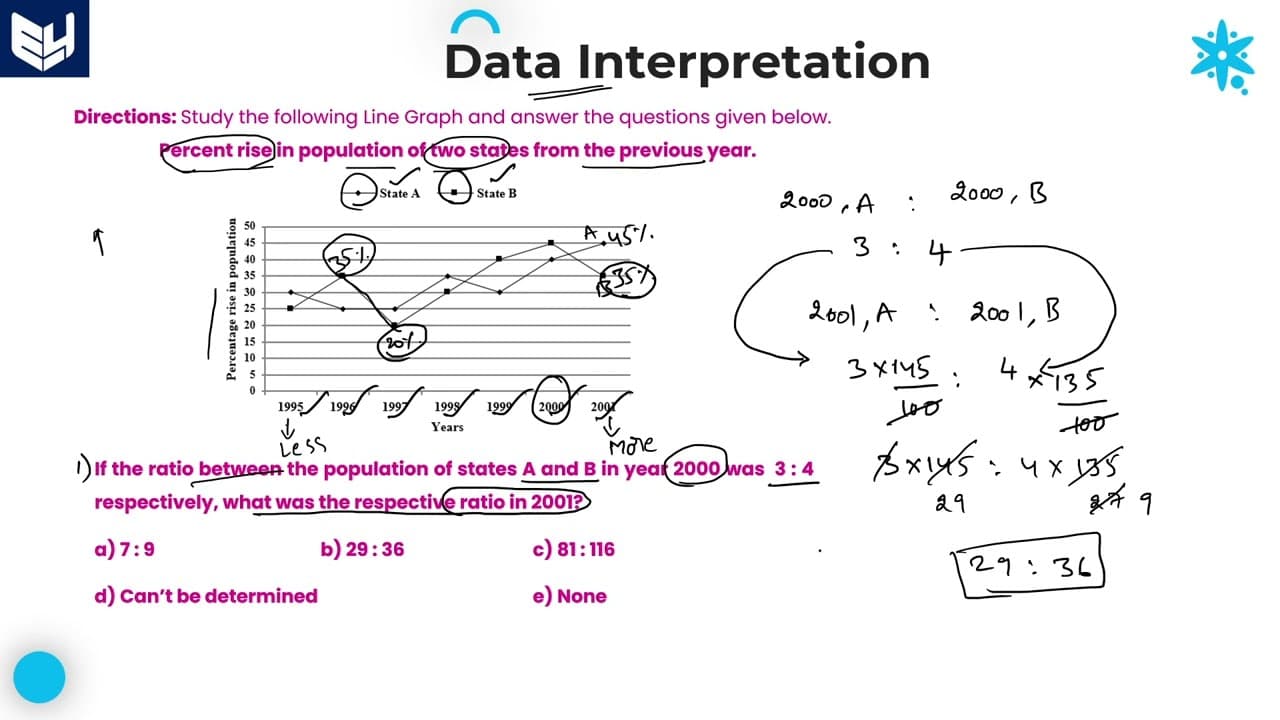
To analyze line graphs depicting population changes, focus on understanding percentage increases over years for different states. Identify year-on-year growth rates and compute ratios of populations based on given data. This helps in accurately determining population trends and making informed forecasts.
Transcript
hi everyone welcome to the session in this session I am continuing line graph data and predation here first of all we need to read the information carefully and now we need to solve the questions according to the given information see here first of all the information which is provided in this line graph data and pressedness see here percentage ris... Read More
Key Insights
- 😮 Understanding the distinction between percentage rise and percentage of population is crucial for interpreting population data effectively.
- ⚾ The calculations require a systematic approach, particularly when moving forward or backward between years based on provided percentage changes.
- ❓ Data integrity relies heavily on knowing the specific populations of each state rather than merely cumulative totals for accurate forecasting and analysis.
- 🫥 Line graph data interpretation is foundational for statistical literacy and aids in developing strong analytical skills for complex data sets.
- ⁉️ Each question posed in the session demonstrates a unique aspect of population change calculations, emphasizing problem-solving skills.
- ❓ Effective communication of findings through accurate calculations is vital for credible data reporting and analysis.
- 🫥 The session aims to enhance the audience's ability to accurately interpret line graph data, a skill essential in demographics and statistical studies.
Install to Summarize YouTube Videos and Get Transcripts
Explore YouTube Video Summarizer or Get YouTube Transcript Extractor
Questions & Answers
Q: What is the importance of understanding line graph data in this context?
Understanding line graph data is crucial because it provides visual insights into trends, such as population changes over time. By interpreting line graph data accurately, one can derive meaningful calculations such as percentage increases and ratios that are significant for data analysis in population studies.
Q: How can the ratio of populations of two states be calculated using the provided graph data?
To calculate the population ratio of two states, one needs to start with the known ratio for a specific year and apply the percentage increases for subsequent years. For instance, if the ratio in 2000 is given, apply the percentage increase to find the populations for 2001 and then derive the new ratio.
Q: Why was it impossible to determine the total population of both states in 1998 based on the information provided?
It was impossible to determine the total population of both states in 1998 because the combined population figures only provide overall data without specific individual state populations. The calculations depend on knowing the distinct populations of each state, which were not provided in the data.
Q: How was the population of State B calculated for the years 1997 and 1998?
The population of State B in 1997 was calculated by applying a 20% increase to its 1996 population of 20 lakhs, resulting in 24 lakhs. For 1998, a 30% increase was applied to the 1997 figure, leading to a final population of 31.2 lakhs for that year.
Summary & Key Takeaways
-
The content outlines how to interpret line graph data showing the percentage rise in population for two states, A and B, from 1995 to 2001.
-
Key calculation strategies are discussed, particularly in determining population ratios and total figures over specific years based on provided percentage increases.
-
The session includes multiple examples and problem-solving scenarios to illustrate methods for calculating population averages and effective increases between years.
Read in Other Languages (beta)
Share This Summary 📚
Summarize YouTube Videos and Get Video Transcripts with 1-Click
Try YouTube Summary with ChatGPT & Claude or YouTube Transcript Generator