How to Train an Elite Competitive Hacking Team
TL;DR
Elite hackers develop through applied deliberate practice: they solve carefully sequenced security challenges, research unfamiliar problems, learn through trial and error, and advance in small increments. Capture the Flag contests provide this pathway while making practice engaging, and a sustainable team system combines progressive training with recurring recruitment to replace experienced members when they graduate.
Transcript
Ever asked yourself how the best hackers learn their craft? Have you ever thought about that? And by hackers, I don't mean criminals, people who break into people's websites and commit acts of fraud or theft. I mean hackers, people who can go out and make computers bend to their own will. I'm fascinated with this question of how the best hackers le... Read More
Key Insights
- Hacking is a creative exercise in making computers perform actions beyond the limitations or ecosystems established by vendors. In Brumley's framing, hackers are not necessarily criminals, but skilled problem solvers who understand systems deeply enough to alter their intended behavior.
- George Hotz demonstrated advanced hacking ability by producing the first iPhone jailbreak at age 17, allowing software installation and use with other compatible carriers. He later rooted the PlayStation 3 and identified previously undiscovered vulnerabilities in popular products including Adobe and Firefox.
- Pwn2Own tests hackers against fully patched operating systems and current web browsers with no known vulnerabilities. Competitors apply years of training to find new zero-days, demonstrate access and persistence, and provide their discoveries to vendors so affected products can be patched.
- Competitive hacking functions like a sport because participants train, compete against peers, and combine offensive and defensive skills. Carnegie Mellon's Plaid Parliament of Pwning competes on closed networks and uses major events such as DEF CON to test its capabilities against teams of comparable caliber.
- A Capture the Flag challenge is a security problem whose successful solution reveals a text token called a flag. Even a beginner task can teach an essential habit by requiring players to search for an unfamiliar error message, identify its meaning, and submit the correct term.
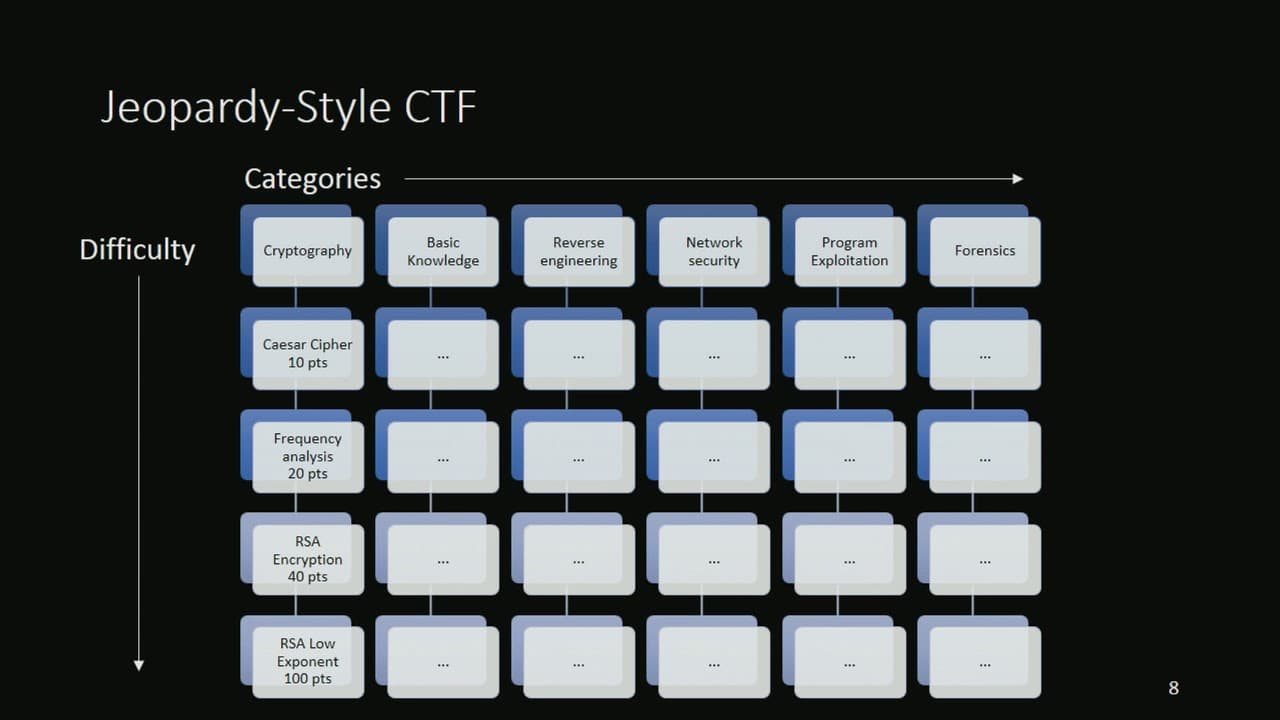
- Jeopardy-style CTFs organize learning into categories such as cryptography, forensics, exploitation, and reverse engineering. Each sequence moves from basic problems toward advanced ones, with research, hints, experimentation, and repeated success forming an explicit pathway to greater technical mastery.
- PicoCTF gamifies cybersecurity education for United States high school students through an interactive story and progressively difficult challenges. Small increases in difficulty can take participants from beginner tasks to advanced techniques, including return-oriented programming, by the end of the contest.
- Applied deliberate practice is a core principle of effective CTF design because learners need repeated, appropriately sequenced challenges that build familiarity and insight. Simply placing beginners into an open competitive arena can fail when they lack the foundational techniques required to participate successfully.
Install to Summarize YouTube Videos and Get Transcripts
Explore YouTube Video Summarizer or Get YouTube Transcript Extractor
Questions & Answers
Q: How do elite hackers learn cybersecurity skills?
Elite hackers build skill through applied deliberate practice. They begin with manageable security challenges, research concepts they do not yet understand, experiment with possible solutions, and submit a flag when they succeed. The next challenge is placed slightly beyond their existing ability, creating a progressive pathway from basic familiarity to advanced, creative problem solving.
Q: What is a Capture the Flag cybersecurity contest?
A Capture the Flag contest presents participants with digital security challenges and asks them to recover a flag, which is a text token proving that the problem was solved. The contests operate in environments created by hackers for hackers, including closed networks rather than the open internet, and can cover both offensive and defensive computer security skills.
Q: How do Jeopardy-style CTF competitions work?
Jeopardy-style CTF competitions divide challenges into security categories such as cryptography, forensics, exploitation, and reverse engineering. Players solve an initial problem, submit its flag, and progress to increasingly difficult tasks. Hints, independent research, trial and error, and repeated practice help participants acquire the knowledge needed to reach more advanced levels.
Q: Why is deliberate practice important for learning hacking?
Applied deliberate practice gives learners challenges that match their current level while stretching their abilities incrementally. Repetition creates familiarity and insight, while research and experimentation fill specific knowledge gaps. Throwing beginners directly into an arena is less effective because they may not yet understand the basic techniques required to make progress or compete meaningfully.
Q: How does gamification support cybersecurity education?
Gamification makes sustained security practice interesting by placing challenges inside a contest, scoring system, or interactive story. PicoCTF lets players move through a narrative, interact with objects, and encounter progressively harder hacking concepts. This structure rewards each small success and encourages participants to continue practicing until they can perform advanced technical tasks.
Q: What does a beginner CTF challenge teach?
A beginner CTF challenge teaches practical problem solving rather than requiring extensive prior knowledge. In the example presented, players see an error message, search for it online, discover that it identifies a FAT file system error, and submit FAT as the flag. The exercise establishes research as a fundamental part of solving security problems.
Q: How can a university maintain an elite hacking team?
A university team needs a repeatable system for identifying talent, recruiting participants, developing their skills, and preparing them for major competitions. Carnegie Mellon also plans for undergraduate turnover every four years, when trained members graduate. Its pipeline must therefore replenish the team while preserving the level of talent and performance established by earlier members.
Q: What achievements demonstrate Carnegie Mellon's competitive hacking success?
Carnegie Mellon's Plaid Parliament of Pwning had been the number one United States competitive hacking team since 2011 at the time described. It also ranked number one worldwide in three of the previous seven years and won four of the previous five DEF CON competitions, an event Brumley characterizes as hacking's Super Bowl.
Summary & Key Takeaways
-
David Brumley defines hackers as creative people who make computers behave in ways their vendors did not intend. Examples include George Hotz jailbreaking the iPhone and Richard Zhu competing at Pwn2Own, where participants attack fully patched systems, discover previously unknown vulnerabilities, demonstrate persistence, and submit their findings so vendors can improve their products.
-
Carnegie Mellon's Plaid Parliament of Pwning illustrates how competitive hacking can be organized like a sport. The team competes on closed networks, has remained the top United States team since 2011, ranked first worldwide in three of seven years, and won four of five DEF CON competitions discussed by Brumley.
-
Capture the Flag contests teach security through progressively harder challenges in cryptography, forensics, exploitation, and reverse engineering. Players research problems, test possible solutions, and submit text tokens called flags. PicoCTF adapts this model for United States high school students, using a story-driven game and small learning steps that eventually introduce advanced tasks such as return-oriented programming.
Read in Other Languages (beta)
Share This Summary 📚
Summarize YouTube Videos and Get Video Transcripts with 1-Click
Try YouTube Summary with ChatGPT & Claude or YouTube Transcript Generator
Explore More Summaries from RSAC Cybersecurity 📚

Summarize YouTube Videos and Get Video Transcripts with 1-Click
Try YouTube Summary with ChatGPT & Claude or YouTube Transcript Generator