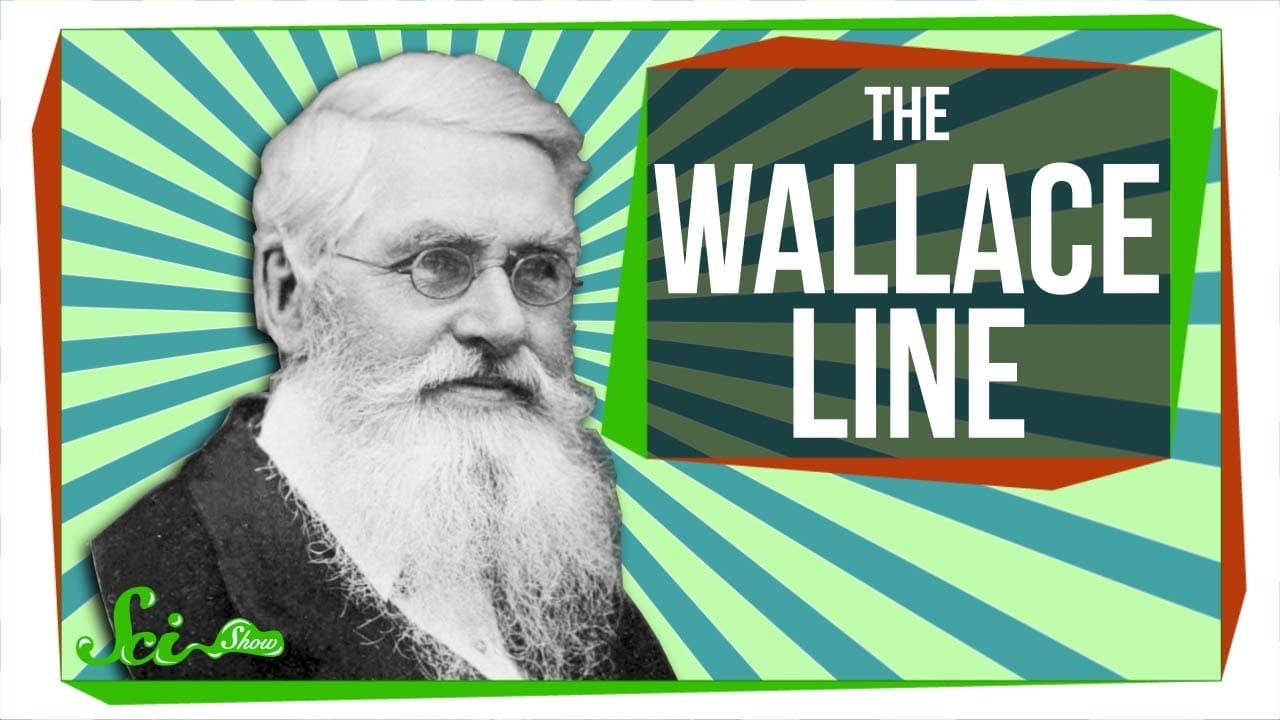
What Is the Wallace Line and Why Is It Important?
TL;DR
The Wallace Line is an invisible separation in the Indian Ocean that distinguishes distinct animal populations on either side. It was proposed by Alfred Russel Wallace to be the result of changes in sea levels during ice ages and tectonic plate activity, emphasizing the connection between geology and biogeography in understanding species distribution.
Transcript
Between two groups of islands in the Indian Ocean, there’s a seemingly invisible line splitting up two totally different animal populations. It became known as the Wallace Line after the scientist who found it, and it took three branches of science to figure it out why it exists. A lot of the time, plant and animal communities will gradually change... Read More
Key Insights
- 🇮🇴 The Wallace Line refers to an invisible border in the Indian Ocean that separates distinct animal populations.
- ⚾ Biogeography is the study of species distribution based on biology, geology, and climatology.
- 🤢 Alfred Russel Wallace discovered the Wallace Line and proposed that changes in sea levels and tectonic plate activity were responsible for the separation of animal populations.
- 🥳 The details of plate tectonics were discovered after Wallace's observations, but they helped explain species boundaries in other parts of the world as well.
- 🤕 Tectonic plate activity and changes in sea levels during ice ages have shaped the animal communities we see today.
- ❓ Understanding geology is crucial in explaining the distribution of species.
- 🆘 The relationship between geology and biology helps us uncover mysteries about species distribution and evolution.
Install to Summarize YouTube Videos and Get Transcripts
Explore YouTube Video Summarizer or Get YouTube Transcript Extractor
Questions & Answers
Q: What is the Wallace Line and why is it significant?
The Wallace Line is an invisible border in the Indian Ocean that separates animal populations with distinct species on each side. It is significant because it raised questions about how different species are distributed and evolved.
Q: How did Alfred Russel Wallace explain the existence of the Wallace Line?
Wallace proposed that during ice ages, the lower sea levels connected the islands in shallower water, allowing species to spread and adapt within their respective mainlands. The deeper water between the two groups of islands acted as a barrier and kept ecosystems separated.
Q: What is biogeography and how does it contribute to understanding species distribution?
Biogeography is the study of how species are distributed around the world and the factors that determine their habitats. It combines biology, geology, and climatology to divide the Earth into regions based on plant and animal communities.
Q: How does tectonic plate activity explain the Wallace Line?
The Wallace Line coincides with the convergence of two tectonic plates in the Indian Ocean. The deeper water in this area is a result of their collision, creating a barrier that separates animal populations.
Summary & Key Takeaways
-
The Wallace Line is a distinct border dividing animal populations in the Indian Ocean, with different species on each side.
-
The study of biogeography explores the distribution of species around the world and the factors that determine their habitats.
-
Alfred Russel Wallace, the father of biogeography, discovered the Wallace Line and proposed that changes in sea levels during ice ages and tectonic plate activity were responsible for the separation of animal populations.
Read in Other Languages (beta)
Share This Summary 📚
Summarize YouTube Videos and Get Video Transcripts with 1-Click
Try YouTube Summary with ChatGPT & Claude or YouTube Transcript Generator
Explore More Summaries from SciShow 📚
Summarize YouTube Videos and Get Video Transcripts with 1-Click
Try YouTube Summary with ChatGPT & Claude or YouTube Transcript Generator