What Is a Bi-CMOS Inverter and How Does It Work?
TL;DR
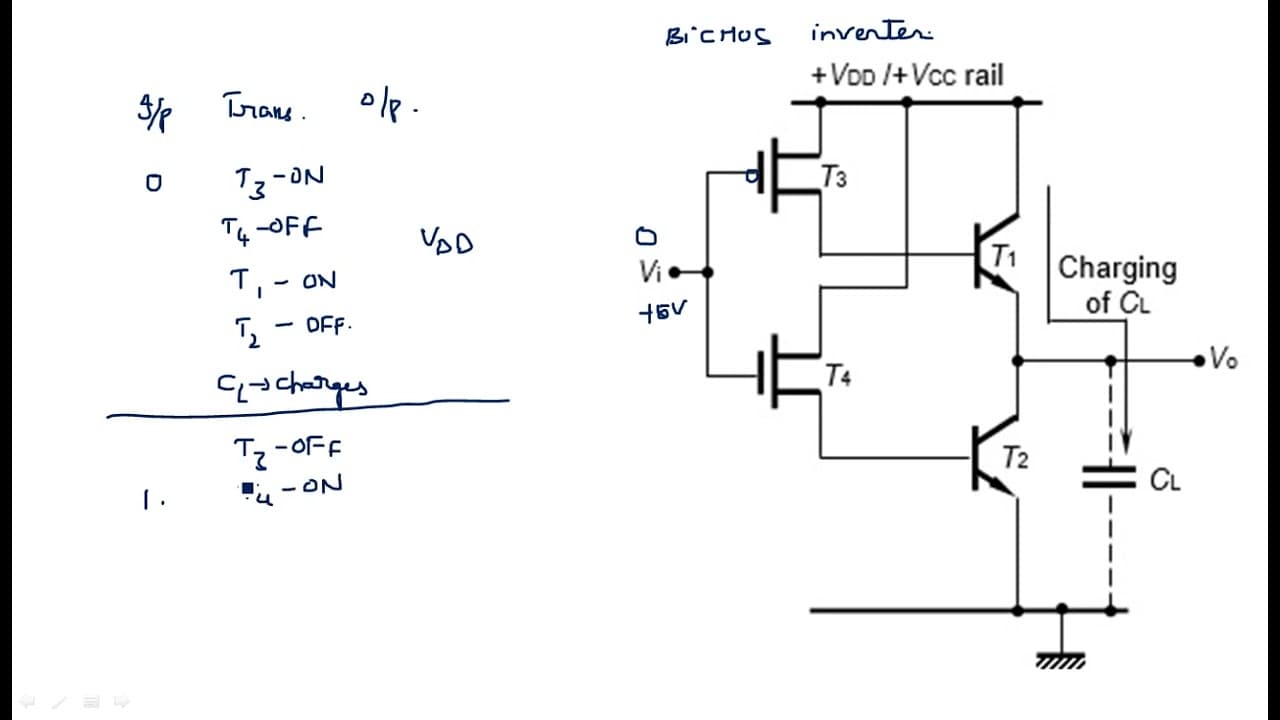
A Bi-CMOS inverter combines bipolar (BJT) and CMOS (NMOS/PMOS) technology, providing both low power consumption and high-speed operation. It operates by using specific input voltages to control the states of the transistors, effectively inverting the output. Modifications to the circuit are necessary to eliminate static current flow and enhance efficiency during operation.
Transcript
hi everyone in this video I am going to explain about the by CMOS inverter by CMOS inverter by the name by seeing the name we can understand that it is a combination of two different Technologies which is nothing but by CMOS bipolar technology and as well as cmash technology we know bipolar technology as we have studied in the second year you might... Read More
Key Insights
- 😃 Bi-CMOS technology merges BJT and CMOS characteristics for enhanced inverter performance.
- 🚄 Low power consumption and high-speed operation are the primary benefits of using Bi-CMOS technology.
- ❓ The operational states of PMOS and NMOS transistors are critical for the inverter's function, enabling it to switch outputs effectively.
- ✊ Reducing static current flow in circuits is essential to minimize power waste and improve efficiency in electronic devices.
- 🛟 The design modifications in the Bi-CMOS inverter serve as an example of how circuit efficiency can be increased through simple architectural changes.
- 🎨 Understanding the behavior of each transistor type under different conditions is crucial for effective circuit design.
- 🧑🎓 The video’s educational content is particularly useful for electrical engineering students studying digital circuit applications.
Install to Summarize YouTube Videos and Get Transcripts
Explore YouTube Video Summarizer or Get YouTube Transcript Extractor
Questions & Answers
Q: What are the key technologies combined in a Bi-CMOS inverter?
The Bi-CMOS inverter integrates bipolar technology, characterized by BJT (bipolar junction transistor) transistors, with CMOS technology, made of NMOS and PMOS transistors. This fusion allows the inverter to benefit from the high-speed operation offered by BJTs while maintaining the low power consumption inherent in CMOS technology, making it efficient for various electronic applications.
Q: How does the input voltage affect the Bi-CMOS inverter's function?
In a Bi-CMOS inverter, when the input voltage is at zero volts, the PMOS transistor turns on while the NMOS transistor turns off. This configuration allows current to flow through certain transistors, charging the output capacitor, resulting in the output becoming high. Conversely, when the input is at a high voltage (e.g., 5 volts), the PMOS turns off and the NMOS turns on, discharging the capacitor and bringing the output low, effectively performing the inverter function.
Q: What is the main disadvantage of traditional Bi-CMOS inverters?
A significant disadvantage of traditional Bi-CMOS inverters is the occurrence of static current flow when both PMOS and NMOS transistors are in an 'on' state simultaneously. This situation leads to unnecessary power consumption as current can flow directly from the power supply (VDD) to ground (VSS), which can potentially cause overheating and power loss in the system.
Q: How was the static current issue addressed in the modified Bi-CMOS inverter?
The modified Bi-CMOS inverter circuit was designed to disconnect the PMOS transistor's drain connection from the power supply, redirecting it to the emitter of the BJT transistors. This strategic change prevents static current flow during operation, allowing the inverter to maintain efficiency and avoiding a short circuit path from the power supply, which enhances reliability and performance.
Summary & Key Takeaways
-
The Bi-CMOS inverter combines bipolar technology (BJT transistors) and CMOS technology (NMOS and PMOS transistors) to achieve the benefits of both, primarily low power consumption at high speed.
-
The video explains the operational characteristics of the Bi-CMOS inverter, including how input voltages affect the states of the transistors involved, leading to inverter behavior.
-
A modification is presented to the Bi-CMOS inverter circuit to eliminate static current flow, which can lead to inefficiencies and power loss during operation.
Read in Other Languages (beta)
Share This Summary 📚
Summarize YouTube Videos and Get Video Transcripts with 1-Click
Try YouTube Summary with ChatGPT & Claude or YouTube Transcript Generator