What Causes the Blue Bottle Experiment Color Change?
TL;DR
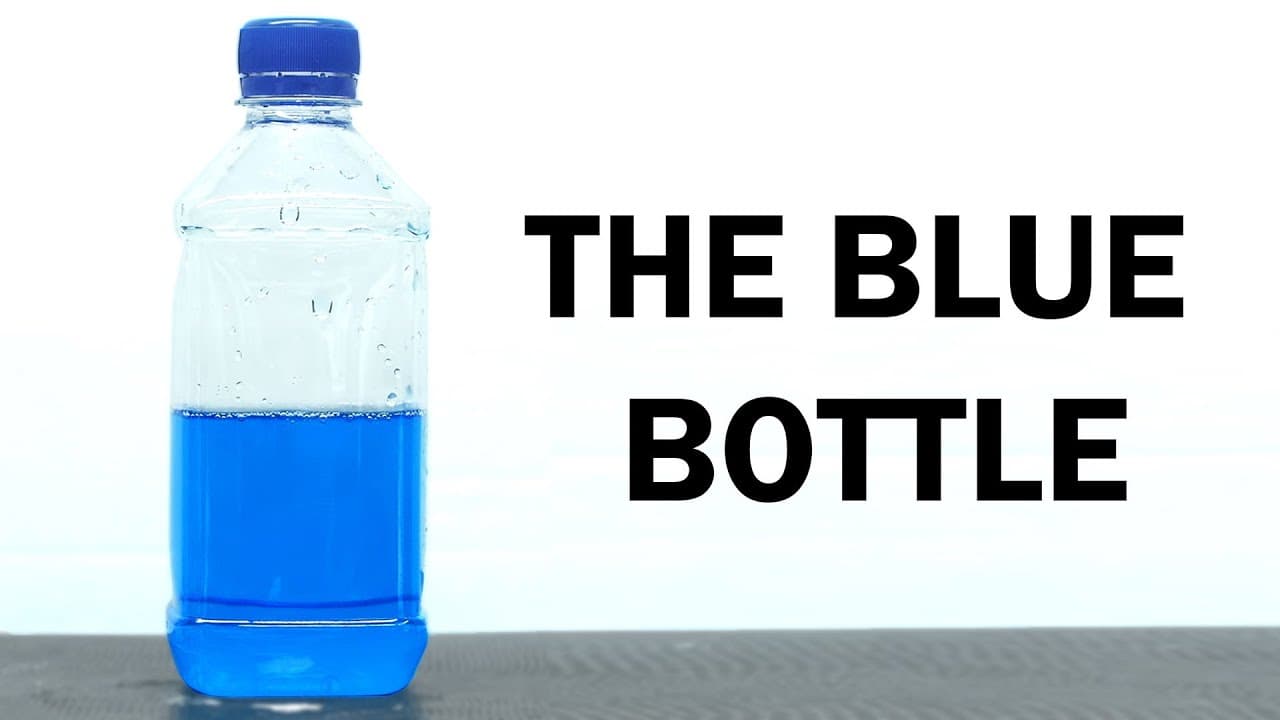
The Blue Bottle Experiment demonstrates a color change where a colorless solution turns blue when shaken due to the oxidation of methylene blue by introduced oxygen. When left undisturbed, the reducing effects of dextrose and potassium hydroxide revert the solution back to its colorless form, illustrating the principles of redox reactions.
Transcript
the topic of today's video is the blue bottle demonstration it's a pretty cool demonstration where we start with a colorless solution and when we shake it it turns blue if we then leave it somewhere undisturbed the blue color will disappear and we be back with a colorless solution we're going to first prepare the demonstration and then we're going ... Read More
Key Insights
- 💙 The blue bottle demonstration involves a colorless solution turning blue when shaken and reverting back to colorless when left undisturbed.
- 💙 Methylene blue serves as an indicator that has both colored and colorless forms.
- 🫢 Shaking the bottle introduces oxygen gas, allowing for oxidation of methylene blue to its colored form.
- 💁 The reducing effects of dextrose and potassium hydroxide convert the colored form back to its colorless form.
Install to Summarize YouTube Videos and Get Transcripts
Explore YouTube Video Summarizer or Get YouTube Transcript Extractor
Questions & Answers
Q: What are the main ingredients used in the blue bottle demonstration?
The main ingredients used are dextrose, potassium hydroxide, and methylene blue solution. Dextrose acts as the reducing agent, potassium hydroxide creates a basic solution, and methylene blue serves as an indicator.
Q: How does shaking the bottle turn the colorless solution blue?
Shaking the bottle introduces oxygen gas into the solution, which oxidizes the methylene blue back to its colored form. This is due to the reducing effects of dextrose and potassium hydroxide.
Q: Why does the blue color disappear when the bottle is left undisturbed?
When the bottle is left undisturbed, the reducing effects of dextrose and potassium hydroxide take over, converting the colored form of methylene blue back to its colorless form.
Q: How does temperature and concentration affect the reaction rate?
Higher temperatures increase the reaction rate as molecules move faster. Concentration can also influence the reaction rate, with higher concentrations of the reducing solution speeding up the process.
Summary & Key Takeaways
-
The experiment involves mixing dextrose, potassium hydroxide, and methylene blue solution to create a colorless solution that turns blue upon shaking.
-
The color change occurs due to the oxidation of methylene blue when introduced to oxygen gas during shaking.
-
The solution reverts back to its colorless form when the reducing effects of dextrose and potassium hydroxide take over.
Read in Other Languages (beta)
Share This Summary 📚
Summarize YouTube Videos and Get Video Transcripts with 1-Click
Try YouTube Summary with ChatGPT & Claude or YouTube Transcript Generator
Explore More Summaries from NileRed 📚
Summarize YouTube Videos and Get Video Transcripts with 1-Click
Try YouTube Summary with ChatGPT & Claude or YouTube Transcript Generator