What Are Some Intermediate Action Verbs in English?
TL;DR
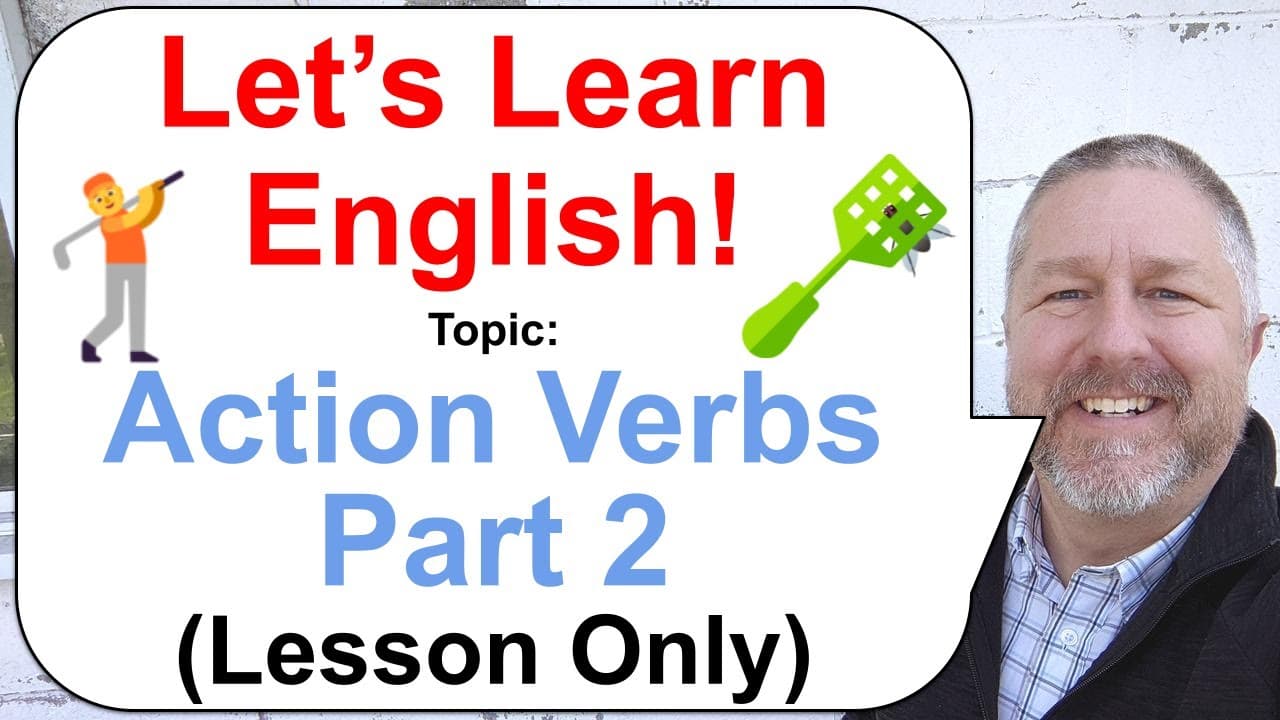
Intermediate action verbs include terms like 'slam,' 'pounce,' and 'pry,' which are commonly used in everyday situations. The lesson provides video clips to illustrate their meanings and usage, enhancing the understanding of these verbs in context.
Transcript
Well hello and welcome to this English lesson about action verbs. As you can see this is part two about a month ago a little over a month ago I did a lesson on action verbs. I think it was called basic action verbs. This English lesson will be a little more advanced. Actually more intermediate these are action verbs that we use quite commonly but t... Read More
Key Insights
- 🎮 This lesson focuses on intermediate-level action verbs, providing examples and video clips for better understanding and usage.
- 🛟 The verbs covered in this lesson are commonly used in daily life situations, such as opening, closing, or securing objects.
- 💦 Some verbs, like "pound," "swat," and "yank," indicate strong and forceful actions, often associated with exerting physical strength.
- 🔀 Certain verbs, such as "shuffle," "flatten," and "sprinkle," have multiple meanings and can be used in various contexts.
- 🖐️ The lesson also highlights verbs related to specific activities, like cooking, playing sports, and performing household tasks.
- 😋 Several verbs covered in the lesson are associated with specific objects, such as doors, cards, food, and tools.
- 🙈 The importance of measurement and preparation, as seen in verbs like "measure," "pack," and "wrap," is emphasized.
- 👏 Actions like clapping, whistling, and applauding demonstrate social and celebratory behaviors.
- 🤝 The lesson covers verbs related to movement, such as crawling, shaking, sliding, and pouring.
Install to Summarize YouTube Videos and Get Transcripts
Explore YouTube Video Summarizer or Get YouTube Transcript Extractor
Questions & Answers
Q: What are some examples of intermediate action verbs covered in this lesson?
Some examples of intermediate action verbs covered in this lesson include "slam," "pounce," "pry," "shuffle," "flatten," and "pound." The video clips demonstrate how to use these verbs in different contexts.
Q: When would you use the verb "slam"?
"Slam" is used when you close a door forcefully, often accompanied by a loud noise. It can also be used when expressing anger or frustration, such as slamming a door in frustration.
Q: How is the verb "flatten" used?
"Flatten" means to make something flat or even. It is often used when cooking to press down on food to make it thinner or when making something like a pancake or an omelet.
Q: What does the verb "pound" mean in this context?
In this context, "pound" means to forcefully hit something, often using a hammer. It is commonly used when driving a nail into wood or securing something firmly into place.
Q: How is the verb "swat" used?
"Swat" is used when you make a quick, abrupt motion with your hand or a fly swatter to hit or get rid of something, such as a bug or a fly. It is often done to remove pests or insects.
Q: What does it mean to "yank" on something?
To "yank" means to pull something forcefully, often with a lot of strength. It is usually done to open or move something that is stuck or resistant.
Q: How is the verb "shove" used?
"Shove" means to push someone or something forcefully, usually with your hands or body. It can be an intentional act or accidental when moving through a crowd or waiting in line.
Q: What is the action of "twisting" something?
"Twisting" involves rotating or turning something, often to secure or close it. It can be done with objects like bottle caps, locks, or bags, where you turn the item to open or close it.
Q: How is the verb "unscrew" used?
"Unscrew" means to remove a screw by turning it counterclockwise. It is often done using a screwdriver or a similar tool to loosen and remove a screw from a surface or object.
Summary & Key Takeaways
-
This lesson introduces intermediate action verbs, such as "slam," "pounce," and "pry," which are commonly used in daily life.
-
Video clips are included to demonstrate these action verbs in action.
-
The lesson also covers verbs like "shuffle," "flatten," and "pound," providing explanations and examples for each.
Read in Other Languages (beta)
Share This Summary 📚
Summarize YouTube Videos and Get Video Transcripts with 1-Click
Try YouTube Summary with ChatGPT & Claude or YouTube Transcript Generator
Explore More Summaries from Learn English with Bob the Canadian 📚



Summarize YouTube Videos and Get Video Transcripts with 1-Click
Try YouTube Summary with ChatGPT & Claude or YouTube Transcript Generator